

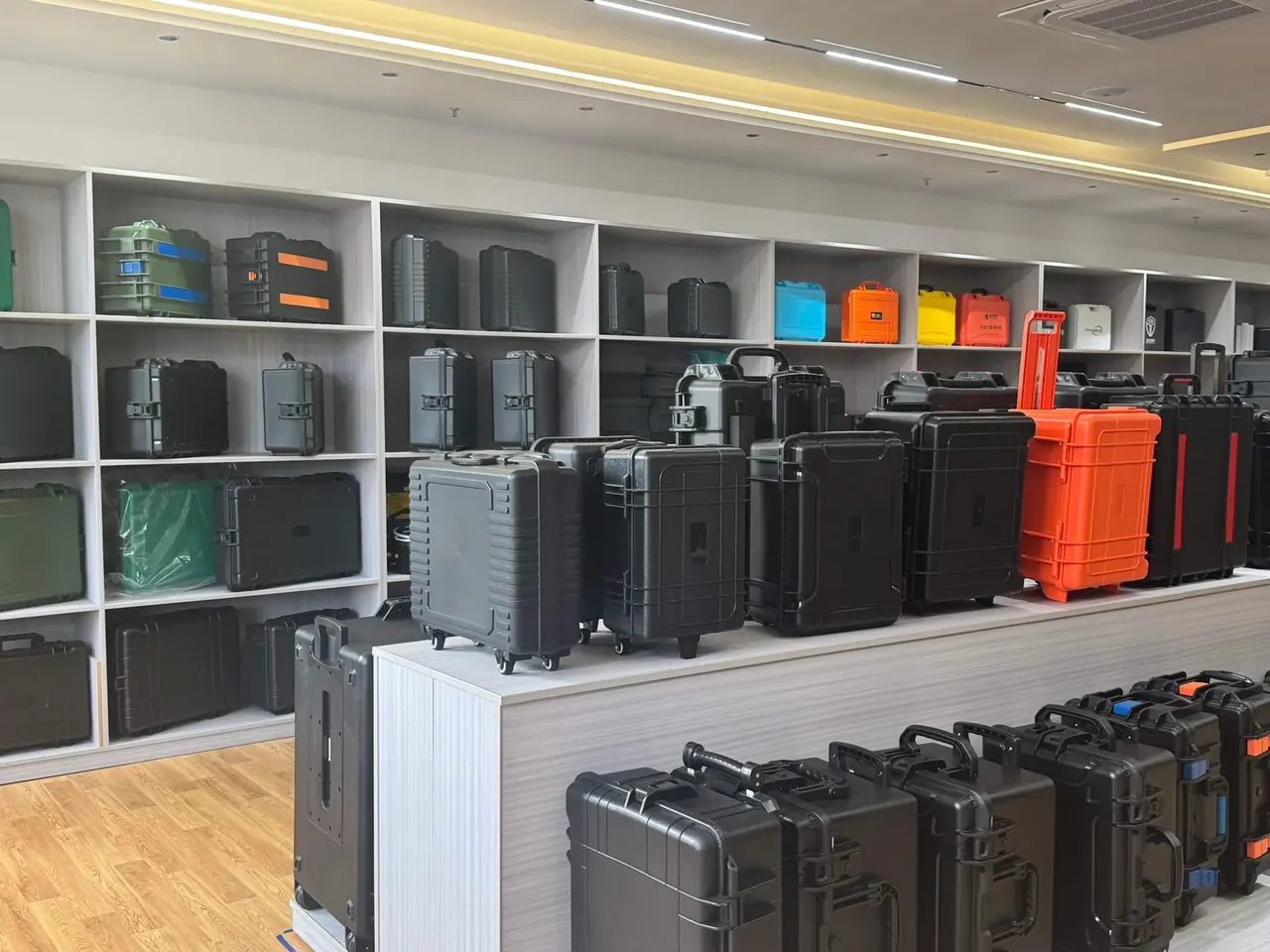
Quick answer: A submachine gun storage box works in four settings: arms room, duty room, vehicle transit and training ground. Storage asks for stable stacking, the duty desk for quick opening with split custody, transit for a latch that holds under vibration, the range for a swappable liner.
Table of contents
- Five Places a Submachine Gun Storage Box Sits
- Static Scenarios: Arms Room and Duty Room
- Mobile Scenarios: Transit and Field Camp
- High-Turnover Scenarios: The Training Ground
- Scenario and Configuration Matrix
- FAQ
1. Five Places a Submachine Gun Storage Box Sits
Ask where the box lives before reading a datasheet. Dwell time sets how often it is carried, opened and stacked, which decides where the body is reinforced.
Group settings by dwell pattern, not customer type. Arms room and duty room are static, so stacking and counting dominate. Transit and field camp are mobile, so latching and sealing dominate. The range sits between: sixty openings a day, never off the compound.
| Setting | How it rests | Main demand | Configuration |
|---|---|---|---|
| Arms room | Shelved or floor-stacked | Countable, stable stacking | Flat lid, corner blocks, number panel |
| Duty room | Leaning on a wall | Fast opening, named custody | Latch plus combination lock |
| Transit | Strapped in a vehicle | Vibration resistance | Two-point latch, corner guards |
| Field camp | On the ground in a tent | Dust and moisture sealing | Low-temperature gasket, floor pads |
| Training ground | Opened daily | Liner wear, readable slots | Replaceable liner, marked slots |
2. Static Scenarios: Arms Room and Duty Room
Leave 350 mm between shelf levels so the lid swings open without pulling the box out. Stack no more than four layers: from the fifth, the bottom sidewall bows and the lid gap tightens, first as a stiff latch, later as a leak. In the duty room keep the empty box at or below 4.6 kg, with one latch plus a combination lock, key and code held by different people.
A number panel at one uniform height clears a twelve-position rack in about 90 seconds; split it between lid and side and the time doubles, turning a full check into spot sampling.
3. Mobile Scenarios: Transit and Field Camp
Strap at four points through the side ribs, never the handle: built for a static lift, it cracks at the root under repeated impact. On a 1200 × 1000 mm pallet, a 620 × 420 mm footprint gives eight boxes per layer, with paper corners between.
A tent can drop to −25 °C at night, where a standard gasket hardens and the lip tears; require one-handed opening after eight hours at −25 °C.
4. High-Turnover Scenarios: The Training Ground
At sixty openings a day, five days a week, a box sees close to 15,000 latch cycles a year. The latch body rarely fails first; the edge of the liner slot does, and once it rounds over the contents shift and wear speeds up.
Make the liner a service part. Screwed in rather than foamed, one section swaps in 40 minutes without a factory return. Laser-mark each slot so a position is confirmed in about 3 seconds, and pick orange or yellow, easier to spot on grass.
5. Scenario and Configuration Matrix
The four settings side by side, with sizes to check against shelf height.
| Setting | External size mm | Stacking | Access time | Configuration |
|---|---|---|---|---|
| Arms room | 620 × 420 × 180 | 4 layers | 90 s per 12 boxes | Uniform number panel |
| Duty room | 520 × 360 × 160 | Not stacked | 20 s | Latch plus code lock |
| Transit | 620 × 420 × 180 | 2 layers with divider | 60 s with lashing | Four-point lashing |
| Field camp | 580 × 400 × 170 | 2 layers | 25 s | Cold-rated gasket |
| Training ground | 560 × 380 × 150 | Not stacked | 15 s | Replaceable liner |
Access time excludes checking and reflects latch type rather than build quality.
Conclusion
The setting decides the configuration, and the configuration decides what the box costs to own. Shelving asks for stacking and counting, the duty desk for fast opening with split keys, transit for a latch that holds under vibration, the range for a liner that can be swapped. A submachine gun storage box chosen by scenario usually outlasts one chosen by unit price by three to four years.
This article discusses only the container (case body) side of specifications and design intent, and does not cover any handling, loading or use of the contents.
Related Reading
- How a submachine gun storage box is built
- Five criteria for choosing a submachine gun storage box
- Firearm storage cases at ranges and law enforcement units
- Submachine gun storage box maintenance: checks and replacement
Related Products
- 8 Series — Gun Cases; Military Equipment Cases; Camera Equipment Cases; Drone Cases; Watch Cases; Knife Cases; First Aid Cases; Electronics Equipment Cases
- WL8-2812 PP Gun Case — model WL8-2812
- All protective cases and toolboxes: 7 series, 158 models