

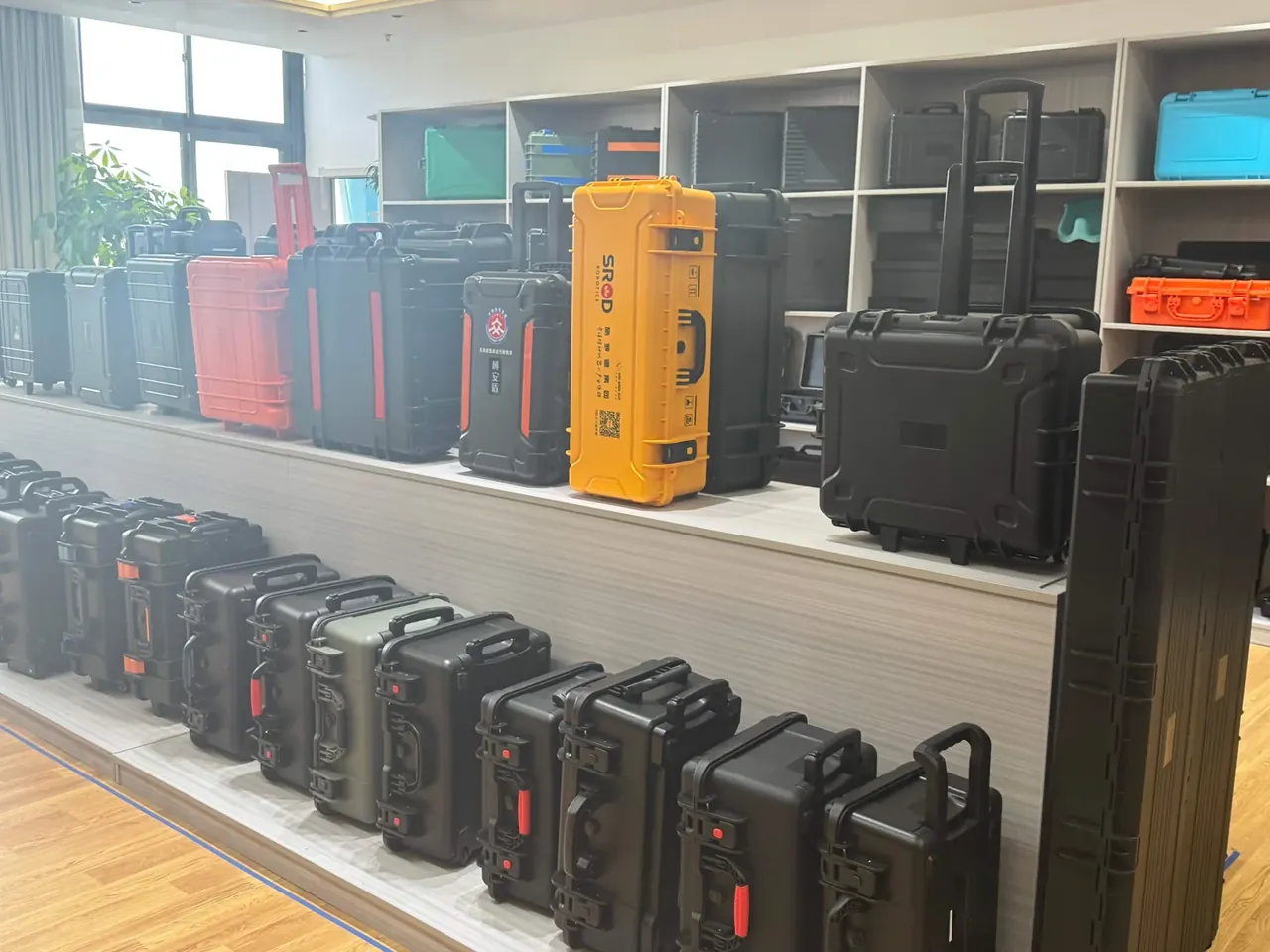
Quick answer: Choosing a submachine gun storage box comes down to five criteria — internal cavity, wall thickness and latches, sealing and pressure equalisation, carrying mode, and foam with its replacement interval. Work through them in order and unsuitable shapes drop out before pricing.
Table of contents
- How to Size the Cavity of a Submachine Gun Storage Box
- Reading Wall Thickness and Latch Count
- Gasket, Pressure Valve and Altitude
- Handles, Wheels and Carrying Mode
- Foam Choice and Replacement Interval
- FAQ
1. How to Size the Cavity of a Submachine Gun Storage Box
Size the cavity against the diagonal of the longest item, not by adding two centimetres to its length. A folded stock and a fixed stock differ by 120 mm, and a magazine in place eats 40 mm of width.
| Load pattern | Cavity L × W × H | Foam | Outer size |
|---|---|---|---|
| One folded stock | 640 × 300 × 140 mm | 25 mm each side | 700 × 360 × 190 mm |
| One fixed stock | 780 × 320 × 150 mm | 25 mm each side | 840 × 380 × 200 mm |
| Two side by side | 700 × 420 × 150 mm | 30 mm divider | 760 × 480 × 200 mm |
Measure clear space after foam compression, not the bare shell: a 25 mm EVA layer settles to about 22 mm. A rear-hinged cover also needs 210 mm of clear height, so a 250 mm shelf gap forces a removable lid.
2. Reading Wall Thickness and Latch Count
Wall thickness carries load and latch count keeps the rim sealed, so decide them together. A rotomolded submachine gun storage box at 4.5 mm weighs 3.6 kg empty; at 6.5 mm it weighs 5.2 kg.
| Wall | Empty weight | Latches | Stacking tiers |
|---|---|---|---|
| 4.5 mm | 3.6 kg | 2 | Single layer or vehicle |
| 5.5 mm | 4.4 kg | 3 | Two tiers |
| 6.5 mm | 5.2 kg | 4 | Three tiers and above |
More latches is not better; the count must match rim stiffness. Two on a 6.5 mm lid leave the middle unsqueezed, four on a 4.5 mm lid pull waves into the rim. Press the corners of a closed empty box: movement past 1 mm means the rim is soft.
3. Gasket, Pressure Valve and Altitude
Sealing follows the storage environment, not the price list. A full-perimeter O-ring of 5.5 mm at 55 Shore A, compressed 25 percent, keeps water out; a dust-only submachine gun storage box uses a flat strip and saves 8 to 12 CNY.
Pressure equalisation is the real dividing line. Moving a sealed box from sea level to 1,500 m builds about 0.17 bar, so without a valve the lid needs both hands; a valve cracking at 0.15 bar keeps opening force under 40 N.
Cold adds a material question: nitrile stiffens below −20 °C, while EPDM still flexes at −30 °C.
4. Handles, Wheels and Carrying Mode
Decide carrying mode early: it rewrites the shell and the cavity. A hand-carried submachine gun storage box takes a 30 kg loaded rating with steel backing behind the rivets; a wheeled version runs 60 mm wheels at 260 mm spacing and raises the floor 35 mm.
| Carrying mode | Structural cost | Best use |
|---|---|---|
| Single handle | None, lightest | Short carries |
| Telescopic handle and wheels | 35 mm less cavity height | Airports, platforms |
The retracted telescopic tube crosses the back and eats 40 mm of depth, so measure the cavity with the handle down.
5. Foam Choice and Replacement Interval
Foam controls how far an item shifts and how long a submachine gun storage box stays useful. EVA at Shore C 35 to 40 holds shape, while closed-cell PE at 25 kg/m³ resists compression but transmits shock.
| Foam | Recovery | Transport intensity | Replacement |
|---|---|---|---|
| Compartmented EVA | Good, repeatable | Frequent short trips | 24 months |
| Closed-cell PE | Fair, takes dents | Long-haul stacking | 18 months |
| Pearl foam | Good, sheds crumbs | One-off use | 12 months |
Intervals come from compression set: EVA held at 50 percent compression for 30 days loses over 15 percent of rebound and should be replaced. Leave an insert flat for 24 hours; 2 mm of slot growth means collapse.
Conclusion
Selection is an ordered checklist: cavity first, then wall and latches, then sealing grade, then carrying mode, finally foam. Reverse the order and the work repeats. Written into a comparison sheet, these criteria give buyers and inspectors a shared language for every submachine gun storage box.
This article discusses only the container (case body) side of specifications and design intent, and does not cover any handling, loading or use of the contents.
Related Reading
- How the Submachine Gun Storage Box Body Is Built
- Where a Submachine Gun Storage Box Is Used
- Designing and Choosing Internal Dividers
- Applications for Firearm Protective Cases
Related Products
- 8 Series — Gun Cases; Military Equipment Cases; Camera Equipment Cases; Drone Cases; Watch Cases; Knife Cases; First Aid Cases; Electronics Equipment Cases
- WL8-2812 PP Gun Case — model WL8-2812
- All protective cases and toolboxes: 7 series, 158 models