

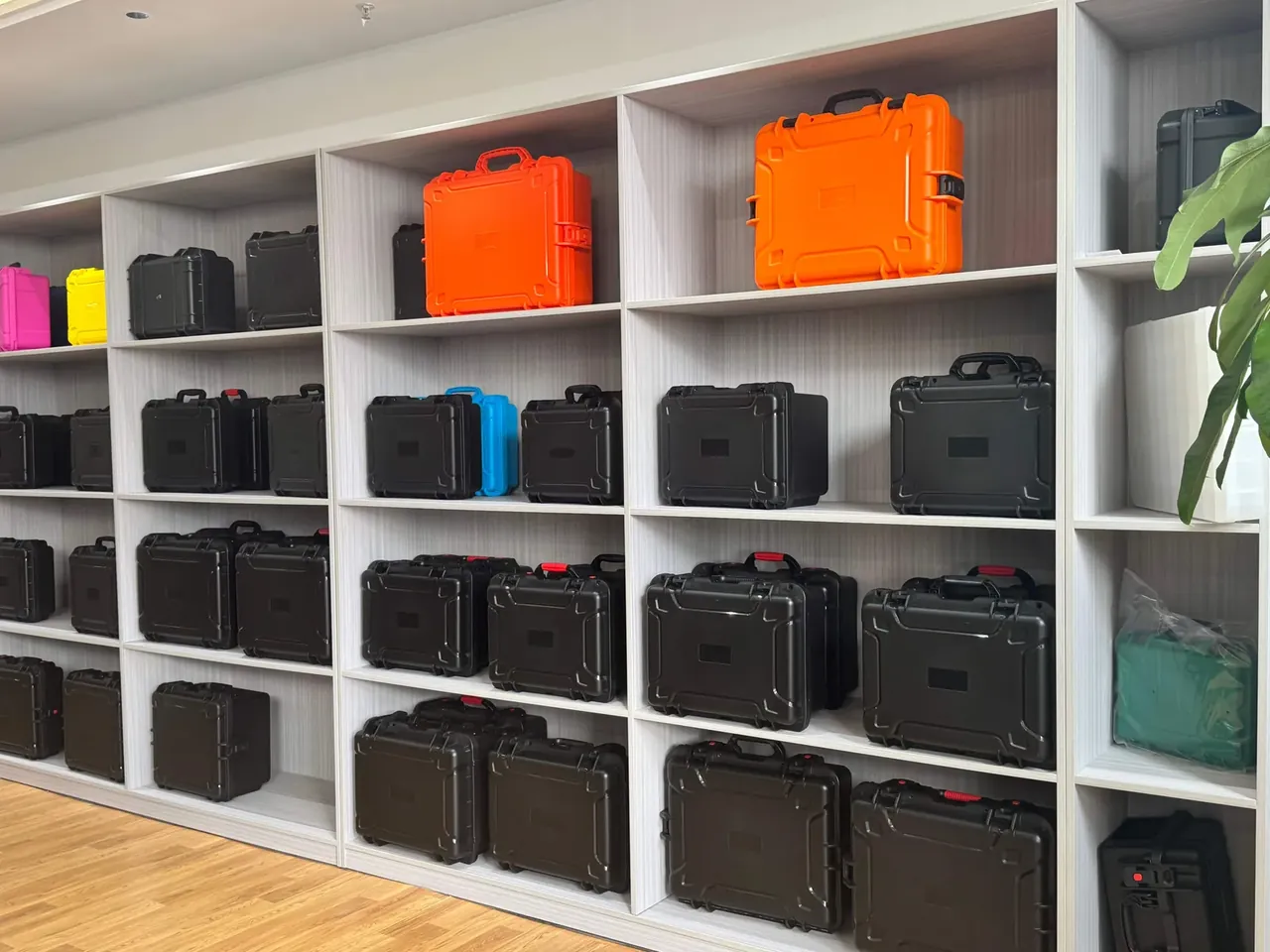
Quick answer: Three numbers fix a Submachine Gun Storage Box spec. Cavity size follows the largest outline plus 8–12 mm per side. Side walls run 2.8–3.2 mm, the base 3.5 mm, rib roots 4.5 mm. Stack load is bottom-layer weight times 2.5.
Table of contents
- Sizing the Submachine Gun Storage Box interior
- Wall thickness, ribs and load capacity
- Stack height and bottom load math
- Latch, hinge and handle ratios
- When specs conflict, which one wins
- FAQ
1. Sizing the Submachine Gun Storage Box interior
Measure the largest outline first, tape on the outermost edge, logging charging handle, magazine floorplate and sling loop separately. Envelope all three axes, then check the envelope slides straight in; if it needs tilting, the width is already wrong.
Allowance equals foam thickness times compression. A 10 mm pad at 20 percent gives 8 mm per side; a 15 mm pad at 10–15 percent gives 8–12 mm. Under 8 mm the lid will not close, over 12 mm contents shift on impact. Height adds 10 mm base foam to 15 mm lid foam; 1.5–2 degrees of draft narrows the floor 4–6 mm, so check fit at the narrowest point.
| Parameter | Value | Derived from | Common error |
|---|---|---|---|
| Cavity length, width | Outline + 16–24 mm | Per-side gap doubled | Missing protruding parts |
| Net height | Outline + 25 mm | 10 mm base + 15 mm lid | Foam on one side only |
2. Wall thickness, ribs and load capacity
Stiffness comes from the section, not thickness alone. A 2.8 mm panel bulges at a 300 mm span, yet an 8 mm rib with a 4.5 mm root turns the section into a T and beats thickening the panel to 3.6 mm.
Wall distribution on a Submachine Gun Storage Box runs 2.8–3.2 mm on the sides, 3.5 mm on the base, 4.5 mm at rib roots, R2 minimum at corners. On an 800 tonne machine with 0.38 square metres of projected area, flow length is about 420 mm and the flow-to-thickness ratio should stay under 280; below 2.5 mm, weld lines appear and carry half the parent strength.
| Location | Wall | Function | If too thin |
|---|---|---|---|
| Side wall | 2.8–3.2 mm | Resists squeeze and bulge | Mid-panel bulge, lid drift |
| Base | 3.5 mm | Stack load and impact | Base dish, contents settle |
| Rib root | 4.5 mm | Bending stiffness | Sink marks, cracking |
3. Stack height and bottom load math
Convert Submachine Gun Storage Box stack claims into numbers. At 12 kg gross, from a 3.2 kg body and 8.8 kg of contents, a five-high stack puts 48 kg on the bottom unit. With a 2.5 safety factor the design static load is 120 kg, checked at the locating step contact area rather than the side wall.
Heat removes margin: polypropylene at 40 °C for 30 days creeps about 0.9 mm more than at room temperature, so write 45 °C and creep under 1.5 mm for uncontrolled storage. A 6 mm lid step over a matching base recess holds layer offset under 3 mm.
4. Latch, hinge and handle ratios
Latch count follows volume: one front and back under 20 litres, two from 20 to 45 litres, two per side above that. Retention stays at or above 180 N, with 35–55 N opening force; anything lighter shakes open in transit.
Use a 4 mm 304 stainless pin, a 5 mm boss and 0.15–0.25 mm clearance; tighter seizes when cold, looser rocks the lid. Above 260 mm of pin length, add a centre support. The handle holds three times gross: 12 kg must carry 36 kg for an hour without permanent set, on a 12 by 22 mm grip with metal inserts.
5. When specs conflict, which one wins
Late in a program the numbers fight, so fix a priority. For a Submachine Gun Storage Box the order is fit, stacking, weight, then appearance. Fit is functional; stacking sets warehouse layers, and one layer changes the logistics chain.
- Height: cut lid foam from 15 mm to 12 mm rather than growing the outer envelope.
- Stack against weight: raise ribs from 8 mm to 12 mm, about 0.15 kg for one more layer.
- Thickness against sink marks: tighten rib pitch from 60 mm to 45 mm.
- Sealing against venting: never delete the pressure-equalisation valve.
Record each outcome as a parameter line with target, tolerance and owner.
Conclusion
A specification turns use requirements into measurable numbers, not the thickest possible body. Derive the cavity from outline and foam recovery, distribute wall by location, let ribs supply stiffness, and convert stack claims into bottom static load. Put those numbers on one sheet and the Submachine Gun Storage Box is genuinely specified.
This article discusses only the container (case body) side of specifications and design intent, and does not cover any handling, loading or use of the contents.
Related Reading
- Submachine Gun Storage Box definition and structural limits
- Submachine Gun Storage Box inspection and upkeep
- Submachine Gun Storage Case selection criteria
- Submachine Gun Storage Case against alternatives
Related Products
- 8 Series — Gun Cases; Military Equipment Cases; Camera Equipment Cases; Drone Cases; Watch Cases; Knife Cases; First Aid Cases; Electronics Equipment Cases
- WL8-2812 PP Gun Case — model WL8-2812
- All protective cases and toolboxes: 7 series, 158 models