

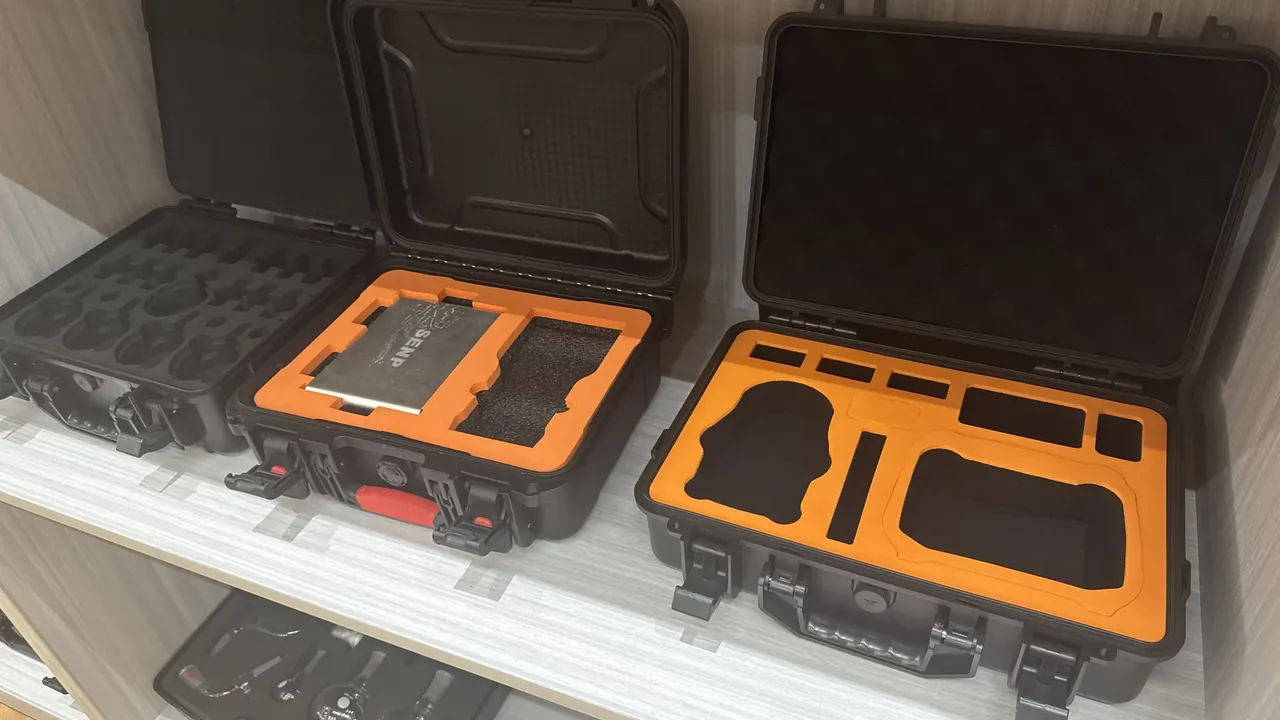
Quick answer: A submachine gun storage case is normally used in five settings: fixed stores, duty rooms, vehicles, vessels and field camps, and batch transfer. Each is judged on a different metric, so case, foam, latches and mounting should follow the setting rather than lead it.
Table of contents
- Five Deployment Scenes for a Submachine Gun Storage Case
- Storage Rooms and Duty Rooms
- Vehicle and Vessel Mounting
- Training and Batch Transfer
- Configuration Matrix and Common Mismatches
- FAQ
1. Five Deployment Scenes for a Submachine Gun Storage Case
The setting decides the configuration, not the reverse. The same 520 mm submachine gun storage case is a stock unit on a shelf, a vibrating component bolted into a van, and a sealed item fighting humidity on a deck.
A fixed store is judged on order; a duty room on speed from call to hand; a vehicle on restraint, because braking moves anything unfixed; a vessel on humidity and heel; batch transfer on handover.
| Setting | Conditions | Lead metric |
|---|---|---|
| Fixed store | Dry, stable | Tiers, count speed |
| Duty room | Dry, frequent access | Retrieval time |
| Vehicle | 65 Celsius in summer | Restraint, vibration |
| Vessel, field camp | 90 percent RH, 15 degree heel | Moisture, blocks |
| Batch transfer | Repeated handling | Labels, handover |
2. Storage Rooms and Duty Rooms
Store layouts work backwards from the rack. On a 900 mm pitch with 420 mm level height, a loaded submachine gun storage case of 7.4 kg fits four per level, and five tiers put about 118 kg on the bottom row. That load needs stacking ribs on the lid, and it must not pass through the latches.
A duty room inverts those priorities. A 12-slot vertical rack with 80 mm slots stands cases lid up and drops retrieval under 15 seconds. Stacking strength is irrelevant; thin walls and low weight matter, because one hand pulls the case free.
3. Vehicle and Vessel Mounting
A closed van reaches 65 Celsius in summer, softening foam and making adhesive tacky, and the row slides forward on the first hard brake. Bolt to four M8 floor points, strap at 300 daN breaking strength, and cross the straps about 30 degrees to the vehicle axis.
Vibration is harder than impact. Over 3 hours of shake equal to 200 km of washboard track, a case bolted without a 5 mm rubber pad works its latches at the resonant frequency, and spring fatigue arrives before wear.
A vessel adds two conditions: at 90 percent humidity, 20 g of desiccant needs quarterly replacement; at 15 degrees of heel, a flat case slides and needs lateral blocks at one third of case height.
| Mounting | Capacity | Watch out for |
|---|---|---|
| Four M8 bolts | 1.5 kN per point | Add 5 mm rubber pad |
| Strap on rail | 300 daN breaking | Cross straps, avoid latches |
| Lateral blocks | 15 degree heel | Block at one third height |
| Vertical slots | 8 kg per slot | Soft pad at slot floor |
4. Training and Batch Transfer
Training moves cases in batches of 40, where hand counting is slow and error-prone. Give each submachine gun storage case a four-digit number on a 60 x 20 mm label, placed on the end face and on the lid, so one faces the aisle and one faces up.
Transfer is sealed by batch: a truck takes 24 cases in three tiers with a rigid divider, and a single-use tie through the latch eye lets the clerk check one thing instead of opening every case.
5. Configuration Matrix and Common Mismatches
A matrix stops one case being ordered for everything: a store wants ribs and labels on a submachine gun storage case, a duty room speed and low weight, a vehicle mounting points, a vessel sealing and blocks.
| Setting | Foam | Latch | Mounting |
|---|---|---|---|
| Fixed store | Layered locating foam | Padlockable draw latch | Flat stack |
| Duty room | Thin locating foam | Quick-release | Vertical slot |
| Vehicle | Full wrap with lid layer | Two-point plus safety | Four bolts |
| Vessel | Closed-cell foam | Two-point, padlock | Blocks plus lashing |
Three mismatches repeat. A portable case used as a store case collapses its lid at the third tier. A store case loaded into a van without mounting points slides as a block. Open-cell foam on a vessel absorbs water, doubles in weight and stops recovering.
Conclusion
The setting writes the specification: order for a store, speed for a duty room, restraint on a vehicle, sealing on a vessel. Split those into a purchasing table before ordering, and a submachine gun storage case lands where it was meant to work.
This article discusses only the container (case body) side of specifications and design intent, and does not cover any handling, loading or use of the contents.
Related Reading
- How to choose a submachine gun storage case
- Where weapon storage cabinets are used
- Ammunition transit case scenes and fixing methods
- Submachine Gun Storage Case vs General Gun Case: Short-Wea…
Related Products
- 8 Series — Gun Cases; Military Equipment Cases; Camera Equipment Cases; Drone Cases; Watch Cases; Knife Cases; First Aid Cases; Electronics Equipment Cases
- WL8-2812 PP Gun Case — model WL8-2812
- All protective cases and toolboxes: 7 series, 158 models