

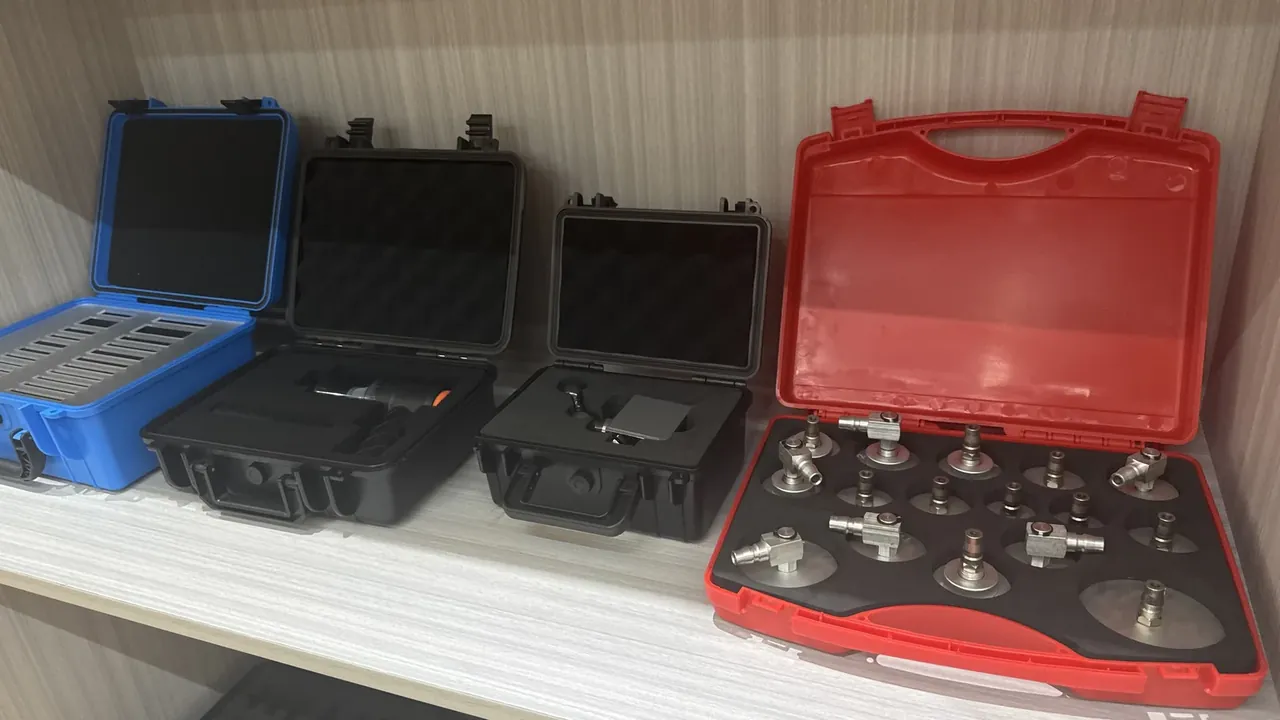
Quick answer: A Submachine Gun Storage Case does not compete with bags and totes on price. It competes on four testable claims: a measurable seal, a rated stack load, posture held by the case, and parts replaced one at a time.
Table of contents
- What This Case Is Actually Compared Against
- Sealing and Stacking Ratings Side by Side
- Five-Year Cost of Ownership
- What Failure Costs: Water and Crushing
- When the Case Is the Wrong Pick
- FAQ
1. What This Case Is Actually Compared Against
Four candidates reach the same tender: a generic rifle case with a fitted insert, a soft bag, an injection tote, and one-way moulded pulp. Only the first is a fixed workplace fixture that can be counted, stacked and sealed.
A short weapon body is short but tall at the grip and optic. Volume without posture lets the load shift; a Submachine Gun Storage Case removes that slack with a shallow wide cavity and cut foam.
| Option | Strength | Weakness |
|---|---|---|
| Submachine Gun Storage Case | Seal, stack load, locked posture | 4.6 kg empty, higher price |
| Generic case with insert | Large volume, cheap to adapt | Deep lid height stays |
| Soft bag | Lightest, folds flat | No seal, no stack rating |
| Injection tote | Low cost, nests when empty | No gasket groove, no liner |
The tote is the trap: one fifth of the price, until a fifteen-minute shower reaches the inner wall through the flat lid joint.
2. Sealing and Stacking Ratings Side by Side
A seal is useful only if it appears on an inspection sheet: one metre of immersion for thirty minutes with no ingress. The groove is cut to seventy percent of the cord diameter, so a closed lid compresses the cord by twenty-five to thirty percent. Soft bags have no sealing face, and totes rely on lid weight, opening a gap at two layers.
A loaded Submachine Gun Storage Case stacks five high, the bottom unit carrying 210 kg for 24 hours and returning under 1.5 mm of residual deflection, thanks to base ribs and radiused corners. Under 96 hours of salt spray the coated latches stay rust-free, while bag pullers pit within 48 hours.
3. Five-Year Cost of Ownership
Unit price misleads because replacement intervals differ. Over five years at twelve movements a year, a case bought at CNY 620 needs two gasket sets worth CNY 90, so CNY 710 in total.
| Option | Unit price | Replacements | Consumables | 5-year total |
|---|---|---|---|---|
| Submachine Gun Storage Case | CNY 620 | 0 | Gaskets CNY 90 | CNY 710 |
| Generic case with insert | CNY 480 | 0 | Insert CNY 160 | CNY 640 |
| Soft bag | CNY 150 | 3 | None | CNY 450 |
| One-way pulp packaging | CNY 35 each | 60 trips | None | CNY 2,100 |
The bag still looks cheapest, but the table ignores failure cost, which is where the ranking turns. Floor space is the second hidden line: an envelope reversed from a 620 x 330 x 155 mm cavity stores 3.2 times as much per square metre.
4. What Failure Costs: Water and Crushing
One wet event has a fixed bill: unload, run 48 hours of dehumidification, swap eight 120 g desiccant packs, re-test the seal. That is about CNY 260 plus downtime, and it is why the immersion clause belongs in the purchase document.
Crushing costs more. A 3 mm wall dent breaks the contact line between cord and groove and no sealant repairs it, so the unit is scrapped. Thickened corners move drop stress off the wall, while a square tote splits at that corner.
5. When the Case Is the Wrong Pick
Three situations argue against it. If the case moves fewer than twice a year in a dry room, the ratings are unused capacity; if the cavity is under 400 mm square, empty weight dominates; near CNY 300, the mould cannot include a true gasket groove.
| Check | Favours the case | Favours an alternative |
|---|---|---|
| Moves per year | Three or more | Two or fewer |
| Storage climate | Wide humidity swing | Stable, dry room |
| Stack height | Three layers or more | Single layer |
Conclusion
The four alternatives each hold a place, and the position of this case type is to turn protection into numbers that can be checked. A 4.6 kg shell, a 210 kg stack rating and a one-metre thirty-minute immersion clause buy traceability that bags and totes cannot match. For long storage and unit-level records, the Submachine Gun Storage Case remains the only option that assigns responsibility in writing.
This article discusses only the container (case body) side of specifications and design intent, and does not cover any handling, loading or use of the contents.
Related Reading
- A Submachine Gun Storage Case versus a generic rifle case
- Sizing and foam cutting for a Submachine Gun Storage Case
- Seal structure and desiccant layout in moisture-proof cases
- Preventing case damage during warehouse storage
Related Products
- 8 Series — Gun Cases; Military Equipment Cases; Camera Equipment Cases; Drone Cases; Watch Cases; Knife Cases; First Aid Cases; Electronics Equipment Cases
- WL8-2812 PP Gun Case — model WL8-2812
- All protective cases and toolboxes: 7 series, 158 models