

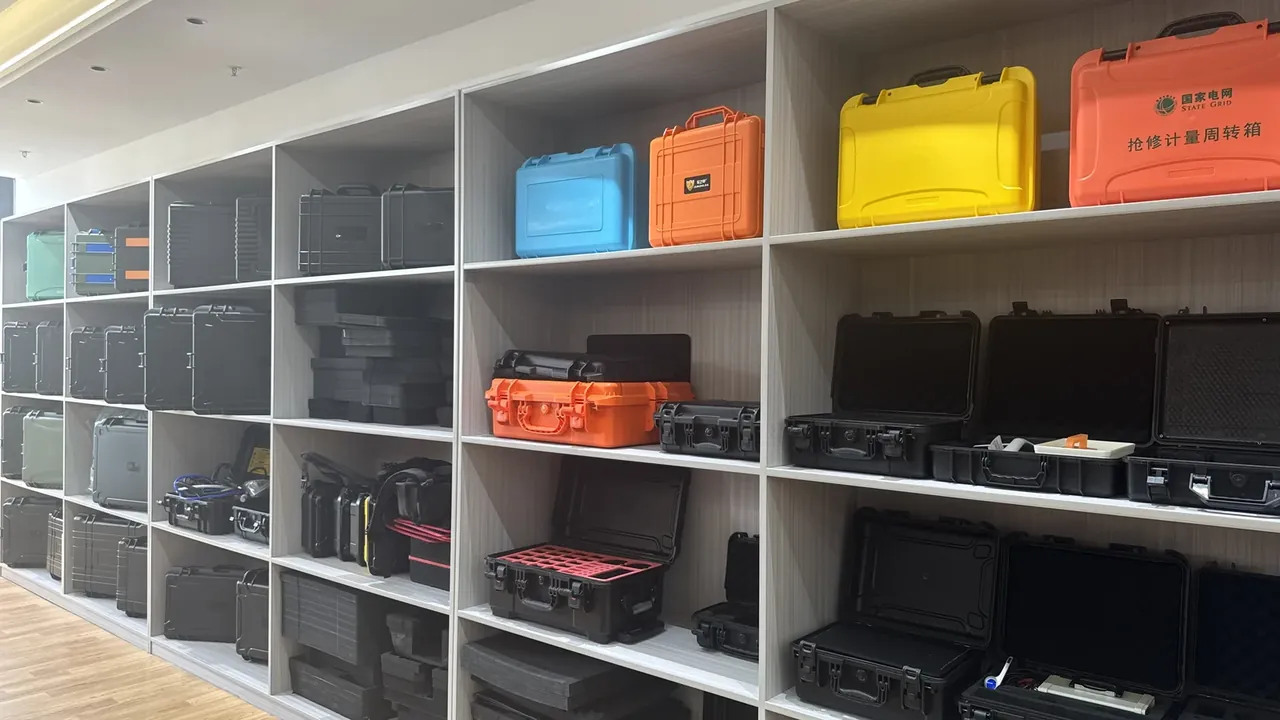
Quick answer: Five decisions decide whether a submachine gun storage case survives stacking and transit: wall thickness and rib layout, the foam layer stack, seal groove section and compression, the load path through hinges and latches, and the moulding window for the shell. Let one slide and the case fails at closing, sealing or drop testing.
Table of contents
- How the Frame of a Submachine Gun Storage Case Is Built
- Foam Layers and Cut Geometry
- Seal Groove and Mating Face
- Hinges and Latches in the Load Path
- Injection Moulding Parameters
- FAQ
1. How the Frame of a Submachine Gun Storage Case Is Built
The frame is two mouldings, body and lid, from one tool in copolymer polypropylene. The parting line sits on the closing rim because that rim datums the seal: flash there trims in one pass, while a side-wall parting line leaves a witness mark along the full length.
A submachine gun storage case for a short weapon lands near 520 x 300 x 145 mm outside and 480 x 260 x 118 mm inside, with 3.0 mm side walls, a 3.4 mm base and a 2.6 mm lid. The base takes the first hit in stacking; the lid resists dishing.
Side ribs run 1.6 mm thick on a 55 mm pitch with an R1.2 root. Bring ribs near wall thickness and cooling slows at the root, drawing a sink mark that becomes a leak on the groove floor. Draft is 1 degree, about 2.5 mm over 145 mm.
| Feature | Value | Purpose |
|---|---|---|
| Side walls | 3.0 mm | Load path, rib support |
| Base | 3.4 mm | Stacking and drop |
| Lid | 2.6 mm | Dishing only |
| Ribs | 1.6 mm, 55 mm pitch | Anti-bulge |
2. Foam Layers and Cut Geometry
Foam in a submachine gun storage case runs three layers: 20 mm base at 45 kg/m3, 30 mm locating layer cut to the weapon profile, and 10 mm lid layer. The base spreads weight, the middle stops lateral slide, the lid layer presses the top face flat.
Cuts go on a CNC router leaving 12 mm of foam to the case wall and 2 mm clearance per side. Too tight and the edge drags on hands; too loose and the weapon shifts as the case tips, shearing the cavity wall.
Base and locating layers are held by dowels plus adhesive: glue alone softens in a hot vehicle, dowels alone tear foam. Spot glue with 8 mm dowels every 150 mm.
3. Seal Groove and Mating Face
The groove of a submachine gun storage case runs around the body rim at 5.0 x 4.2 mm and takes a 6 mm silicone cord compressed to 22 percent. Under 18 percent the cord never seats; over 28 percent closing takes both hands.
Floor flatness is held to 0.3 mm, which matters more than cord tolerance: an undulating floor varies compression, and water enters at the least compressed stretch, usually a corner.
A labyrinth rib 1.8 mm high and 2.2 mm wide drops into a channel in the lid. It is not the seal; it breaks driven water and dust before the cord compresses.
4. Hinges and Latches in the Load Path
The hinge of a submachine gun storage case runs a 4.0 mm 304 stainless pin through 42 mm bosses. A pin in moulded plastic opens the hole within a few hundred cycles; the lid rocks and the seal loses register. A 1.2 mm bronze bushing at 0.15 mm clearance makes the wear replaceable.
Latches are specified by holding force. One latch needs 180 N, two give 360 N, which holds a cord at 22 percent. Life is tested at 20,000 cycles with no more than 15 percent loss.
5. Injection Moulding Parameters
The shell runs on a 650 tonne press at 225 Celsius melt, 48 Celsius mould, 26 seconds of cooling and a 62 second cycle. Below 42 Celsius corners short; above 55 Celsius cooling stretches and warp climbs.
Shrinkage is quoted at 1.5 to 1.7 percent, measured on three cavities. Over a 520 mm edge that spread is 1.0 mm, enough to shift the groove against the hinge bosses.
Pins and hooks run 96 hours of neutral salt spray. Skip it and humidity rusts the pin within three months, and each cycle carries that rust into the bushing.
| Parameter | Value | Drift |
|---|---|---|
| Clamp | 650 tonne | Flash thickens |
| Melt | 225 Celsius | Weld lines |
| Mould | 48 Celsius | Short or warp |
| Shrinkage | 1.5 to 1.7 percent | 1.0 mm on 520 mm |
Conclusion
Walls and ribs carry load, foam keeps the weapon still, groove and labyrinth keep water out, hinges keep closing smooth, and moulding parameters keep all of it repeatable. Read the five together and a submachine gun storage case stops being a black box.
This article discusses only the container (case body) side of specifications and design intent, and does not cover any handling, loading or use of the contents.
Related Reading
- How to choose a submachine gun storage case
- Gun case production from resin to shell
- How clamp force shapes a moulded case
- What goes into a submachine gun storage box
Related Products
- 8 Series — Gun Cases; Military Equipment Cases; Camera Equipment Cases; Drone Cases; Watch Cases; Knife Cases; First Aid Cases; Electronics Equipment Cases
- WL8-2812 PP Gun Case — model WL8-2812
- All protective cases and toolboxes: 7 series, 158 models