

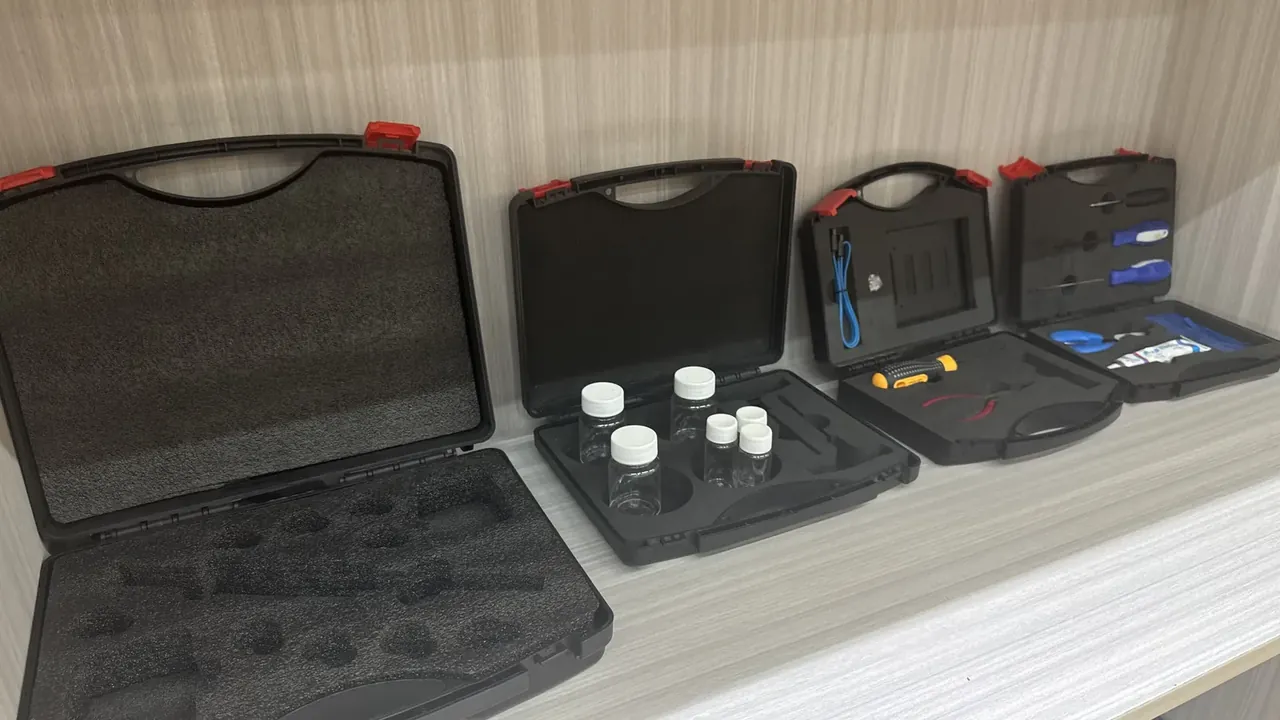
Quick answer: Maintenance for a Submachine Gun Storage Case means measuring three numbers on a schedule: seal gap, latch torque and foam compression set. While all three stay inside limits the case keeps working; once one crosses the line, the fix is a part or a new case, never glue.
Table of contents
- Setting the Inspection Rhythm
- Seal Faces and Gasket Measurements
- Latches, Hinges and the Pressure Valve
- Foam and Wall Ageing
- The Replacement Line
- FAQ
1. Setting the Inspection Rhythm
The interval follows how fast each part fails: gaskets age in months, latches loosen in quarters, foam collapses in years.
The baseline is a 30-day visual, a 90-day measurement and a 365-day re-test. Sites opening the case more than five times a week pull the visual forward to fifteen days, since every open cycle spends latch life.
| Interval | Check | Tool | Verdict |
|---|---|---|---|
| 30 days | Wall cracks, latch feel, debris | Eyes and hand | No crack, no rattle |
| 90 days | Seal gap, latch torque, pin play | Feeler gauge, wrench | Sections 2 and 3 |
| 365 days | Immersion, foam set, valve O-ring | Tank, caliper | Section 4 |
Tools are the usual gap: without a gauge the gap cannot be measured, and tightening by feel spreads thirty percent between technicians on the same screw.
2. Seal Faces and Gasket Measurements
Two numbers describe the sealing face: flatness and gap. With the lid closed a 0.4 mm gauge is pushed around the perimeter and must not enter, and flatness against a straight edge is allowed 0.3 mm. Past either figure the lid has warped.
The gasket is judged where it is crushed. A 3.4 mm groove holding a 4.0 mm cord gives about twenty-eight percent compression; a cord under 3.2 mm at the section has lost that margin. Counting open cycles beats counting years: at five opens a week a Submachine Gun Storage Case reaches its window near twenty-four months, at fifteen a week near ten.
3. Latches, Hinges and the Pressure Valve
Latches on a Submachine Gun Storage Case take the repeated impact. M5 screws are re-tightened to 1.1 N·m, since 1.4 N·m cracks the reinforcing rib and 0.8 N·m lets the screw walk out. A screw still loose after three re-torques has a worn thread and is replaced, not over-tightened.
Hinge play is read with a caliper: above 0.6 mm of pin-to-bore difference the lid swings before it seats and shears the gasket.
The valve needs a new internal O-ring every twelve months; a stuck disc shows up as a lid that fights the user after a temperature swing, by which time the gasket has been drawn flat.
| Part | Spec | Target | Past limit |
|---|---|---|---|
| Latch screw | M5 | 1.1 N·m | New screw after three re-torques |
| Hinge pin | Pin and bore | Play ≤ 0.6 mm | New pin or lid |
| Valve O-ring | Internal seal | 12 months | Replace when sticking |
| Seal face | Flatness | ≤ 0.3 mm | Case scrapped |
4. Foam and Wall Ageing
Foam in a Submachine Gun Storage Case is judged by rebound: press a cavity floor for ten seconds, and a rebound slower than five seconds or a set above fifteen percent means the foam supports nothing.
Walls age near the parting line and where cases stack. Beyond 0.4 mm of wear the stack rating drops, and cracks from ultraviolet exposure call for a re-check after 1,500 hours outdoors. More than 2 mm of liner movement needs a new liner, not a shim.
5. The Replacement Line
A replacement line must be a sentence someone can check. Any of five conditions retires the case: a seal face warped past 0.3 mm, a wall crack over 10 mm, a through-crack at the latch boss, stack wear over 0.4 mm, or leakage in the immersion test.
| Condition | Limit | Action |
|---|---|---|
| Seal face warp | 0.4 mm gauge enters | Retire |
| Wall crack | Over 10 mm | Retire |
| Latch boss crack | Through-wall | Retire |
| Immersion test | Leak within 30 minutes | Retire |
Borderline states can be repaired, with a record. The dividing question for a Submachine Gun Storage Case is whether damage sits in a part or in a load-bearing structure.
Conclusion
The discipline is replacing the phrase it still feels fine with three numbers: gap, torque and set. While they hold, a Submachine Gun Storage Case keeps its seal and stack rating; when one crosses the line, the decision is repair or retire.
This article discusses only the container (case body) side of specifications and design intent, and does not cover any handling, loading or use of the contents.
Related Reading
- What Is a Submachine Gun Storage Box: Structure and Protec…
- Weather Resistance and Long-Term Maintenance of Rotational…
- Density and cutting parameters for custom foam inserts
- Preventing case damage during warehouse storage
Related Products
- 8 Series — Gun Cases; Military Equipment Cases; Camera Equipment Cases; Drone Cases; Watch Cases; Knife Cases; First Aid Cases; Electronics Equipment Cases
- WL8-2812 PP Gun Case — model WL8-2812
- All protective cases and toolboxes: 7 series, 158 models