

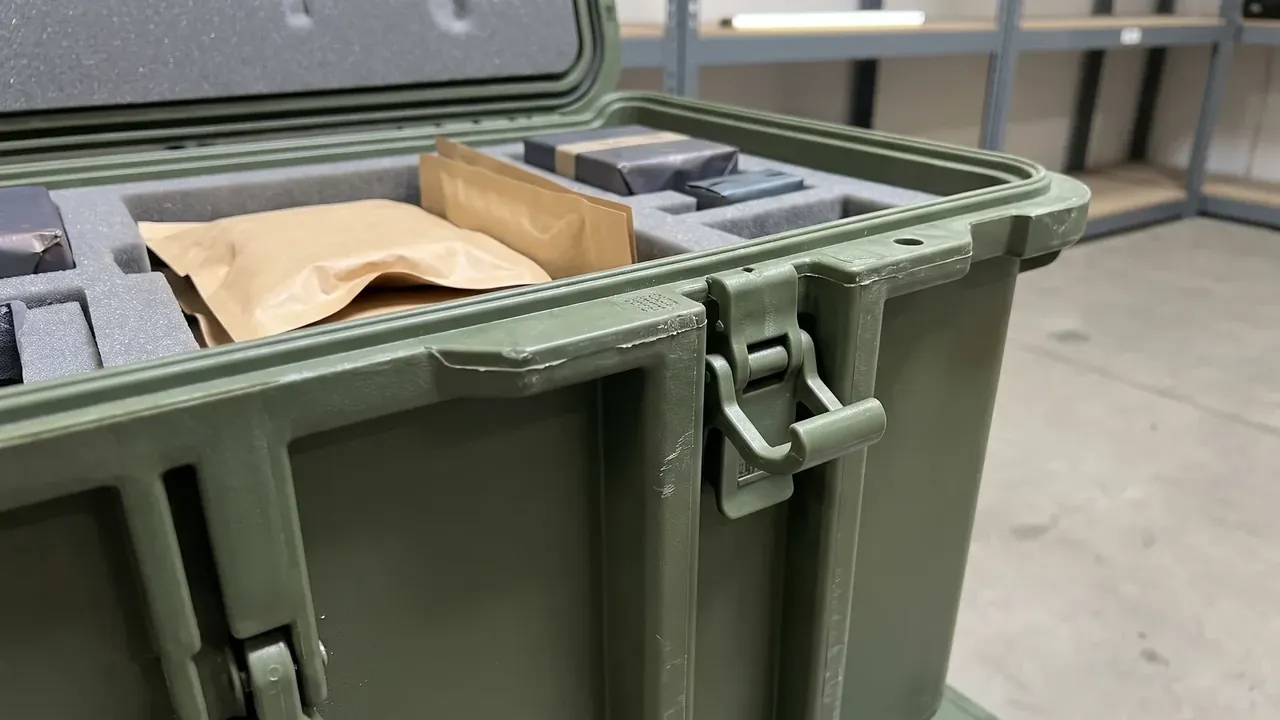
Quick answer: Tactical Equipment Hard Case at 620 × 430 × 250 mm, 8.4 kg empty and 26.4 kg loaded: strap rings at 300 N, side lugs at 700 N, 3 mm tie-down travel.
Table of contents
- Three ways to carry, four loaded parts
- What 26.4 kg leaves on a 45 kg shoulder strap
- How ring and lug loads reach the shell
- Three-high stacking and 480 h of salt spray
- FAQ
1. Three ways to carry, four loaded parts
The same Tactical Equipment Hard Case takes load in different places depending on how it travels. A single shoulder strap uses only the four rings on the long edge of the lid; a two-person lift uses the lugs on the short sides; vehicle tie-down uses two 25 mm slots front and rear. Across all three ways of moving a Tactical Equipment Hard Case, only four parts carry anything: strap rings, side lugs, tie slots and four lid corners.
| Carry mode | Load point | Rating |
|---|---|---|
| Single shoulder | four strap rings | 300 N each |
| Two-person lift | two side lugs | 700 N each |
| Vehicle tie-down | two 25 mm slots | 3 mm travel |
| Storage | lid corners | three high |
The rings sit on the long edge so the case rides against the calf; the lugs sit on the short sides so two people walking front and rear keep the shell from swinging.
2. What 26.4 kg leaves on a 45 kg shoulder strap
Empty is 8.4 kg, load is 18 kg, so a packed case weighs 26.4 kg — 259 N. Split across two rings in use, that is 129 N each, 43% of the 300 N rating. The margin looks generous until walking starts: each step bounces the shell, and peaks reach about 1.8 times static, or 232 N on one ring.
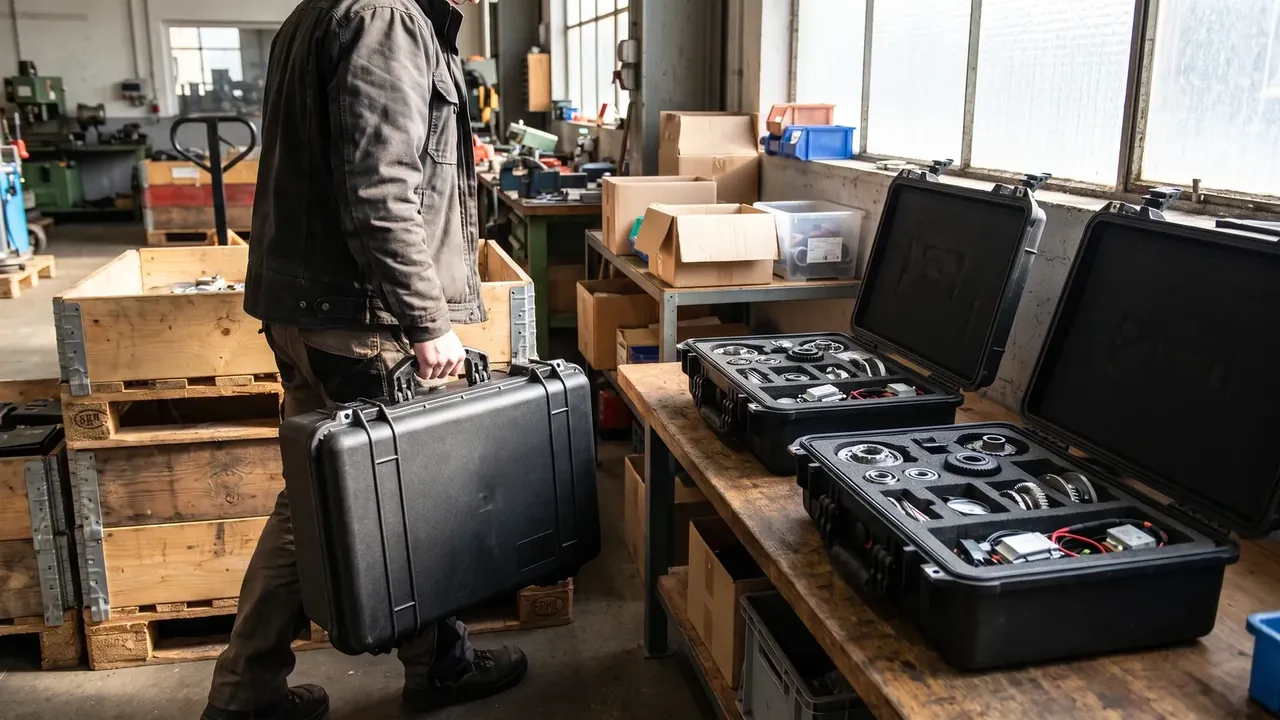
On a Tactical Equipment Hard Case the strap itself is rated 45 kg, or 441 N, so 26.4 kg uses 59% and leaves 41% for a strap caught on a door frame or pulled from behind. The weak point is not the webbing but the ring stitching: 25 mm nylon with a double back-stitch breaks near 1 500 N, yet the thread wears through in about three months of daily carry.
Hanging the case on one shoulder puts all 259 N on two rings, with the other two only steadying the shell. Four rings share load on a Tactical Equipment Hard Case because the webbing passes over the lid face, not because two rings take everything.
Plastic rings go brittle at −30 ℃ and snap; a metal ring through a webbing loop still holds 300 N after a 2 J drop at that temperature.
3. How ring and lug loads reach the shell
Path length separates the four parts. A ring is fixed by four self-tapping screws 12 mm from the wall, so force has to travel around the lid radius — about 40 mm — before it reaches the side wall. A lug is moulded with the shell, so force enters the wall in under 15 mm. The longer the path, the more the shell bulges locally.
The 700 N lug rating comes back from a two-person lift: split 26.4 kg into 129 N each and the lug runs at 18% of rating. Then one person lets go, the whole 259 N lands on one lug, and 2.7 times margin is left.
| Part | Rating | Failure mode |
|---|---|---|
| Strap ring, each | 300 N | screw holes pull out, stitching wears |
| Side lug, each | 700 N | radius at the lug root cracks |
| Tie slot, per side | 400 N preload | slot wears through, travel exceeds 3 mm |
| Latch, each | 400 N | tongue takes a permanent set |
Tie-down is the part people forget. Two 25 mm straps run front and rear over the ribs, and the shell may move no more than 3 mm on a rough road; past 3 mm the webbing grinds the coating, and 90 μm of film is gone in two trips. Slot depth matters as much: at 8 mm deep and 26 mm wide a 25 mm strap has 0.5 mm of play each side, while a 5 mm slot lets the strap jump out and travel goes from 3 mm to over 30 mm. The slots on this Tactical Equipment Hard Case carry a 2 mm chamfer so the webbing edge is not cut.
4. Three-high stacking and 480 h of salt spray
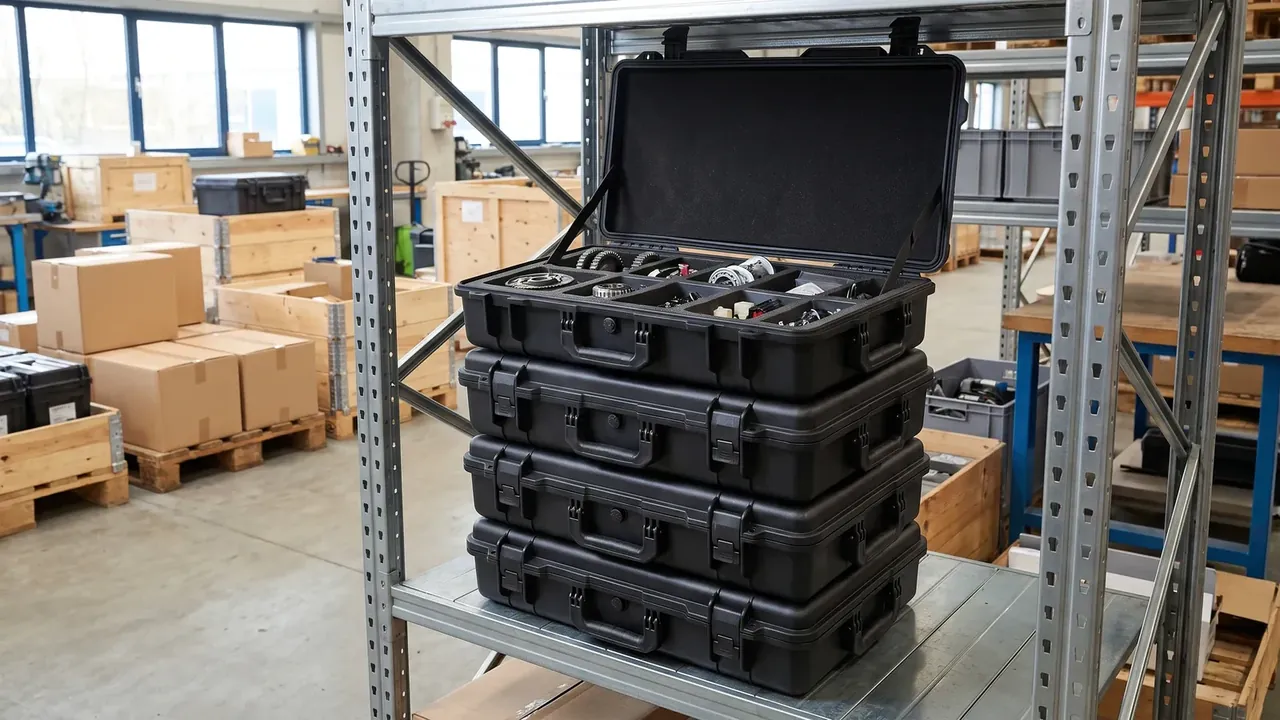
On a Tactical Equipment Hard Case, stacking and corrosion land on the same skin. Three high puts two cases on the bottom lid — 52.8 kg over a 620 × 430 mm face, about 2 kPa average. Average is not the problem; the four corners are.
Weathering is read from two figures: no red rust at a scribe after 480 h of neutral salt spray, and ΔE 1.2 after 500 h of UV. Both depend on 90 μm of film; at 60 μm the salt spray shows white spots by 300 h. A ΔE of 1.2 is invisible to the eye, but two batches side by side separate at about 1.5.
The UV sample is the other half of the same sheet, measured at 45°/0°, with ΔE 1.2 averaged over five points.
Cold is a separate line for a Tactical Equipment Hard Case. At −30 ℃ impact strength falls to about 60% of room temperature: a 2 J drop leaves a 0.5 mm dent without a crack, while a shell with a high regrind ratio cracks at the same 2 J.
| Item | Condition | Result |
|---|---|---|
| Neutral salt spray | 480 h | no red rust at the scribe |
| UV ageing | 500 h | ΔE 1.2 |
| Cold impact | −30 ℃, 2 J | 0.5 mm dent, no crack |
| Stacking | three high, 52.8 kg | 1.2 mm residual set |
Conclusion
Choosing a Tactical Equipment Hard Case comes down to four loaded parts: four rings at 300 N, two lugs at 700 N, two 25 mm straps, and four corners under three-high storage. At 26.4 kg each part runs near 40% of rating, so what actually consumes life is bounce peaks, tie-down travel and the film lost after 480 h of salt spray. Clear those four and the colour can be argued last.
Related Reading
- What to check when choosing a tactical case
- Where handles go for a two-person lift
- How protective cases are stacked
- Coating options for case hardware
Related Products
- 8 Series — Gun Cases; Military Equipment Cases; Camera Equipment Cases; Drone Cases; Watch Cases; Knife Cases; First Aid Cases; Electronics Equipment Cases
- WL8-2812 PP Gun Case — model WL8-2812
- All protective cases and toolboxes: 7 series, 158 models