

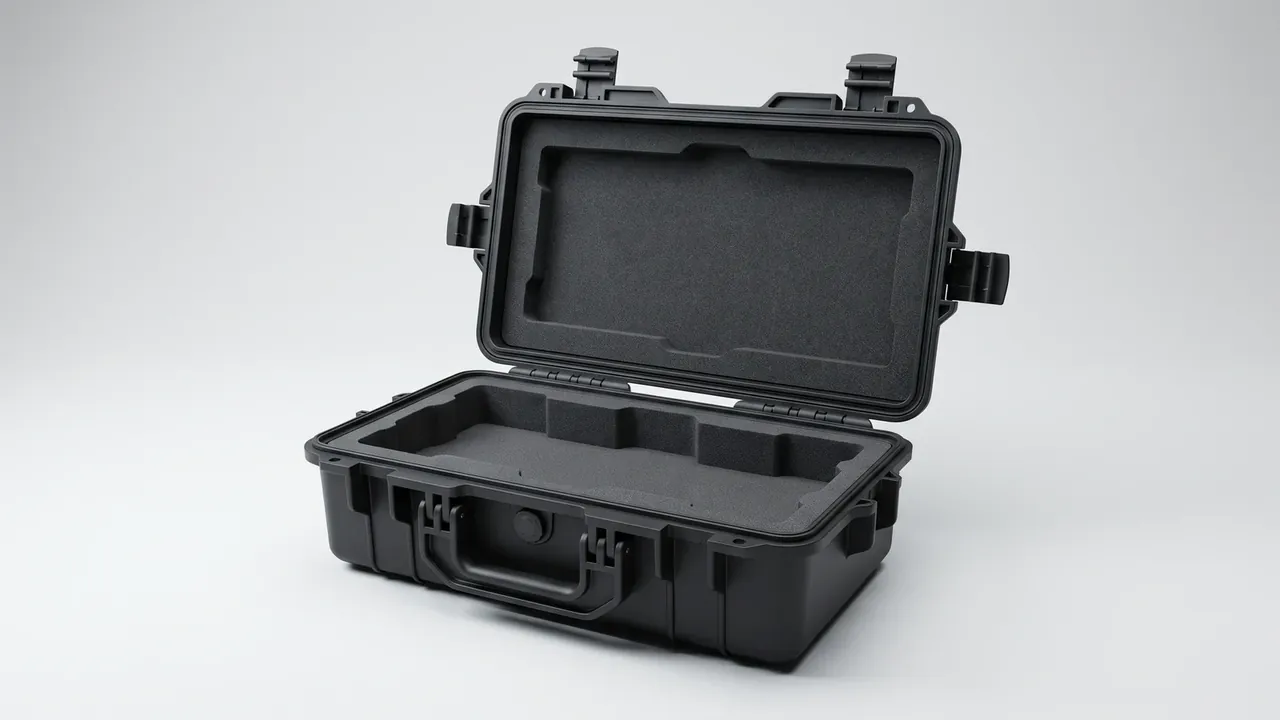
Quick answer: A tactical hard case is limited by its configuration more often than by its shell: transport wants cut foam and stack strength, boats want tie-down points, a command post wants a flat lid, training stores want marking.
Table of contents
- Four Tactical Hard Case Scenarios at a Glance
- Equipment Transport and Carry on Site
- Tie-Down Points on Vehicles and Boats
- Field Command Posts, Stacking and Marking
- Training Stores and Kit Tiers
- FAQ
1. Four Tactical Hard Case Scenarios at a Glance
Swap the insert in a tactical hard case and a shipping box becomes a desk. Decide what the case will live through first, then cavity layout, panel, straps and marking.
Four variables matter most: cavity depth, external panel, base inserts, stacking and marking. Depth decides whether equipment accelerates before it meets foam; inserts decide whether the case slides under braking.
| Scenario | Typical load | First-order configuration |
|---|---|---|
| Transport and carry | 18 to 35 kg | 30 mm cut foam |
| Vehicle and boat | up to 60 kg | four M8 base inserts |
| Command post | 40 kg on the lid | stiffener, 720 mm height |
| Training stores | 8 to 15 kg | label window, tiered trays |
2. Equipment Transport and Carry on Site
The first constraint is a drop, not a static load. A 1.2 m corner drop sends shock along the edges, so the insert must stop the item in that instant. Cavities run 1.5 mm larger than the outline: under 1 mm it will not seat, over 3 mm it rattles.
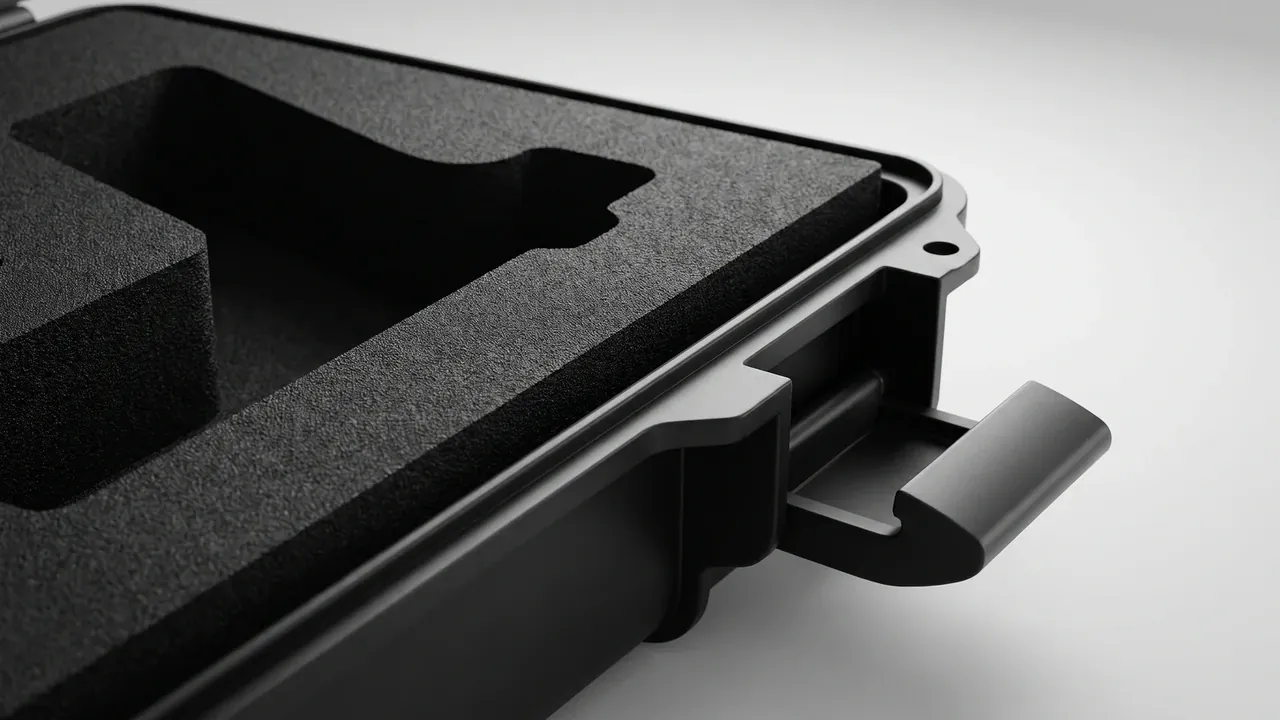
Depth follows thickness: a cavity 2 mm deeper than the item lets the lid foam compress 2 to 3 mm and hold it from both sides. Above 8 kg, use 40 mm EVA.
Opening angle is the second constraint. A lid at 100 to 110 degrees frees both hands; below 90 degrees one hand is always on it. At 18 kg carried for 30 minutes, the handle mount is the fatigue point.
3. Tie-Down Points on Vehicles and Boats
Vehicle mounting aims to make the tactical hard case part of the vehicle. A strap around the shell shifts under braking; four M8 inserts at 8 N·m with 25 kN webbing hold it at 0.8 g.
Boats add salt and vibration: 316 stainless plates, anchors within 600 mm, a 20 mm drainage gap, re-torque at 90 days. Galvanised hardware rusts in one season.
Stacking is structural: two high works with 120 kg on the bottom case and corner grooves engaged; without them, 200 km of rough road shifts a case 30 mm.
| Fixing method | Where it fits | Static rating |
|---|---|---|
| M8 base inserts | vehicle floor, boat deck | 400 kg per point |
| Webbing around the shell | short transfers | 25 kN breaking |
| Quick-release clips | command post bench | 60 kg |
4. Field Command Posts, Stacking and Marking
A command post turns the case into furniture. A 6 mm aluminium composite panel bonded into the lid holds the closed surface within 2 mm of flat, which decides whether anyone can write on the move. Folding legs at 720 mm serve either posture.
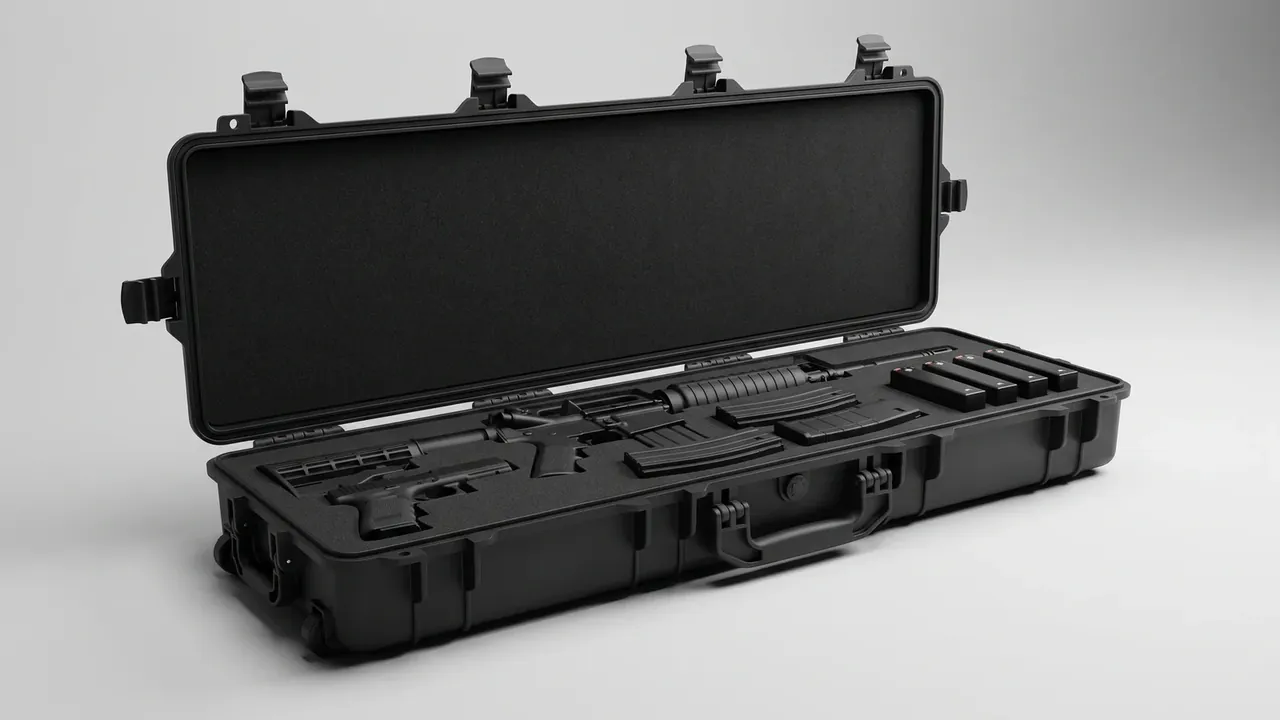
Orientation follows the operator: long edge to the user, lid folding away. Vertical dividers make three levels: maps on top, documents between, power at the bottom.
Three high is normal: 120 kg bottom, 80 kg middle, 40 kg top. Mark by function, not serial number: 100 mm characters on the short edge read at 1.5 m, and a fixed position survives a case swap.
5. Training Stores and Kit Tiers
Training stores need countable, checkable, replaceable: one cavity drawing per batch, labels in fixed coordinates and a clear label window. Opening takes four minutes, a window twenty seconds.
Tier by handling, not size: 12 kg for one person, 25 to 35 kg for two, 60 kg by vehicle. Above 35 kg a case gets dragged rather than lifted, and the base shows it.
Removable dividers keep a re-role reversible: a third of the cost, eight minutes instead of forty. Count every 90 days, shortages per case.
| Tier | Case weight | Handling |
|---|---|---|
| Individual | 8 to 12 kg | one hand |
| Team | 25 to 35 kg | two person lift |
| Vehicle | 45 to 60 kg | pallet and strap |
Conclusion
Configuration, not shell specification, decides how long a tactical hard case earns its place. Transport rewards cavity depth, boats tie-down discipline, command posts a flat lid, training stores marking that survives replacement. A tactical hard case is only as good as the configuration it ships with.
This article discusses only the container (case body) side of specifications and design intent, and does not cover any handling, loading or use of the contents.
Related Reading
- How to choose a tactical hard case
- Hard case or soft bag
- Military rotomolded case applications
- Equipment case applications by industry
Related Products
- 8 Series — Gun Cases; Military Equipment Cases; Camera Equipment Cases; Drone Cases; Watch Cases; Knife Cases; First Aid Cases; Electronics Equipment Cases
- WL8-2812 PP Gun Case — model WL8-2812
- All protective cases and toolboxes: 7 series, 158 models