

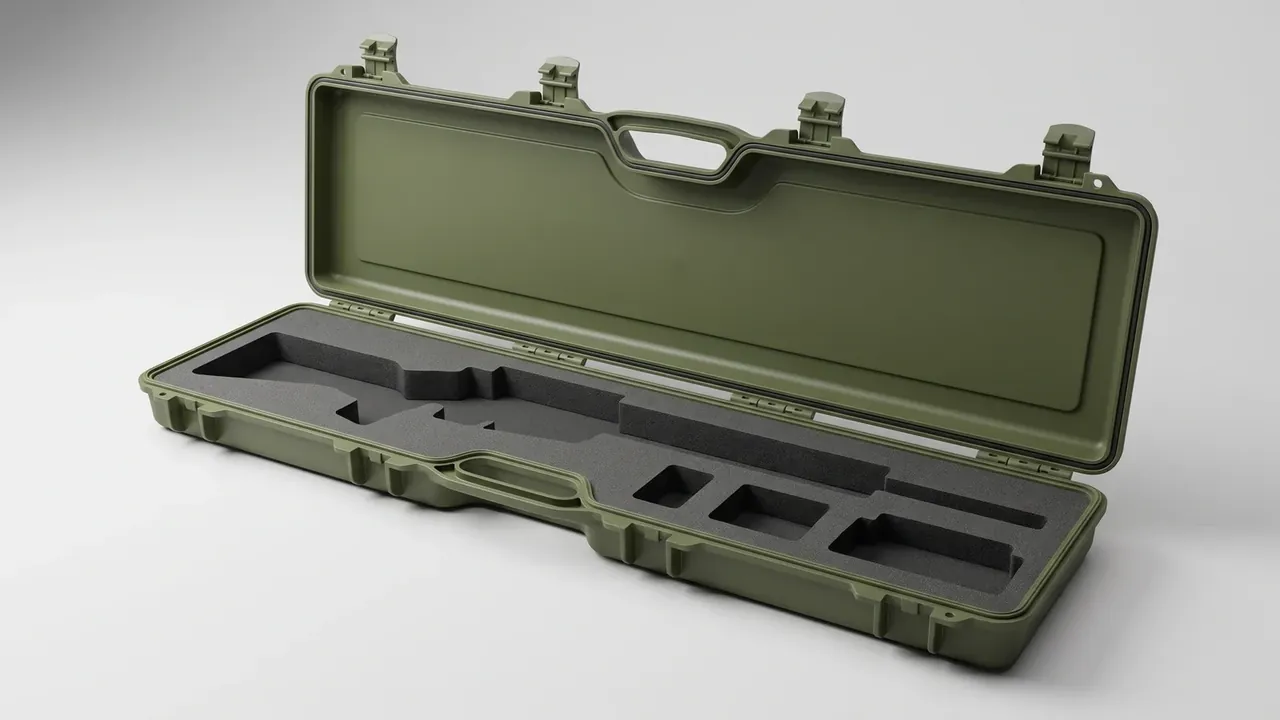
Quick answer: A tactical hard case rests on five points: shell molding and wall thickness, corner buffering, sealing and relief, latches and hinges, internal fixing and dividers. Each maps to a failure path checkable before a tool is cut.
Table of contents
- Tactical Hard Case Structure and Five Checkpoints
- Shell Molding and Wall Thickness
- Corner Buffering and Lid Fit
- Sealing, Pressure Relief and Latches
- Hinges, Internal Fixing and Dividers
- FAQ
1. Tactical Hard Case Structure and Five Checkpoints
Structure is a set of failure paths: a drop breaks the corners, stacking collapses the lid, storage leaks at the gasket, opening wears the hinge.
A tactical hard case is built two ways: injection molding of PP or PC alloy near a 90 second cycle, or rotational molding of PE powder at 4.5 to 6 mm walls.
| Checkpoint | What to look at | Common deviation |
|---|---|---|
| Molding and walls | wall, rim, corner thickness | 3.2 mm wall, 5.0 mm corner |
| Corner buffering | outer radius, radial ribs | square corners, edge cracks |
| Sealing and relief | groove width, valve pressure | tight seal, no valve |
| Latches and hinges | over-centre lock, pin material | latch holds, hinge loosens |
| Fixing and dividers | insert density, slot pitch | soft insert, load shifts |
The five are linked, so changing one moves the others.
2. Shell Molding and Wall Thickness
Wall thickness on a tactical hard case is a distribution, not a number: 3.2 mm at the side wall, 3.5 mm on the lid, 4.5 mm at the rim, 5.0 mm at the corner, so impact travels from lid to rim to corner.
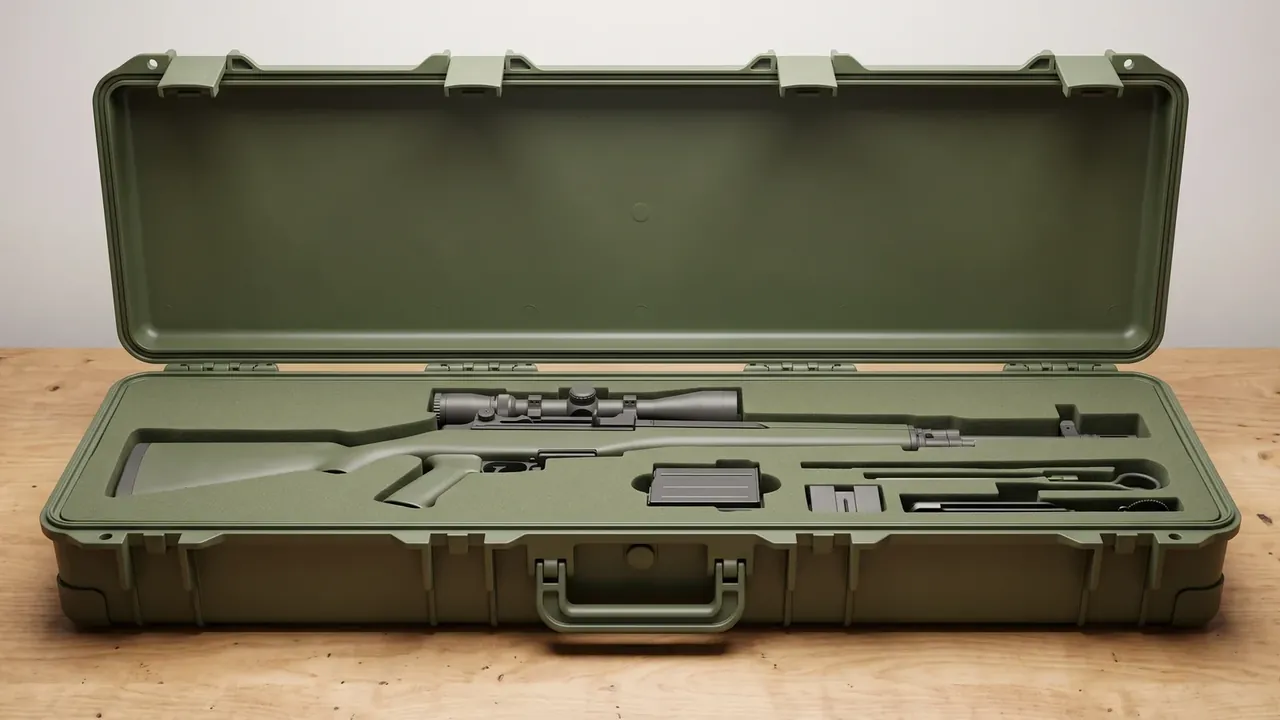
Transition matters more than absolute value: keep the change under 0.5 mm per 10 mm at a 1:3 taper, since a step leaves sink marks outside and a weld line inside, and a drop opens along it. Ribs run 10 mm high with R1.5 roots.
Rotomolded walls depend on powder charge and mold temperature: a 280 °C oven for 18 minutes is common, and a 15 °C spread leaves 0.8 mm of variation.
Injection windows are narrow too: at 230 °C melt and 40 °C mold a 90 second cycle is stable, while a 30 °C mold stretches it to 105 seconds or the rim distorts.
3. Corner Buffering and Lid Fit
Corners take the first hit. An external cap is toughest but adds an assembly step; radial ribs are cheapest in tooling with eight ribs spreading impact; a double-wall corner is heaviest.
| Corner option | Structure | Best for | Cost |
|---|---|---|---|
| External cap | separate part over three faces | frequent handling | assembly and spares |
| Radial ribs | eight ribs from the corner | medium and large cases | mold machining |
| Double wall | shell with a gap | heavy long-haul loads | weight, cycle time |
Give the radius room: at R25 edge stress concentration drops sharply, while below R8 cracks start at the tip. A double tongue 6 mm deep with a 3 mm step holds offset within 0.5 mm.
4. Sealing, Pressure Relief and Latches
Sealing on a tactical hard case depends on compression, not on soft rubber: an EPDM hollow O-profile in a 5.5 mm groove compresses 30 percent, and the range is rated from -30 °C to 60 °C. Too little leaks; too much fatigues it.
The better the seal, the more relief matters: temperature swings build up to 0.35 bar, and without a valve the latches and hinges absorb that force. A silicone disc vents at that pressure and closes on its own.
| Part | Key figure | Failure mode |
|---|---|---|
| Gasket | 5.5 mm groove, 30% compression | flattened profile, rim leaks |
| Relief valve | 0.35 bar cracking pressure | hard opening, gasket rolled |
| Latch | 90 kg holding force, 30 to 45 N | worn point, lid pops |
Latches are over-centre devices, so vibration cannot shake them loose; one holds 90 kg, opens at 30 to 45 N, with 300 mm spacing.
5. Hinges, Internal Fixing and Dividers
Hinge life sets the cycle count: the seat is molded in, the pin is Ø4 mm stainless, and bench testing runs 5000 cycles before clearance passes 0.8 mm.
Internal fixing controls movement, not appearance. On a tactical hard case, EVA at 30 kg/m³ suits light loads and PE at 45 kg/m³ heavy ones, held by 2 mm interference; dividers use 8 mm PP sheet on a 25 mm pitch.
Conclusion
The five points form one chain: wall distribution sets what the corner absorbs, corner and lid fit decide whether the gasket holds, the seal demands relief, latches and hinges carry the wear, and dividers set the changeover cost. Aligned, they make the durability of a tactical hard case designed in rather than inspected in.
This article discusses only the container (case body) side of specifications and design intent, and does not cover any handling, loading or use of the contents.
Related Reading
- Injection molding a protective case
- Wall thickness and tooling in rotomolding
- Internal divider structures
- Cutting and fitting foam inserts
Related Products
- 8 Series — Gun Cases; Military Equipment Cases; Camera Equipment Cases; Drone Cases; Watch Cases; Knife Cases; First Aid Cases; Electronics Equipment Cases
- WL8-2812 PP Gun Case — model WL8-2812
- All protective cases and toolboxes: 7 series, 158 models