

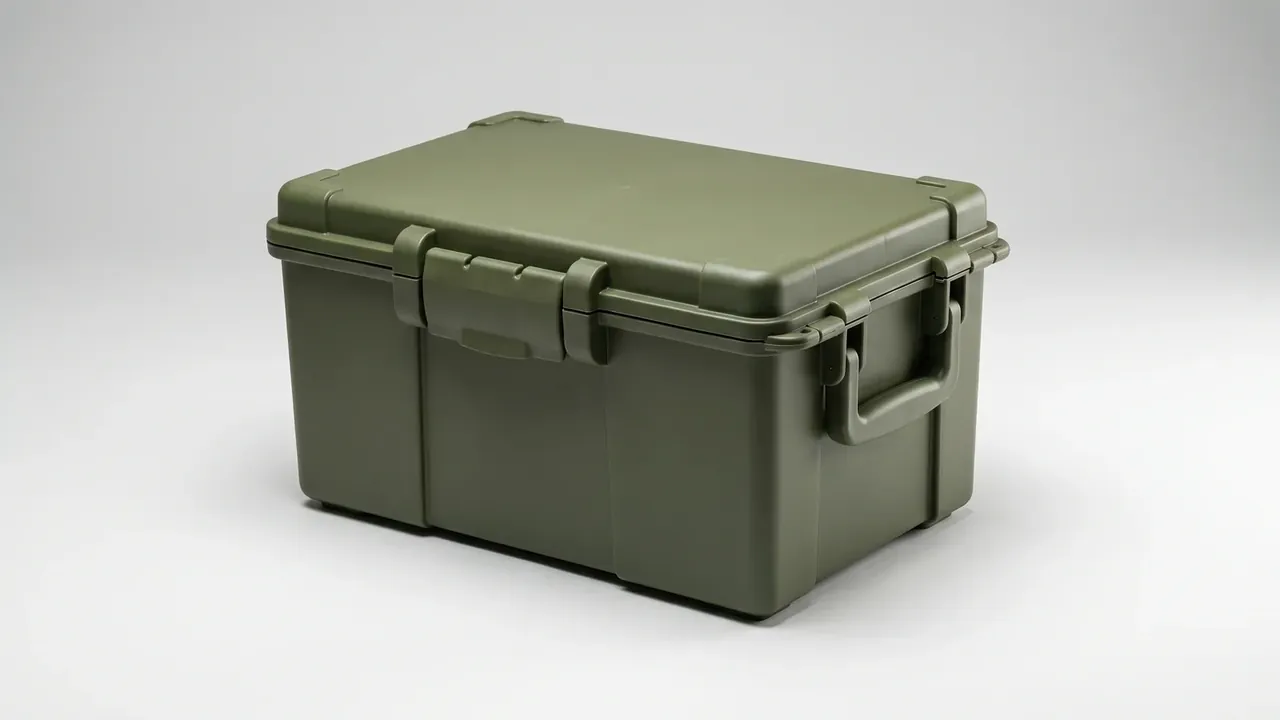
Quick answer: Upkeep on a tactical hard case is scheduled, not reactive. Measure latch closing force, seal compression set, hinge pin diameter and valve cracking pressure at shift, 30 day, 90 day and 12 month intervals, then replace any part past its limit.
Table of contents
- Inspection Cycles for a Tactical Hard Case
- Seal and Relief Valve Condition
- Latch and Hinge Pin Wear
- When the Foam Insert Has to Go
- Cleaning, Salt Spray Recovery, Spares
- FAQ
1. Inspection Cycles for a Tactical Hard Case
Servicing a tactical hard case means turning a feeling into a number. Each one leaves the mould with baselines for latch force, seal compression and valve pressure, so maintenance is subtraction until a reading reaches the limit. Waiting for visible damage misses the early signal: a latch that no longer preloads the lid.
Four intervals divide the work: shell each 8 hour shift, closing force and pin diameter at 30 days, seal and valve calibration at 90 days, salt spray and insert rebound at 12 months.
| Interval | Checked | Tool |
|---|---|---|
| 8 hours | Shell, rivets, latch seating | Eyes and hands |
| 30 days | Closing force, pin diameter | Pull gauge, micrometer |
| 90 days | Seal set, valve pressure | Caliper, differential gauge |
| 12 months | Salt spray, insert rebound | Salt chamber, durometer |
Log three numbers per case. If three of a hundred cross a limit in a quarter, the cause sits in the mould run or assembly torque.
2. Seal and Relief Valve Condition
On a tactical hard case the gasket ages first. EPDM or silicone sits at Shore A 65 to 75; harder rubber will not bed down, softer rubber extrudes. A new seal returns to 95 percent of its thickness after 24 hours under a closed lid.
Replace at 0.8 mm indentation, 25 percent permanent set or 0.5 mm corner mismatch, and never splice a patch into the loop; salt fog finds that seam within months. The valve cracks at 0.35 bar, and drift beyond 0.10 bar means a tired spring, so swap it whole and refit at 1.2 N·m.
3. Latch and Hinge Pin Wear
Closing force leads sealing. The baseline is 180 N on a pull gauge along the latch centreline; below 90 N the lid no longer compresses the gasket and a rain test will pass water. The loss shows up a quarter before staining does.
Hinge pins hide at the back. They run 6.0 mm nominal, replaced at 5.7 mm, measured at both ends where the pin meets the lug, since a worn pin lets the lid rock.
| Item | Baseline | Replace at | Method |
|---|---|---|---|
| Latch closing force | 180 N | below 90 N | Pull gauge |
| Hinge pin | 6.0 mm | under 5.7 mm | Micrometer |
| Seal indentation | 0.5 mm | over 0.8 mm | Caliper |
| Valve cracking | 0.35 bar | drift 0.10 bar | Differential gauge |
| Wall crack | none | over 10 mm | Dye penetrant |
A hairline on a flat panel can be checked with penetrant and sanded back. The same crack at a corner rib or handle boss condemns the case, since a patch reopens within a few dozen trips.
4. When the Foam Insert Has to Go
Inside a tactical hard case the insert locates the load and absorbs shock; once it collapses a flawless shell protects nothing. EVA at 45 kg/m³ is the common choice: it cuts cleanly and resists long compression.
Replace the base layer when 30 mm foam reads 24 mm after two hours at rest, and the lid foam when a third of the peaks are flat. Chalky, shedding EVA must go too, since crumbs migrate into the latch track. Cut 2 mm undersize per side and keep lid lift under 1 mm.
5. Cleaning, Salt Spray Recovery, Spares
Wash with pH 6 to 8 neutral detergent, a soft brush and water under 40 °C, working the lid groove, latch track and hinge root, then blow the seams dry within 30 minutes. Acetone and xylene swell the gasket.
A tactical hard case that travels coastally takes a 96 hour neutral salt spray recheck every 6 months. White rust on springs and pins is repairable: rinse the salt off, dry, grease thinly, verify with a 24 hour run inside 48 hours.
Keep per 100 cases: 8 latch sets, 10 pins, 12 seals, 6 valves, 6 inserts. Fit latches and pins first, then the seal, then clean and dry, and refit M5 stainless screws at 3.5 N·m as single use items.
Conclusion
Upkeep turns a purchase into a predictable rhythm: four intervals, five replacement limits, one spare parts count. The only decision that needs nerve is swapping a part when a reading crosses the line, and that habit keeps a tactical hard case sealing like new.
This article discusses only the container (case body) side of specifications and design intent, and does not cover any handling, loading or use of the contents.
Related Reading
- Choosing a tactical hard case: five criteria
- Sealing standards of a waterproof hard case
- Rotomolded case upkeep: failures and fixes
- Preventing damage during case storage
Related Products
- 8 Series — Gun Cases; Military Equipment Cases; Camera Equipment Cases; Drone Cases; Watch Cases; Knife Cases; First Aid Cases; Electronics Equipment Cases
- WL8-2812 PP Gun Case — model WL8-2812
- All protective cases and toolboxes: 7 series, 158 models