

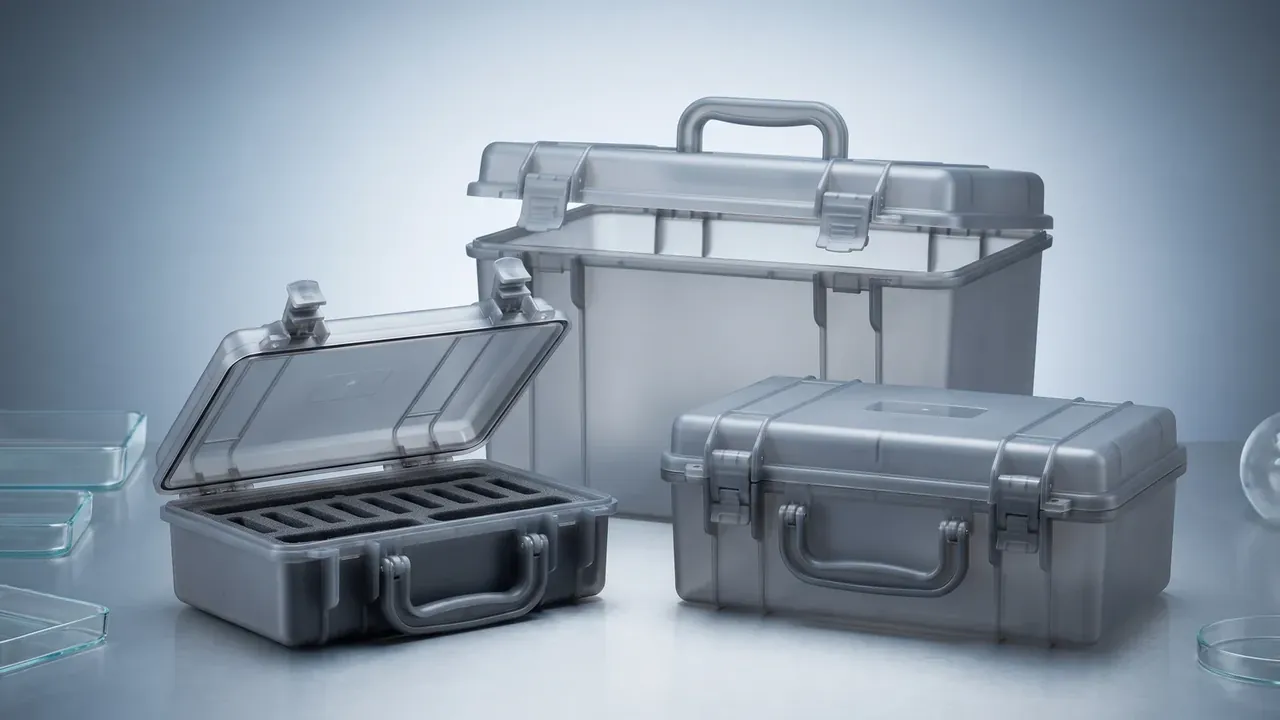
Quick answer: Build a tactical hard case specification backwards from the cavity: largest item plus 10 mm, an envelope from a 4.5 mm wall and 14 mm ribs, then a 45 kg load, five-high stacking and a 0.15 to 0.25 bar relief setting.
Table of contents
- Tactical Hard Case Specifications Start With Internal Volume
- Wall Thickness and Rib Layout
- Load Rating, Stacking and Handle Strength
- Sealing and Pressure Relief Values
- Latch Count and Insert Thickness
- FAQ
1. Tactical Hard Case Specifications Start With Internal Volume
A tactical hard case specification starts at the cavity, not the envelope. Users measure the largest item that must fit, so the cavity carries 10 mm clearance per axis and R6 corners; a 520 x 390 x 195 mm cavity holds 39.5 litres.
The envelope follows: a 4.5 mm wall, a 5.5 mm lid and 27.5 mm per side give 575 x 445 x 230 mm. Specify only the outside and a supplier's own thickness split will eat 8 to 12 mm of cavity.
| Item | Value |
|---|---|
| Cavity | 520 x 390 x 195 mm |
| Envelope | 575 x 445 x 230 mm |
| Volume | 39.5 litres |
| Empty weight | 6.8 kg |
At 60 mm lid depth there is 45 mm of clear space above the 15 mm foam; at 40 mm the egg crate reaches only 12 mm peaks.
2. Wall Thickness and Rib Layout
Wall thickness means little without its ribs. A 4.5 mm wall with 3.5 mm thick, 14 mm deep vertical ribs at 90 mm pitch gives about 2.4 times the section modulus of a flat panel for 12 percent more weight.
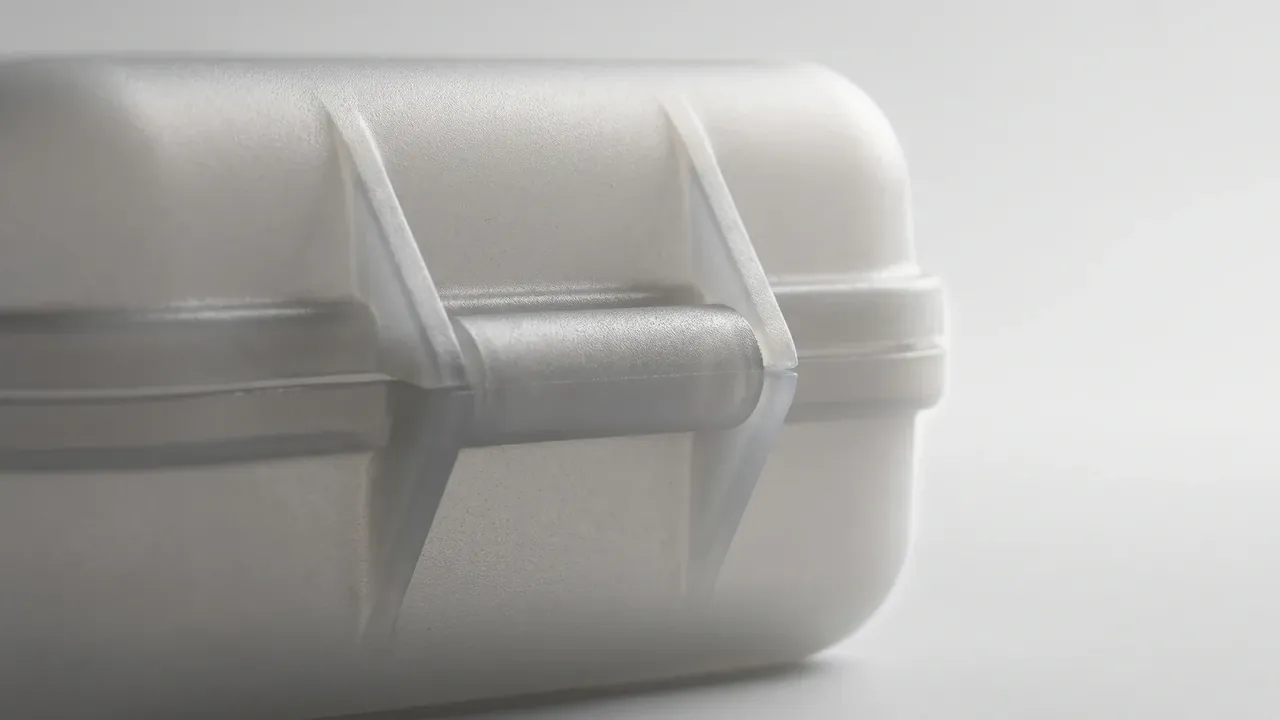
Vertical ribs carry stacking load into the floor, horizontal ribs only stiffen locally. Use R3 at the rib root, R10 outside and R6 inside with 1.5 degrees of draft. Keep the lid within 1 mm of wall thickness, since a thin lid shifts seal compression by 0.2 mm day to night.
3. Load Rating, Stacking and Handle Strength
Rate load as distributed, never as a maximum. 45 kg suits 39.5 litres at a fill density near 1.14, and the sheet should name distributed and concentrated loading separately.
Stacking is a layer count plus a factor. Five loaded layers put 265 kg on the bottom case, and a factor of 3 sets the design value at 800 kg, proven by 72 hours of constant load with lid seam sink under 0.5 mm.
| Item | Value | Condition |
|---|---|---|
| Rated load | 45 kg | Distributed |
| Handle load | 135 kg | 10 minutes |
| Stack | 5 layers | 265 kg bottom |
| Drop | 1.2 m | Six faces |
4. Sealing and Pressure Relief Values
IP67 is enough as a headline, but ask how it is reached. A 6 mm groove with a 7 mm cord gives 25 to 30 percent compression; under 20 percent the case leaks in a 1 m, 30 minute immersion, and over 35 percent the gasket takes a set and stops recovering.
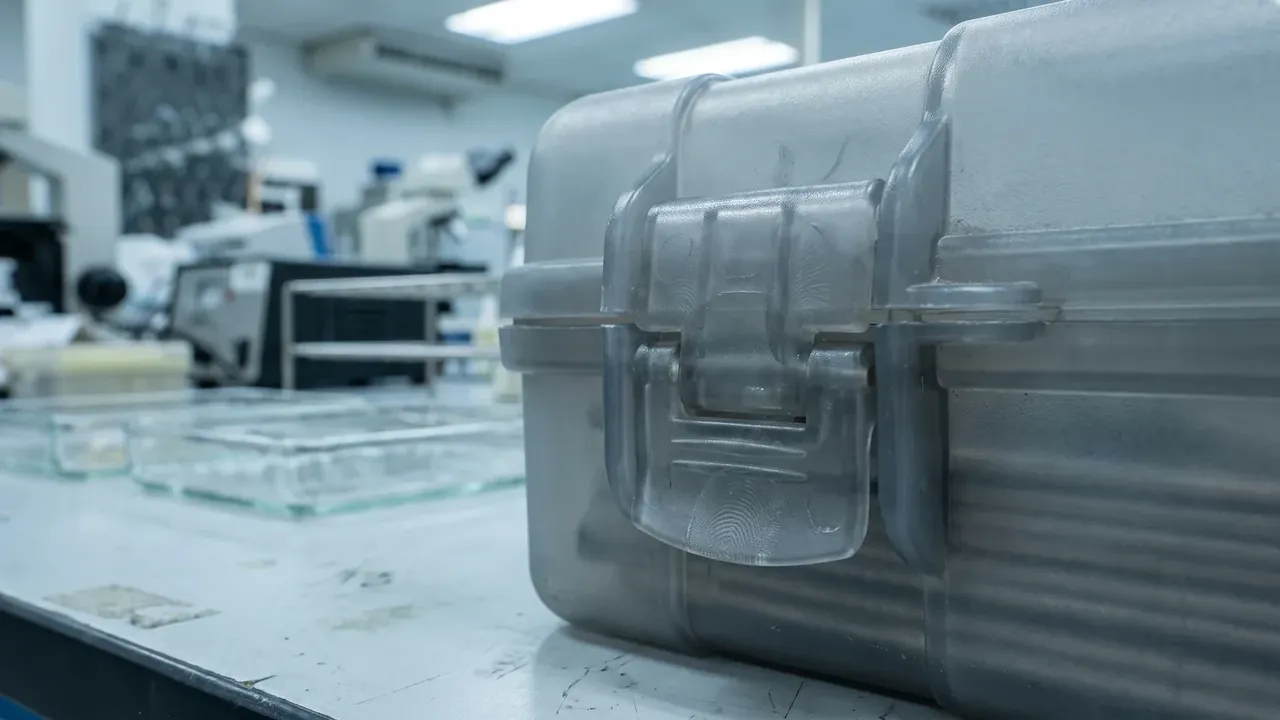
Specify the relief valve with the seal, because the two fight. A tactical hard case valve cracks at 0.15 to 0.25 bar, or 15 to 25 kPa; higher lifts the gasket, lower chatters on rough roads. Silicone suits the -30 °C end better than EPDM.
5. Latch Count and Insert Thickness
Latch count tracks the long side: two centre latches to 600 mm, four from 600 to 900 mm, six beyond. Each is rated 250 N, so a pair gives 500 N against the seal reaction of a 39.5 litre box; fall short and the seam gapes at mid span.
Inserts run two layers: a 25 mm base of 55 kg/m³ EVA locates the load, a 15 mm egg crate with 12 mm peaks holds it down; 38 kg/m³ PU feels softer but rebounds slower.
| Configuration | Value |
|---|---|
| Centre latches | 2, under 600 mm |
| Four latches | 4, 600 to 900 mm |
| Latch force | 250 N each |
| Base insert | EVA 55 kg/m³, 25 mm |
| Lid foam | 15 mm, 12 mm peaks |
Insert total should sit 3 to 5 mm under cavity height for preload; exceed it and the latches never reach over-centre.
Conclusion
Specifications for a tactical hard case are a chain rather than a list: cavity sets clearance, wall sets rib pitch, load sets the safety factor, sealing sets the relief valve, and latches plus insert close the loop on volume. Written as a chain, quotations compare and inspection has something to measure, which is how a tactical hard case keeps its numbers.
This article discusses only the container (case body) side of specifications and design intent, and does not cover any handling, loading or use of the contents.
Related Reading
- Sizing a protective case: cavity versus envelope
- Sealing standards of a waterproof hard case
- Specification values for custom foam inserts
- Stacking and tie-down rules for air transport cases
Related Products
- 8 Series — Gun Cases; Military Equipment Cases; Camera Equipment Cases; Drone Cases; Watch Cases; Knife Cases; First Aid Cases; Electronics Equipment Cases
- WL8-2812 PP Gun Case — model WL8-2812
- All protective cases and toolboxes: 7 series, 158 models