

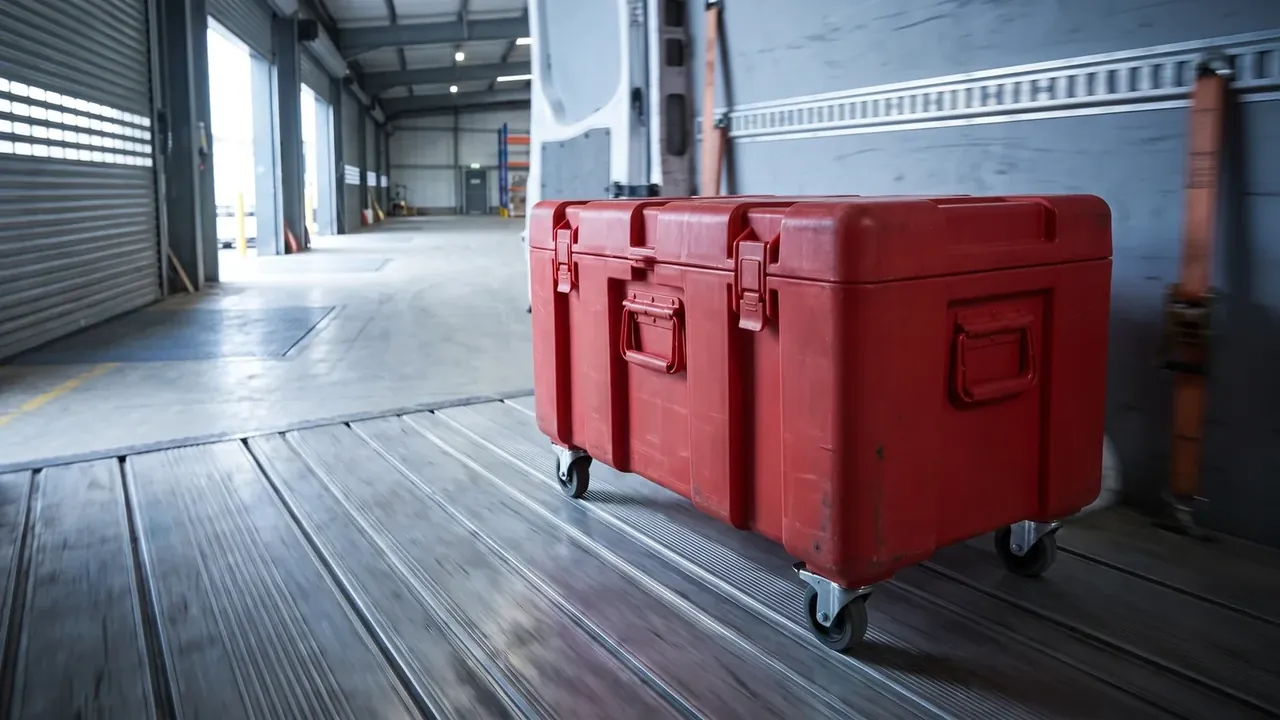
Quick answer: A tool bag specification is three chains that must agree: the dimension chain from envelope to cavity, wall and ribs that set stiffness, and rated load that works back into handle hardware.
Table of contents
- Where a Tool Bag Specification Starts: The Dimension Chain
- Wall Thickness and Material Build
- Working Back From Load to the Handle
- Tolerances and the Gauges That Check Them
- Writing the Spec Sheet Without Mismatches
- FAQ
1. Where a Tool Bag Specification Starts: The Dimension Chain
A tool bag specification grows outward from the cavity. On a 460 × 360 × 220 mm body with 3.0 mm walls and 1.2 mm draft, the cavity reads 451.6 × 351.6 × 211.6 mm, and volume falls from 36.4 L to 33.6 L.
| Link | Value | Note |
|---|---|---|
| Envelope | 460 × 360 × 220 mm | Maximum outline |
| Single wall | 3.0 mm | Nominal shell |
| Draft | 1.2 mm | Per side |
| Cavity | 451.6 × 351.6 × 211.6 mm | Envelope less walls |
| Usable space | 421.6 × 321.6 × 181.6 mm | Cavity less liners |
Two 15 mm foam layers take 30 mm more; four 50 mm casters lift the body to 285 mm, past a 300 mm shelf pitch.
2. Wall Thickness and Material Build
Thicker is not better. A 2.6 mm shell whitens at the corners after a 1.2 m drop, 3.0 mm is the working grade, and 3.4 mm belongs at the base. Each extra 0.4 mm adds 13 percent weight and 8 s of cooling, moving the cycle from 62 s to 70 s.
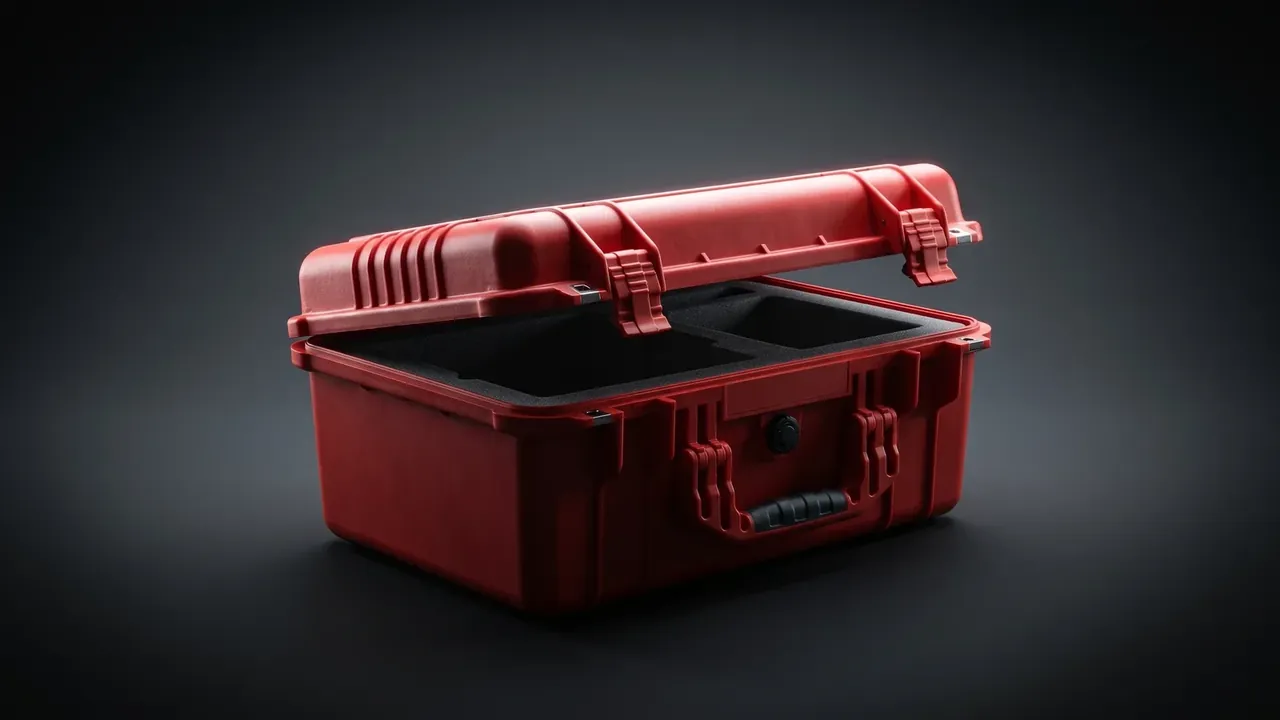
Ribs beat thickness. At 1.8 mm thick, 9 mm high and 55 mm pitch, section modulus rises 2.4 times for 6 percent more weight. Polypropylene with 20 percent talc shrinks 1.5 percent; 10 percent glass fibre lifts modulus from 1 500 to 2 300 MPa but drops notched impact to 6 kJ/m².
3. Working Back From Load to the Handle
Rated load comes first. A 25 kg tool bag at a safety factor of 4 gives 980 N. A φ8 mm pin at each end offers 50.3 mm²; at 8 MPa each carries 402 N, so the pair gives 804 N and falls 176 N short. At φ10 mm the pair reaches 1 256 N.
| Check | Expression | Result |
|---|---|---|
| Design load | 25 kg × 4 | 980 N |
| Two φ8 pins | 50.3 mm² × 8 MPa × 2 | 804 N, short |
| Two φ10 pins | 78.5 mm² × 8 MPa × 2 | 1 256 N, passes |
| Stacking | 3 × 18 kg | 54 kg |
The handle also bends: a 45 mm grip offset turns 25 kg into 11 N·m, or 18 MPa at a 3.0 mm root, which a 2 mm boss ring halves.
4. Tolerances and the Gauges That Check Them
Cavity takes ±1.0 mm, envelope ±1.5 mm, the lid joint ±0.5 mm and flatness 0.6 mm, because a 0.3 mm spread between cavities is ordinary shrinkage. A 0.02 mm caliper reads the envelope, a coordinate machine reads 8 points per unit, and a plug gauge 2 mm under nominal rejects an oversize cavity in 15 s.
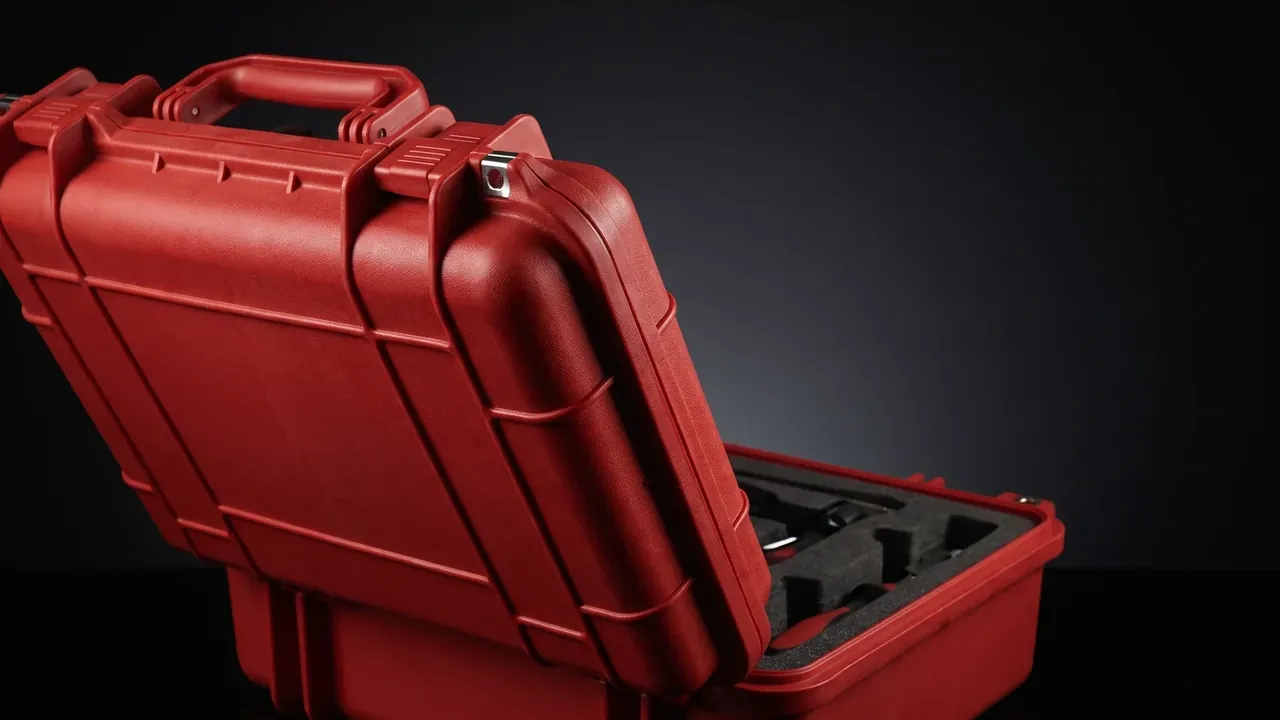
Gauge repeatability stays under 10 percent. Wall thickness comes from 5 ultrasonic points 80 mm apart, since rib roots read 2.4 mm rather than the nominal 3.0 mm.
5. Writing the Spec Sheet Without Mismatches
Seven fields carry a tool bag spec sheet: envelope, cavity, wall and ribs, rated load, handle hardware, sealing, tolerances and gauges.
| Field | Sound wording | Common error | Consequence |
|---|---|---|---|
| Cavity | 451.6 × 351.6 × 211.6 mm | Envelope only | Liner will not seat |
| Wall | 3.0 mm ±0.2 mm, ribs 1.8 mm | About 3 mm | Quoted at 2.6 mm |
| Load | 25 kg vertical lift, factor 4 | 25 kg alone | Handle sized at 1.5× |
| Tolerance | Cavity ±1.0 mm, flatness 0.6 mm | Per national standard | Two rulers |
The commonest error quotes the envelope as a cavity; the second writes about 3 mm, so the shop plans 2.6 mm and ships 90 g light. The third omits load direction, doubling the moment in a sideways drag.
Conclusion
The dimension chain turns an envelope into a cavity, wall and ribs put stiffness where load arrives, and the load calculation settles the hardware. Ten millimetres lost in the cavity is repaid later. A tool bag derived from its dimension chain is the one whose quotation matches the sample.
This article discusses only the container (case body) side of specifications and design intent, and does not cover any handling, loading or use of the contents.
Related Reading
- Tool bag versus hard case by scenario
- How to configure a handle and shoulder strap
- Structure of a tool roll
- How protective case size bands are drawn
Related Products
- 8 Series — Gun Cases; Military Equipment Cases; Camera Equipment Cases; Drone Cases; Watch Cases; Knife Cases; First Aid Cases; Electronics Equipment Cases
- WL8-2812 PP Gun Case — model WL8-2812
- All protective cases and toolboxes: 7 series, 158 models