

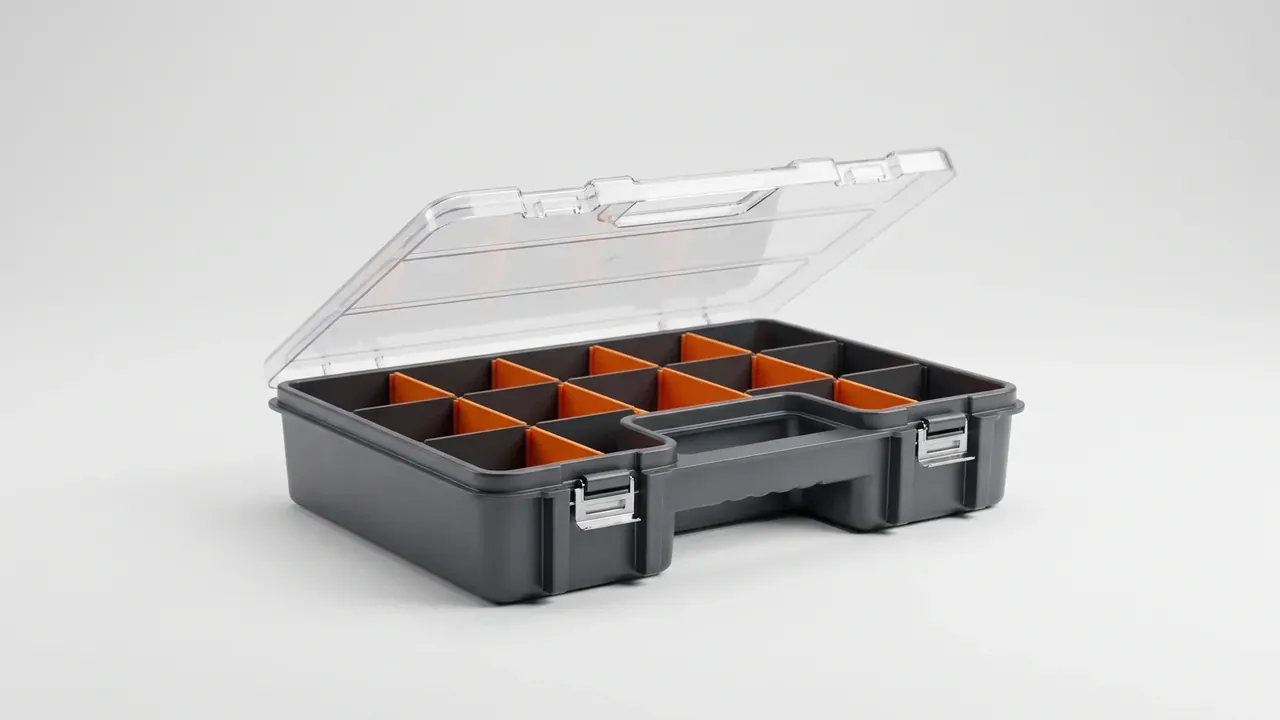
Quick answer: Judge a tool box cover on three hard points first — fit clearance against the box, wall thickness with rib layout, and where the latches and hinge carry load. Then match material and protection rating to the environment, and confirm tolerances with a small pilot batch.
Table of contents
- Sizing a Tool Box Cover Starts at the Box
- Material and Wall Thickness Trade-offs
- Latch and Hinge Fit
- Protection Rating Against the Environment
- Budget Split and a Small Pilot
- FAQ
1. Sizing a Tool Box Cover Starts at the Box
The first step is not colour, it is the box. On a 520×360×230 mm body, a 3 mm clearance per side sits well; beyond 5 mm the cover shifts in transit and wears the rim.
Measure three things: maximum outer length, width and height; step depth on the mating face; and centre distance between latch holes. Take the largest of three readings, since moulded parts carry 1 to 2 mm of draft and a midpoint reads small.
| Item | Instrument | Pass criterion |
|---|---|---|
| Outer length, width, height | Tape and square, three points | Within 2 mm of drawing |
| Mating step depth | Depth gauge | 4 to 6 mm; shallower lifts at the rim |
| Latch hole centre distance | Vernier caliper | Symmetry within 0.5 mm |
The mating face is the step most often skipped: flat-on-flat, the joint walks out after half a day on a truck; a 4 to 6 mm step makes the cover bite the rim.
Corner radius counts too. A box with R10 corners holds a square cover off the bottom; allow 1.5 mm at each opening corner.
2. Material and Wall Thickness Trade-offs
Material choice divides impact resistance, weathering and weight. Moulded polypropylene is the default: 2.2 mm suits indoor storage, 3.0 mm survives vehicle vibration. ABS is harder but brittle in cold.
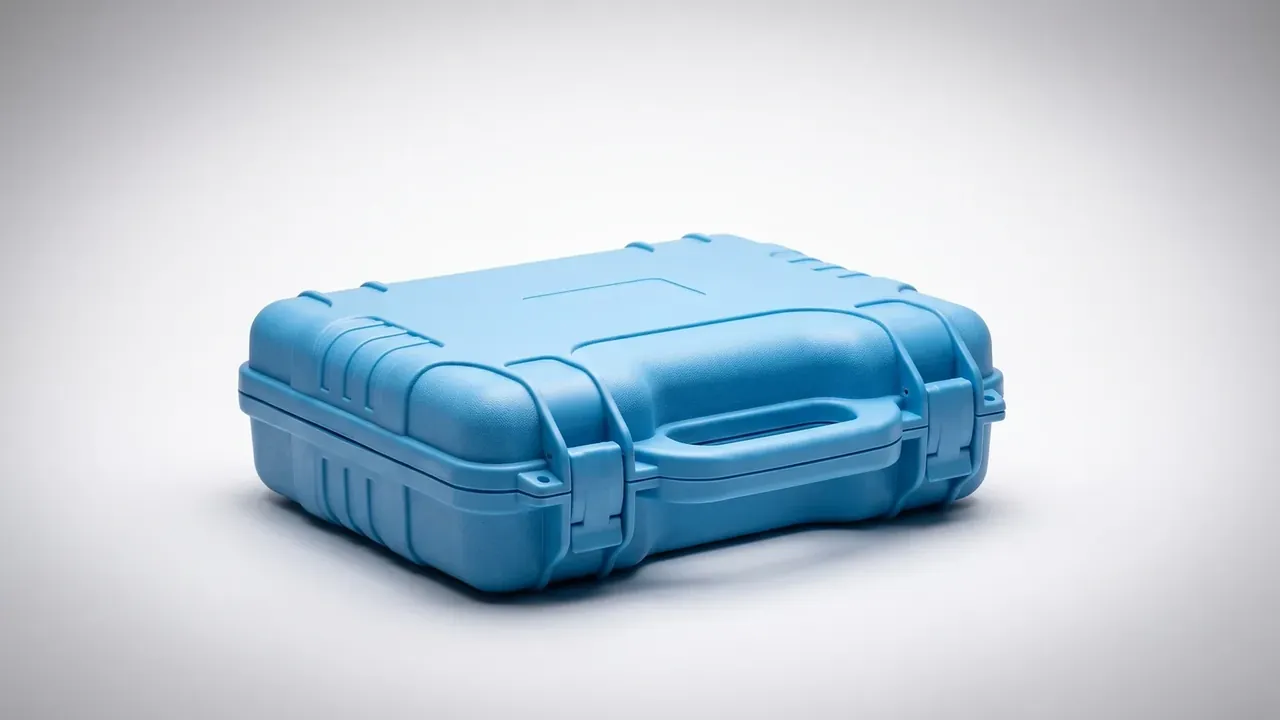
Ribs matter more than thickness. At 60 mm spacing and 8 mm height they stiffen the top better than extra wall and save about 15 percent in weight. Field test: fit the cover, press both hands into the top corners, listen for a dull thud.
| Material | Typical wall | Working range | Trade-off |
|---|---|---|---|
| Moulded PP | 2.2–3.0 mm | -20 to 60 °C | Tough and cheap, moderate weathering |
| ABS | 2.0–2.5 mm | -10 to 70 °C | Hard and presentable, brittle when cold |
| Laminated EVA | 5–8 mm | -15 to 55 °C | Light, but creeps under load |
3. Latch and Hinge Fit
Whether a cover stays on is mostly a latch question: 2 mm of preload when closed, a pin of at least 8 mm, under 10 percent force difference between latches.
On the hinge side, hinge axes within 0.5 mm open smoothly, and the joint should stay free of play after 5000 cycles. During sampling, work a cover 200 times, then feel the barrel for heat and dust.
Latch material needs its own question. Nylon beats acetal in cold, while metal pulls harder but rusts within three months near the coast.
4. Protection Rating Against the Environment
A higher rating is not automatically better; it has to match the site. Sheltered racking needs dust protection, open yards rain and UV resistance, coastal sites salt spray performance.
| Environment | Suggested protection | Key features |
|---|---|---|
| Indoor racking | Dust protection | Mating step with a dust lip |
| Outdoor yard | IP54 or better | Drain channel, two latches, 500 h UV |
| Coastal or chemical | IP65 or better | Stainless pins, 72 h salt spray |
Drainage is routinely forgotten. Slope an outdoor cover 1 to 2 degrees with a 3 mm channel at the front edge, and use closed-cell gasket, since open-cell foam becomes a reservoir.
Cold belongs in the same check: at -20 °C ordinary polypropylene loses about half its impact strength, so ask for low-temperature data.
5. Budget Split and a Small Pilot
Split the budget 60 / 25 / 15: six tenths on the cover, a quarter on latches and hinge, the rest on packing. Squeeze the hardware and the latch breaks first.
A pilot needs no volume — 200 pieces complete one cycle. Number each sample, log closing counts, drops and sun exposure, then check fit at week one, transport shift at week three, feedback at week six.
Conclusion
Measure the box before choosing the cover, or the mould gets revised twice. Run the five tests in order — size, material, latch and hinge, protection, budget — and most arguments end at the drawing stage. Fit accuracy decides the life of a tool box cover more than price.
This article discusses only the container (case body) side of specifications and design intent, and does not cover any handling, loading or use of the contents.
Related Reading
- How a tool box cover is built
- Comparing tool box cover materials
- How a tool box lid differs
- Selection points for tool carriers
Related Products
- 8 Series — Gun Cases; Military Equipment Cases; Camera Equipment Cases; Drone Cases; Watch Cases; Knife Cases; First Aid Cases; Electronics Equipment Cases
- WL8-2812 PP Gun Case — model WL8-2812
- All protective cases and toolboxes: 7 series, 158 models