

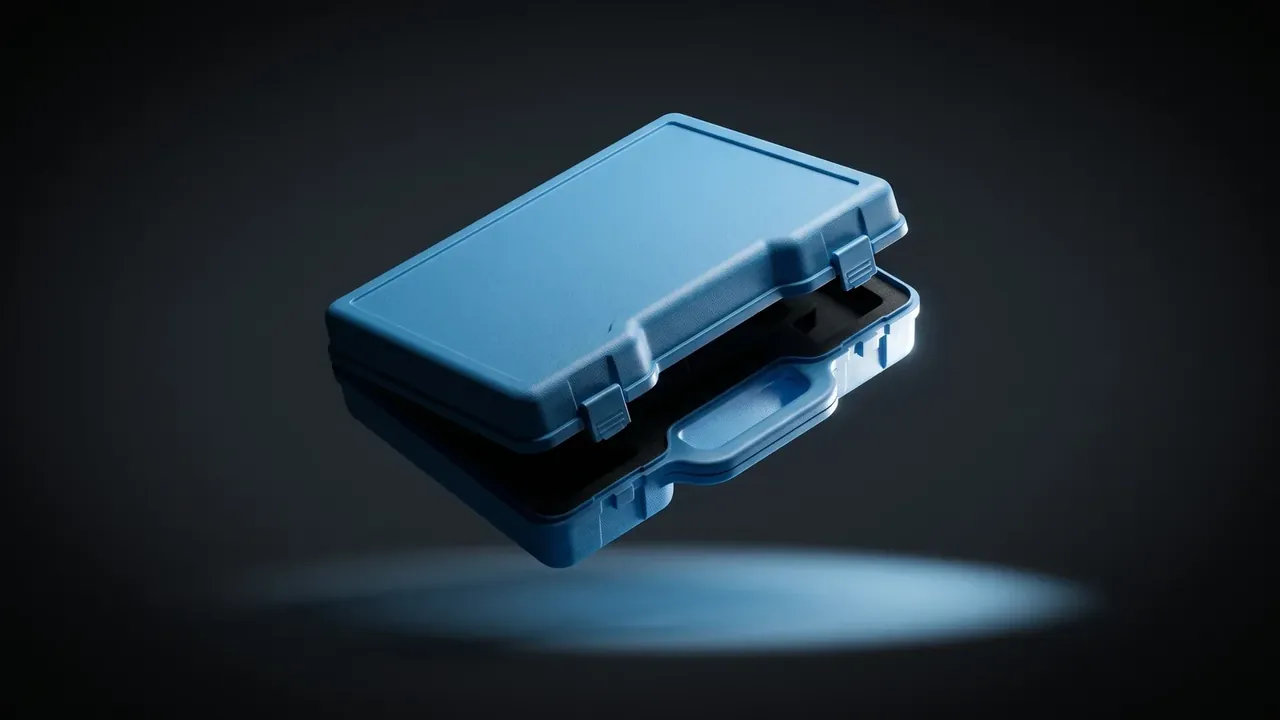
Quick answer: A tool box cover is specified through three chains: dimensions start at the case outline with 6 mm of clearance per side, wall thickness and tolerance govern folds and seams, and load comes from the top area and the lift points.
Table of contents
- Where the dimension chain starts
- Wall thickness and tolerance
- Calculating load: stacking and lifting
- Hardware and divider specifications
- Material grades and the tolerance table
- FAQ
1. Where the dimension chain starts
Measure from the case outline, never the cover face. The height chain splits into crown rise and skirt drop: rise sends rain one way, drop sets how far dust travels.
| Chain | From and to | Formula | 600 x 400 x 340 case |
|---|---|---|---|
| Length | Outline to inner face | Case plus two gaps | 612 mm |
| Width | Outline to inner face | Case plus two gaps | 412 mm |
| Height | Base to inner top | Case plus top gap | 352 mm |
| Skirt drop | Top face to hem | Ground clearance | 90 mm |
| Crown rise | Low to high point | Drainage slope | 12 mm |
Six millimetres per side survives two constraints: corners wrap a 20 mm radius and wear through below 5 mm, while the wall flaps above 10. Diagonal mismatch matters too: a gap over 6 mm bunches one side and tightens the other.
2. Wall thickness and tolerance
A tool box cover carries no load, yet thickness needs a value, because folds resist stress through it. Coated cloth runs 0.55 mm, plus or minus 0.05, on a 0.30 mm base with 0.12 mm coating per face. Laminated PE weave runs 0.28 mm, plus or minus 0.03.
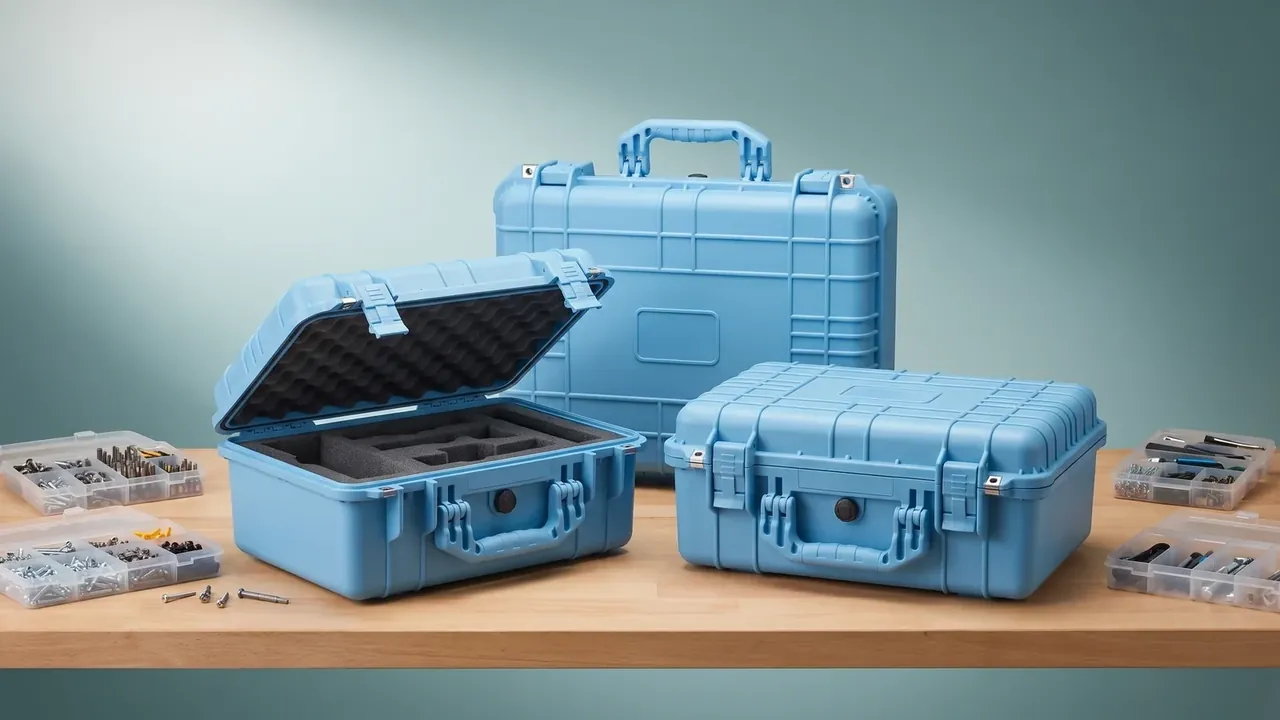
A folded hem is double at 1.1 mm and the needle crosses four layers, so use 210D three-ply polyester at four stitches per 3 cm; at six the holes become a leak path.
3. Calculating load: stacking and lifting
Load splits in two. Stacking: the top projects 0.24 square metres, two empty cases sit on it at 4.2 kg each, about 23 kg per square metre. Lifting: four points at 25 kg give 100 kg, and a factor of 3 leaves 33 kg.
| Case | Load | Criterion | Check |
|---|---|---|---|
| Stacking | 23 kg per square metre, 24 hours | Set under 2 mm | Centre deflection |
| Point load | 5 kg on 100 square cm | No puncture | Visual after an hour |
| Four-point lift | 25 kg per point, factor 3 | Movement under 3 mm | Load each point |
| Wind | 20 m per second | Wall stays on the case | Field or tunnel |
Set is read after a full day because coated cloth creeps, and past 2 mm the top dishes. Four points sit a fifth of the long edge in from each end.
4. Hardware and divider specifications
Specify 304 for the latch, 0.8 mm plate and 4 mm rivets; coastal sites move to 316, good for 480 hours of salt spray. Clearance is 0.5 mm, and a 3 mm pin in a 3.1 mm hole keeps salt from seizing it.
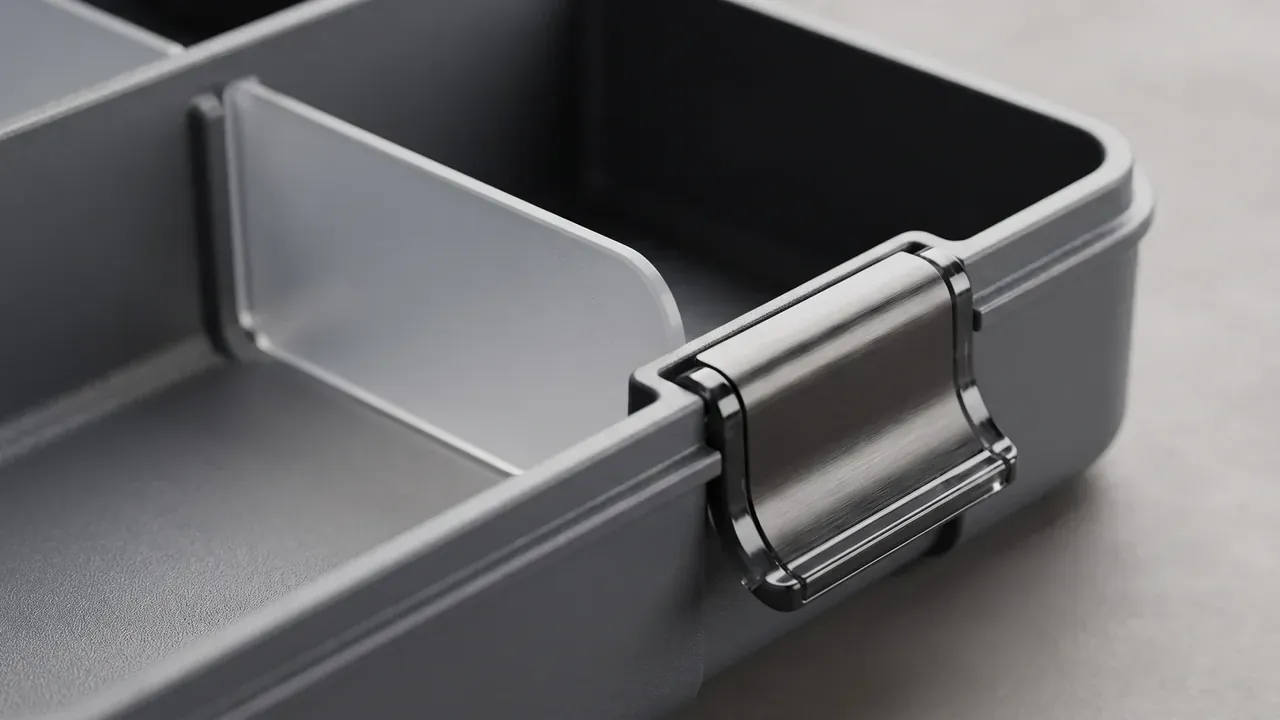
Dividers are 3 mm translucent PP in a 3.4 mm slot, 8 mm deep, standing 6 mm below interior height, edges rounded by 0.5 mm so the panel cannot score the wall. Verify tool box cover hardware at 200 newtons, the peak on a one-hand lift.
5. Material grades and the tolerance table
Name all three layers: 300D polyester oxford, PVC both faces, 480 g per square metre finished; or PE weave at 120 g with a 25 micrometre laminate.
Additives by percentage: light stabiliser 1.5, UV absorber 0.3, antioxidant 0.1. Under 2 percent total, and it decides two years outdoors or four.
| Item | Specification | Tolerance | Test |
|---|---|---|---|
| Base fabric | 300D polyester oxford | plus or minus 3 percent | Pick counter |
| Coating | PVC both faces | at least 0.12 mm | Micrometer |
| Weight | 480 g per square metre | plus or minus 5 percent | Sampled balance |
| Seam strength | 350 N per 50 mm minimum | never below the floor | Tensile machine |
| Temperature | minus 20 to 70 Celsius | not applicable | Climate chamber |
Close with sampling: 5 percent per batch, never under three pieces, with full dimensional inspection.
Conclusion
A tool box cover specification is three chains that restrain each other: dimensions decide fit, thickness decides life, load decides whether it can be stacked or lifted. As measurable numbers they make quotations comparable, and they are the whole specification of a tool box cover.
This article discusses only the container (case body) side of specifications and design intent, and does not cover any handling, loading or use of the contents.
Related Reading
- Where a tool box cover sits
- Comparing tool box cover materials
- Rotomoulding and case wall thickness
- How internal dividers are configured
Related Products
- 8 Series — Gun Cases; Military Equipment Cases; Camera Equipment Cases; Drone Cases; Watch Cases; Knife Cases; First Aid Cases; Electronics Equipment Cases
- WL8-2812 PP Gun Case — model WL8-2812
- All protective cases and toolboxes: 7 series, 158 models