


Quick answer: A tool box lid is judged on three counts: whether the mouth sheds rain once lifted, how much stacked load the panel carries, and how much hinge life survives daily openings. A drawer is quick to reach into but hates grit, an open tote seals nothing, and a lift-off lid needs somewhere to park the panel.
Table of contents
- How to Compare a Tool Box Lid with Four Alternatives
- Opening Type: Hinged, Drawer or Lift-Off
- Load and Stacking: What the Panel Takes
- Access Speed: Opening Area and Hand Motion
- Cost, Life and Where Each Option Stops
- FAQ
1. How to Compare a Tool Box Lid with Four Alternatives
Judge a tool box lid on four counts kept apart: opening type fixes where the operator stands, panel structure fixes stack height, action count fixes throughput, seal path keeps dust out.
| Form | Opening | Hand actions | Seal path |
|---|---|---|---|
| Integral hinged lid | rear swing, fan mouth | lift, reach | rim groove, gasket |
| Lift-off lid | corner lips, latched | lift off, reach | flat gasket, full loop |
| Drawer unit | horizontal slide | release, pull | cabinet gaps, open |
| Hinged lid with tray | lid swings, tray rides | lift, take from tray | rim groove, tray dry |
| Open tote | full open top | reach in | none |
At thirty openings a day the hinge passes forty-five thousand cycles in five years, so it fails before the body does.
2. Opening Type: Hinged, Drawer or Lift-Off
A tool box lid swings about one edge, so the operator works from one side. A drawer runs straight and needs three hundred and fifty millimetres of clear floor. A lift-off lid opens to the full rim but needs a home once off.
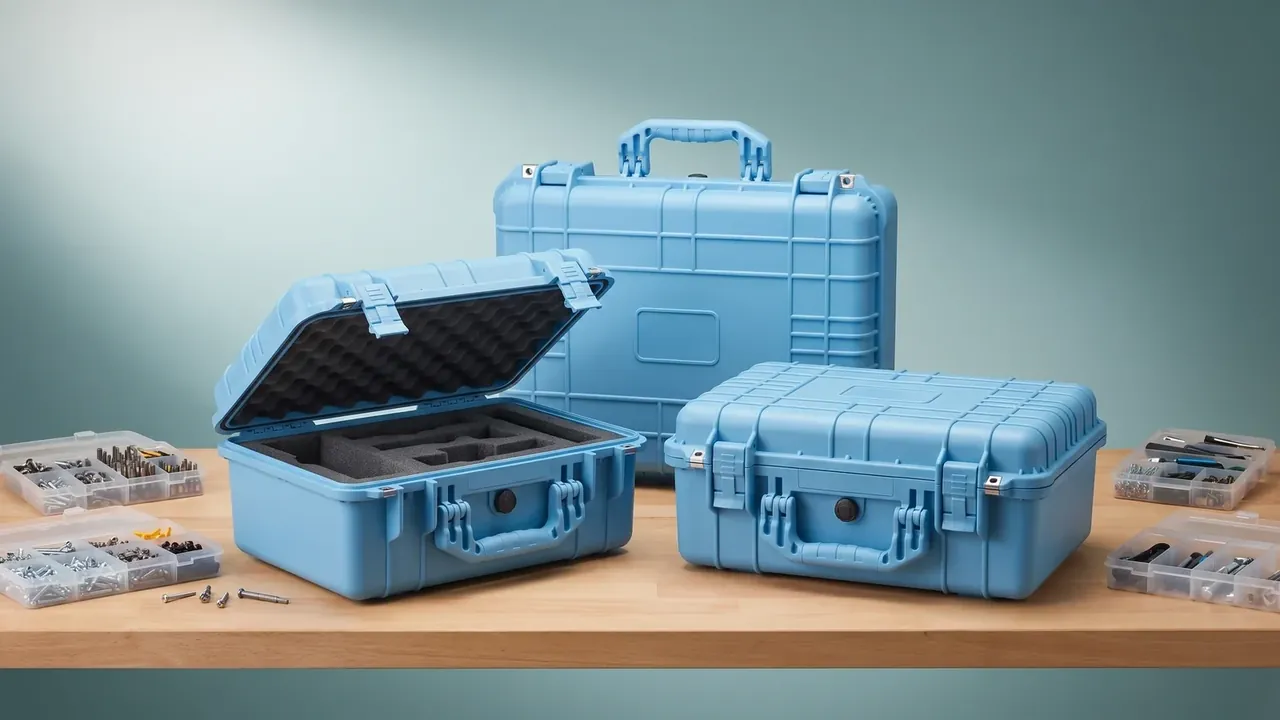
Clear opening is smaller than the rim: at ninety degrees it falls to sixty or seventy percent of the mouth, blocked by the lid root. Two boxes rated forty litres feel alike with flat contents but the hinged one pinches at a tall bag.
3. Load and Stacking: What the Panel Takes
A tool box lid is sized for uniform load, not point load. Forty kilograms over six hundred by four hundred millimetres gives 1.6 kPa, mild until that mass sits on four corners. Grid ribs feed force to the walls; radial ribs gather it at the centre.
Stack height follows the weakest of panel stiffness, wall squareness and the face underneath. A hinged body holds three full tiers, the fourth halved; a drawer cabinet takes light items only, five kilograms bowing the slides.
| Form | Load, whole lid | Stacking | Top-tier limit |
|---|---|---|---|
| Integral hinged lid | 40 kg | three tiers, fourth halved | 25 kg |
| Lift-off lid | 35 kg | two tiers | 20 kg |
| Drawer unit | dust cover only | not stacked | 5 kg |
| Hinged lid with tray | 30 kg | two tiers | 15 kg |
| Open tote | no panel | single tier | not applicable |
4. Access Speed: Opening Area and Hand Motion
Speed is counted in actions. A hinged tool box lid takes two, lift and reach, near 2.5 seconds; an open tote one at 1.2 seconds; a drawer needs the stop released, about 1.8 seconds; a lift-off lid four, near 4 seconds.
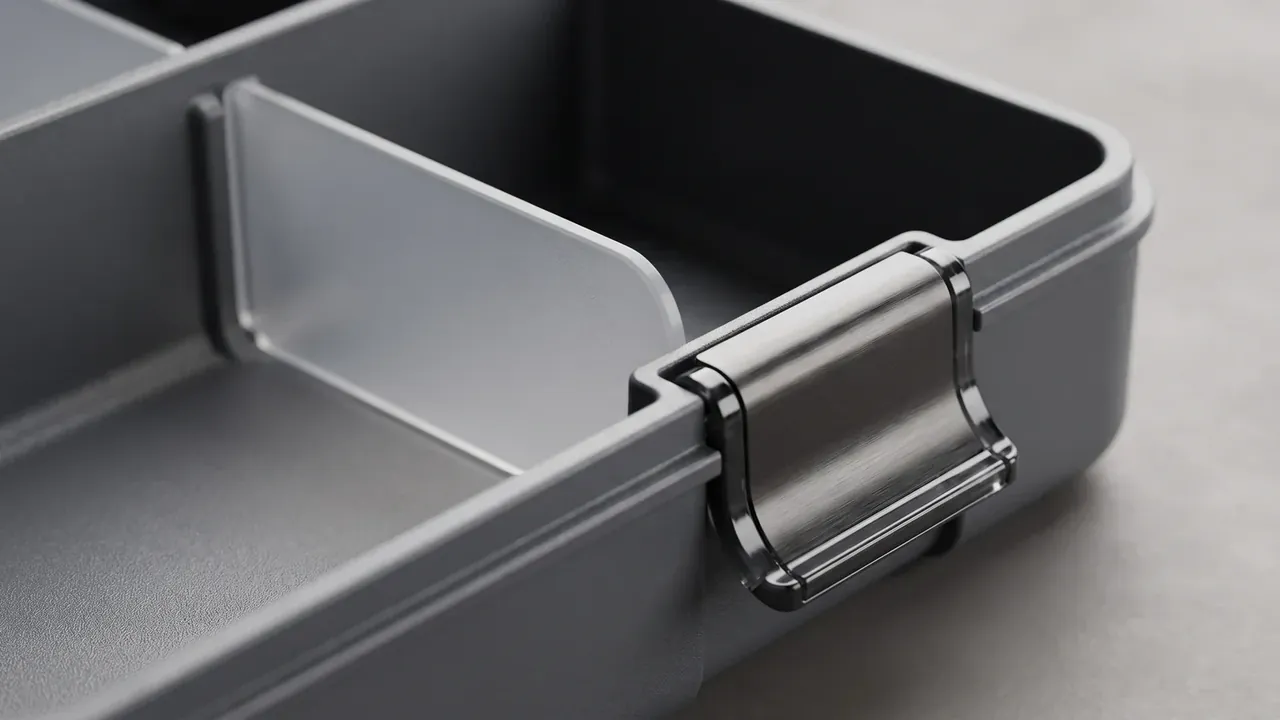
Posture costs sit on top: a hinged lid stays put while one hand holds and the other reaches, whereas a separate panel ends up on the ground and grit scores the seal.
5. Cost, Life and Where Each Option Stops
Tool box lid cost splits in two. An integral lid is moulded with the body and adds nothing, while a lift-off lid needs its own tool, sixty to one hundred and fifty thousand yuan mid-size, so below five hundred pieces tooling beats material cost.
In cycles an injection-moulded latch fatigues near eight thousand, a slide manages fifty thousand travels, a gasket needs review after three years outdoors. Field work takes the hinged lid, a bench the drawer, washdown the lift-off lid.
Conclusion
The difference is not panel thickness but where each form puts its money: the hinged tool box lid buys a shared tool and a moulded groove, the drawer buys slides, the lift-off lid buys its own tool and four latches. Settle dust and daily openings first, and the tool box lid picks itself.
This article covers container-side specifications and design implications only, not the handling, loading or use of the contents.
Related Reading
- How the three lid types are built
- Tool box against the alternatives
- Diagnosing lid distortion and latch failure
- Cover structure and materials
Related Products
- 8 Series — Gun Cases; Military Equipment Cases; Camera Equipment Cases; Drone Cases; Watch Cases; Knife Cases; First Aid Cases; Electronics Equipment Cases
- WL8-2812 PP Gun Case — model WL8-2812
- All protective cases and toolboxes: 7 series, 158 models