

Quick answer: Settle four things before a tool box lid is quoted: cycles per day, case length, lid weight, and what stacks on top. The gasket comes last.
Table of contents
- The five criteria and their order
- Matching opening style to use frequency
- Latch count and hinge structure by length and lid weight
- The gasket and load criteria most buyers skip
- Turning five criteria into one selection table
- FAQ
1. The five criteria and their order
Buyers start with material and color; what retires a tool box lid early is structure. A case in service three years takes tens of thousands of openings under stacked weight, and no resin covers for too few latches.
The order is frequency, opening style, latch count, hinge structure, then gasket and load. Each answer constrains the next, so a hinge life target without a cycle figure is guesswork.
| Criterion | Threshold | Cost if wrong |
|---|---|---|
| Frequency | Above 20 a day | Hinge whitens in a year |
| Opening style | Single, double, removable | Case tips back |
| Latch count | Within 200 mm | Rim lifts mid-span |
| Hinge | Replace at 0.2 mm play | Lid rocks out of line |
| Gasket and load | 25 to 35 percent | Loose or crushed |
Those thresholds are check lines from repair records, not standards.
2. Matching opening style to use frequency
Frequency is the most under-reported number: users answer from memory and halve it. At 25 cycles a day over 250 working days that is 6,250 a year, past the 8,000-cycle line of a living hinge in fourteen months.
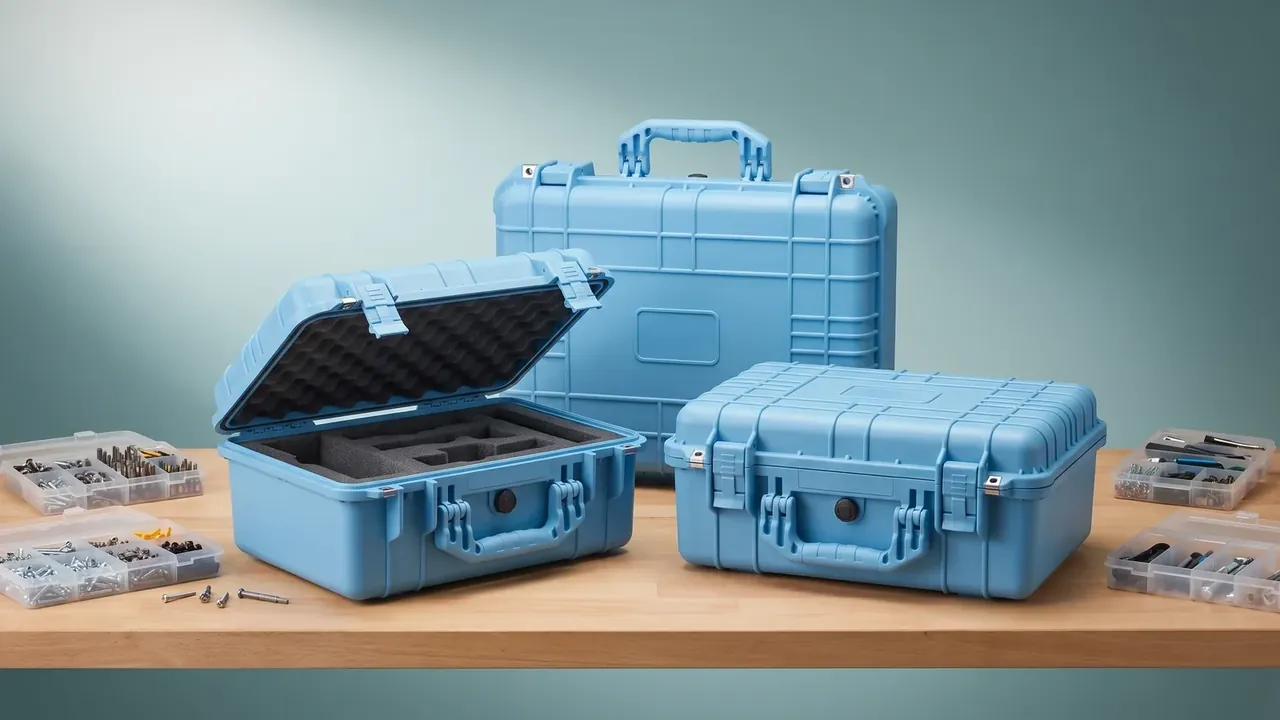
The classes change structure, not material. Up to 5 cycles, two latches and one hinge suffice. From 6 to 20 a living hinge holds, its fold whitening in three to five years. From 21 to 60 use a pin and bush, so wear costs a pin. Above 60, split the lid or make it removable. Past 1.3 kg it also needs a stay at 18 N, or an empty case tips back.
3. Latch count and hinge structure by length and lid weight
Latch count on a tool box lid follows length: two to 400 mm, three to 600 mm, four beyond, spacing inside 200 mm. The rim deflects between latch points, so a 700 mm case with two latches passes a 0.5 mm feeler at mid-span.
Hinge condition is judged by play: a 4 mm pin in a 2.5 mm bush reaches 0.15 to 0.2 mm clearance in two years, which no latch adjustment recovers. The 110 mm lever from hinge to rim sets how much each latch carries. Lid limits run 1.0 kg up to 400 mm, 1.8 kg to 600 mm, 2.6 kg to 800 mm and 3.5 kg beyond, with four latches plus a centre one above 800 mm.
Four-latch cases close on opposite corners first, or the gasket sets skewed.
4. The gasket and load criteria most buyers skip
A gasket earns its place only where dust or water matters. On a 6 mm cord, 1.5 to 2.1 mm of compression is the 25 to 35 percent band: below it the seal never seats, above it the cord stays crushed.
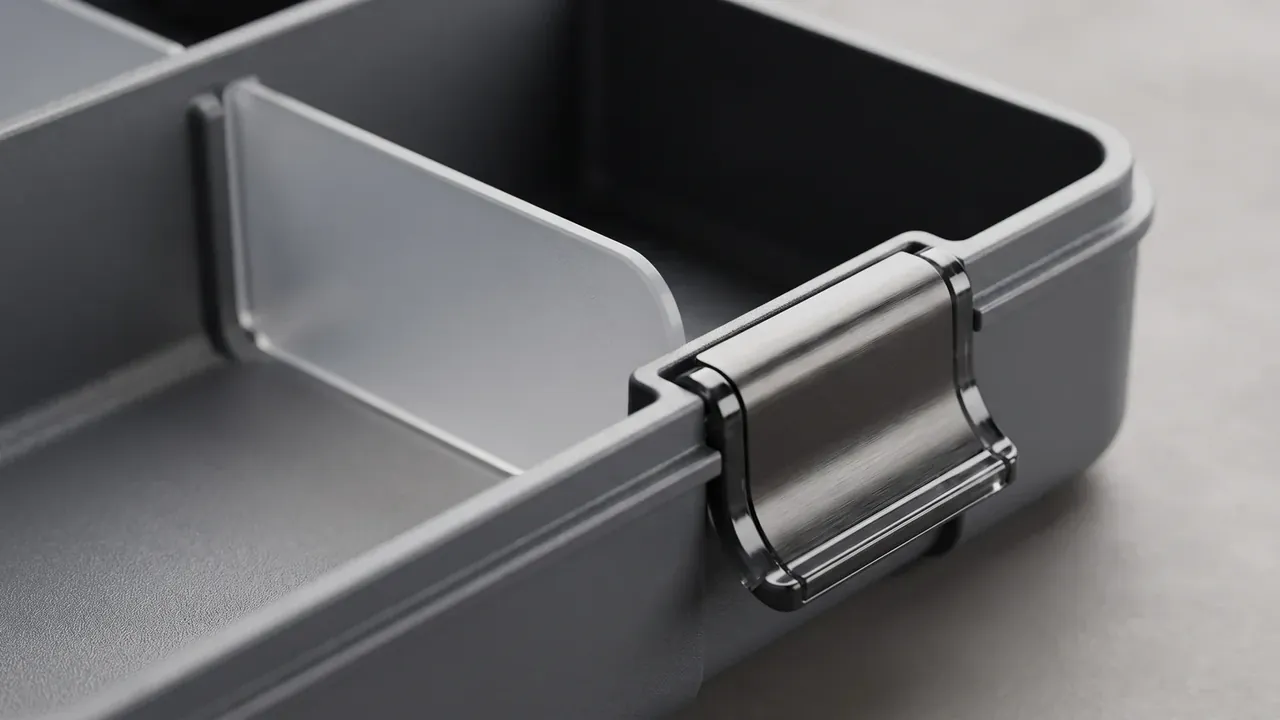
Load sits on the tool box lid, not the base: 25 kg uniform for one tier, 50 for two, 80 for three or forklift handling, with deflection inside one two-hundredth of the span, so 480 mm allows 2.4 mm.
5. Turning five criteria into one selection table
Read side by side, the criteria turn five questions about a tool box lid into one combination; these sets cover bench work, field service, assembly and warehouse turnover.
| Set | Frequency | Latches | Hinge | Gasket, load |
|---|---|---|---|---|
| Bench | 8 a day | 2 | Living | Single lip, 25 kg |
| Field | 15 a day | 3 | Pin | Double lip, 50 kg |
| Assembly | 65 a day | 3 | Pin and bush | Single lip, 25 kg |
| Warehouse | 3 a day | 4 | Twin pin | Double lip, 80 kg |
Sets overlap and sometimes none fits: score each criterion 0 to 2 and quote only what reaches 7. Same mould and batch matter, since 0.2 percent shrink difference leaves one side tight.
Conclusion
Frequency sets the opening style, case length sets latch count, lid weight sets the hinge, stack height sets the section and gasket. Settle those four and price becomes comparable; start from resin instead and the shortfall shows at the latches. Run this tool box lid check past its thresholds and the decision becomes arithmetic.
This article discusses only the container (case body) side of specifications and design intent, and does not cover any handling, loading or use of the contents.
Related Reading
- How a tool box lid is built
- Diagnosing a warped lid or a failed latch
- Selecting a hardware tool box
- Choosing a portable tool box
Related Products
- 8 Series — Gun Cases; Military Equipment Cases; Camera Equipment Cases; Drone Cases; Watch Cases; Knife Cases; First Aid Cases; Electronics Equipment Cases
- WL8-2812 PP Gun Case — model WL8-2812
- All protective cases and toolboxes: 7 series, 158 models