

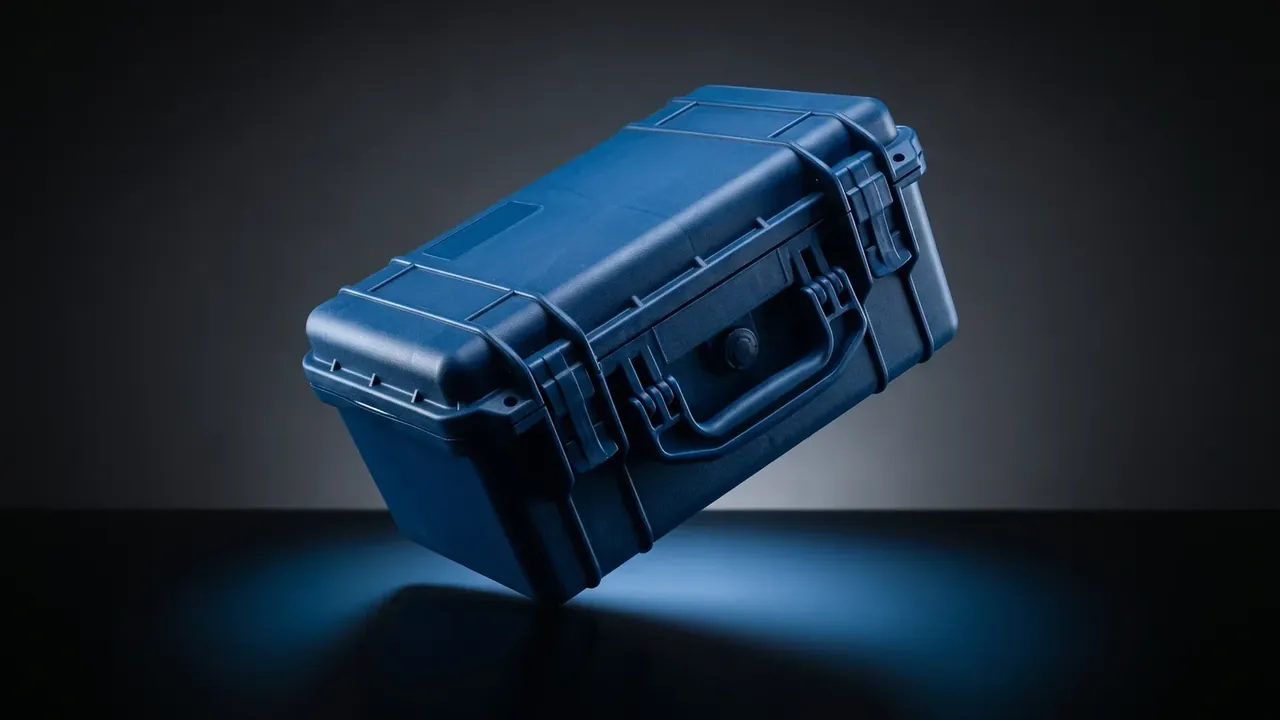
Quick answer: Choose a Tool Box in five steps: count the tools and total weight, match the carry mode, set protection for the environment, lay out compartments for access speed, then check stacking. Each step narrows the next.
Table of contents
- Start with the Tool List and Total Weight
- Carry Mode Sets the Case Frame
- Matching Protection to the Environment
- Access Speed and Compartment Layout
- Stacking and Storage Constraints
- FAQ
1. Start with the Tool List and Total Weight
Choosing a Tool Box starts with a list, not a case: weigh every tool, add 15 mm to the longest for internal length and 3 mm to the widest for one cell.
Case weight should stay under 18 percent of the loaded weight, or the box eats payload. A wrench, a hex set, a drill and a cable reel come to 5.4 kg; with a 1.1 kg case that stays in the one-hand class.
| Loaded weight | Carry mode | Case size | Key feature |
|---|---|---|---|
| under 5 kg | one hand | 330 x 230 x 120 mm | 28 mm grip |
| 5–8 kg | one hand | 400 x 300 x 160 mm | 32 mm grip |
| 8–16 kg | two hands or strap | 460 x 330 x 185 mm | two handles |
| over 16 kg | wheels | 560 x 400 x 240 mm | wheel mounts |
Above 16 kg the limit is the lifter, not the handle: wheels or two cases. A 2.8 versus 3.2 mm wall differs by 0.4 kg, which decides the strap at the 8 kg boundary.
2. Carry Mode Sets the Case Frame
The handle takes the highest stress on a Tool Box. Holding 16 kg puts 6.5 MPa at the root against 25 MPa yield for PP; lifted, the 2.5 times dynamic factor leaves 1.5. A grip of 28 to 32 mm and 110 mm of usable length suits a hand.
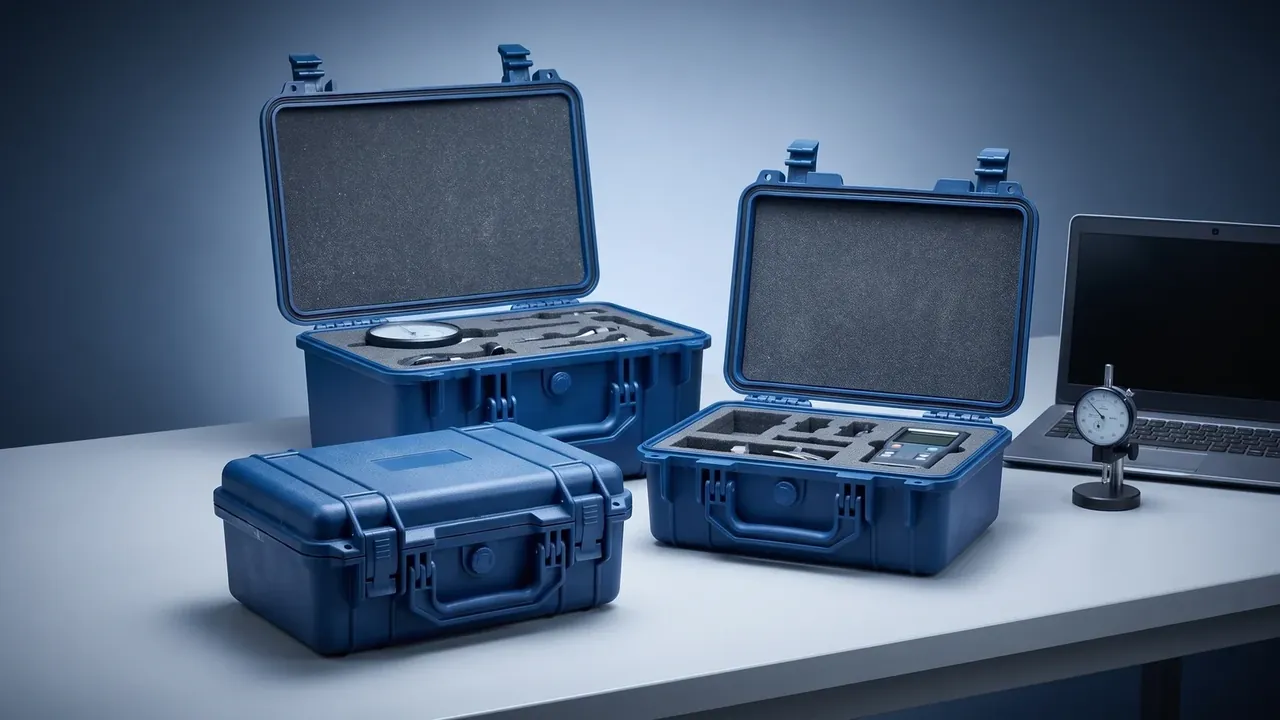
Latches follow length: one per 200 mm, so 460 mm needs two opposite, each holding 300 N, and a loaded 12 kg case must survive a 1.2 m corner drop three times. Strap ports belong high on the body with 4 mm walls.
3. Matching Protection to the Environment
More sealing is not better, just heavier. A dry shelf needs a 0.5 mm rim gap; a dusty shop needs under 0.3 mm plus a dust lip, since 75 micrometre particles grind the rim.
| Environment | Gap and seal | Body | Reading |
|---|---|---|---|
| dry indoor | 0.5 mm, no gasket | PP | sufficient |
| dusty workshop | under 0.3 mm, dust lip | PP with TPE | near IP54 |
| rain, outdoor | gasket at 30 percent | PP with silicone | near IP65 |
| cold store | gap opened 0.2 mm | low-temp PP | drop at minus 20 °C |
PP goes brittle below minus 10 °C, so a cold store Tool Box needs the gap opened 0.2 mm or shrinkage seizes the lid. Sealing also costs 40 N per opening.
4. Access Speed and Compartment Layout
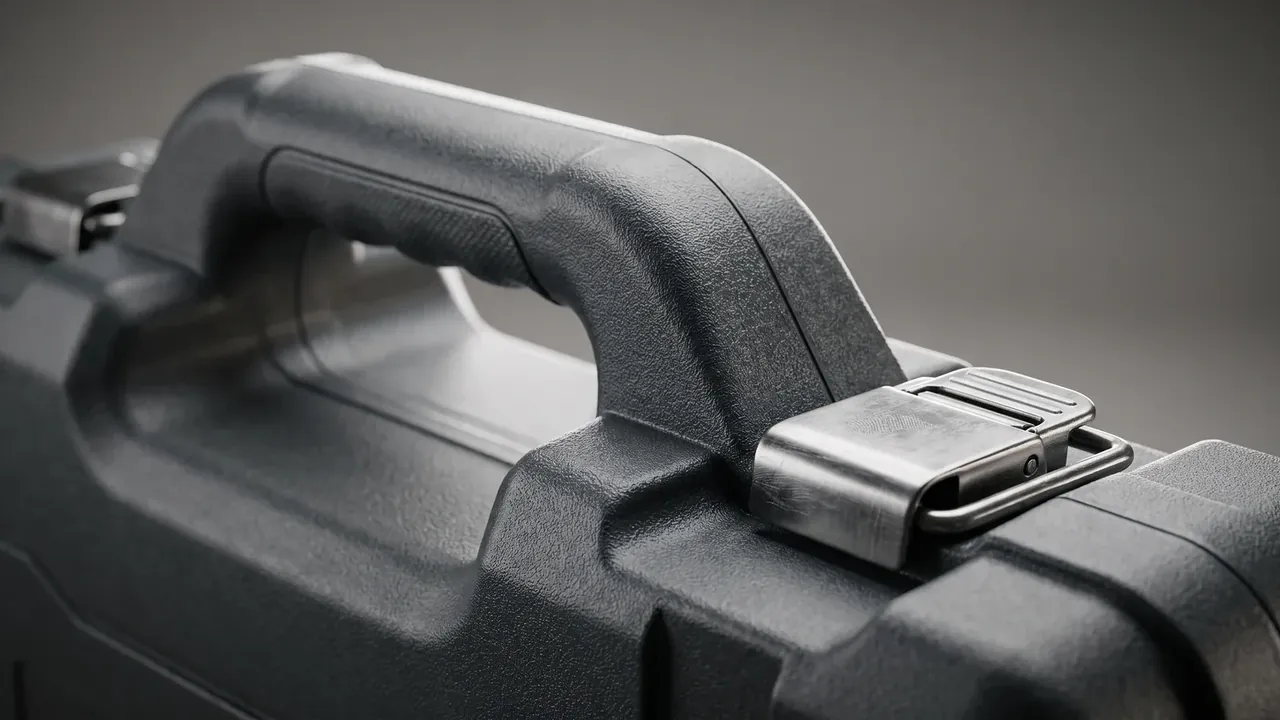
One measure decides this section: seconds from lid open to hand on the right tool. A plain cavity measured 18 s, dividers 11 s, die-cut EVA 6 s.
| Layout | Cells | Access | Fits |
|---|---|---|---|
| plain cavity | 0 | 18 s | few large items |
| movable dividers | 6 | 11 s | changing kit |
| die-cut EVA | 12 | 6 s | fixed list |
| two-tier trays | 16 | 5 s | high density |
Below 45 mm clear width a finger will not fit, and sockets need 70 mm deep cells. A hinge stop at 105 degrees keeps the lid behind the work.
5. Stacking and Storage Constraints
Four tiers at 22 kg puts 66 kg on the bottom lid, and deflection after thirty days must stay under 1.5 mm.
The handle is the dimension people forget: folded it stands 18 mm proud, so four tiers of a 185 mm case need 840 mm clear. Shelf depth takes case depth plus 40 mm, or the front overhangs and the base dishes.
Conclusion
How to choose a Tool Box is a question of order: the list sets the class, the carry mode the frame, the environment the sealing, the layout the speed, stacking the outline. Walk the five criteria and every figure on a Tool Box follows.
This article discusses only the container (case body) side of specifications and design intent, and does not cover any handling, loading or use of the contents.
Related Reading
- How a tool box is built and moulded
- Where a compartment tray earns its place
- Lid distortion and closing problems
- Tool boxes against alternative formats
Related Products
- 8 Series — Gun Cases; Military Equipment Cases; Camera Equipment Cases; Drone Cases; Watch Cases; Knife Cases; First Aid Cases; Electronics Equipment Cases
- WL8-2812 PP Gun Case — model WL8-2812
- All protective cases and toolboxes: 7 series, 158 models