

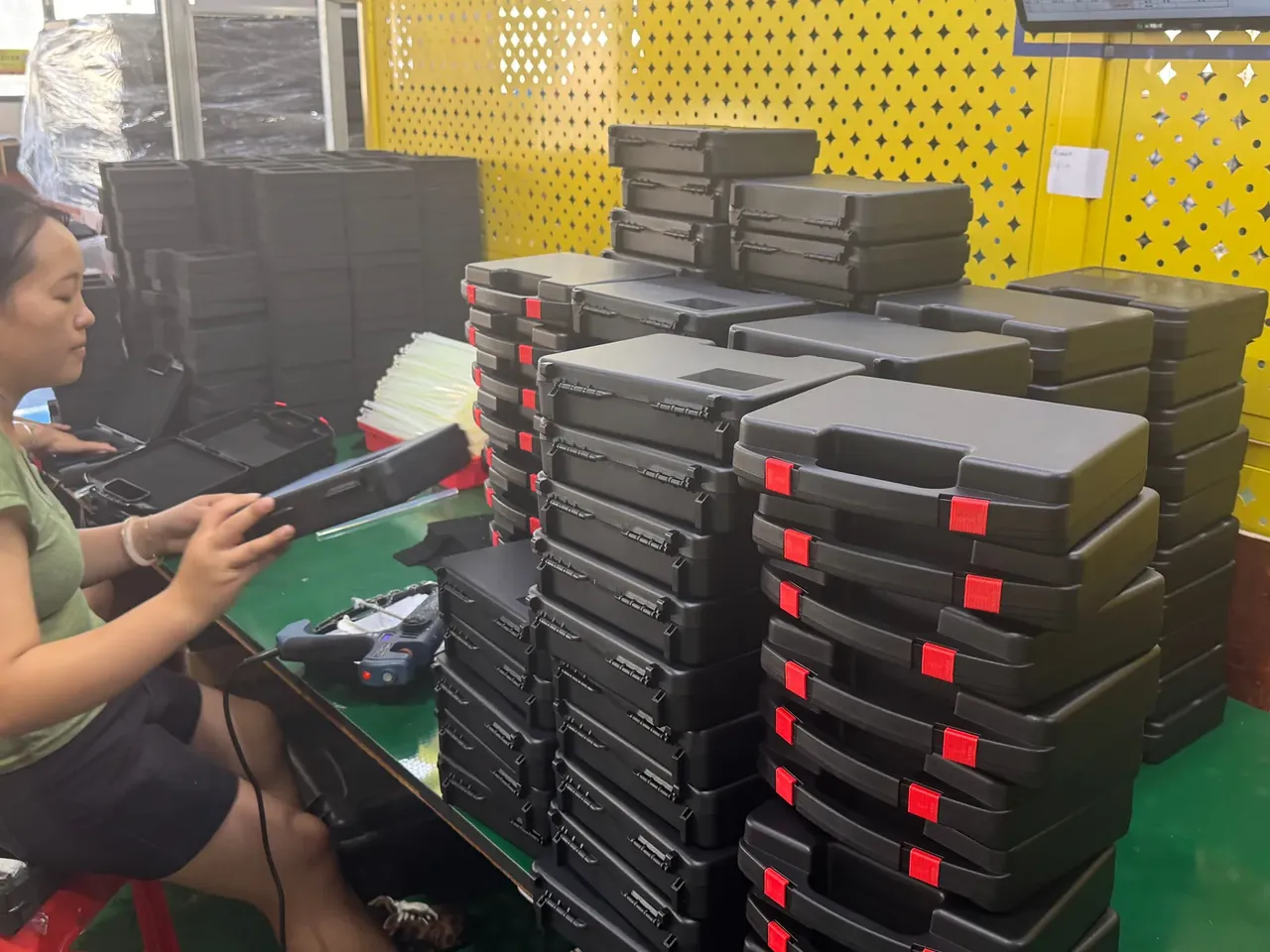
Quick answer: A Tool Carrier runs on three rhythms — a pre-shift look, a quarterly check, an annual review. Handle, latch, hinge, gasket and wheel each carry a measurable replacement line: cross it and the part goes.
Table of contents
- Maintenance Intervals for a Tool Carrier
- Handle and Strap Fatigue Checks
- Latches, Hinges and Gaskets
- Wheels and Body Wear Limits
- Repair or Replace: Drawing the Line
- FAQ
1. Maintenance Intervals for a Tool Carrier
A Tool Carrier moves a set of tools between stations and keeps them within reach once it stops. Lifting, setting down, opening and rolling load the same three places — handle root, hinge seat, wheel boss. None wears evenly; each cracks first and lets go later, so the question is whether a dimension has moved.
Three rhythms keep this manageable: a pre-shift look for today, a quarterly check for the season, an annual review for the unit's future. Trend beats a single reading: 0.5 mm of pin gap after break-in is normal, 0.7 mm three months later is not.
| Level | Interval | Limit |
|---|---|---|
| Pre-shift look | 5 minutes per shift | crack, seizure |
| Monthly function | 250 working hours | 30 percent loss of force |
| Quarterly structure | every quarter | pin gap above 0.8 mm |
| Annual review | once a year | red rust at 48 hours |
2. Handle and Strap Fatigue Checks
The handle is the only part of a Tool Carrier that a person loads directly, and it fails first. Read it in a fixed order: broken stitches, stress whitening around each rivet, a thinned radius where the handle meets the body.
Test at 1.5 times the rated 25 kg, or 37.5 kg, hung for 10 minutes; measure residual set at the midpoint. Above 2 mm the webbing has yielded. Three broken stitches in a row, or webbing worn through a third of its thickness, means replacement with no sewing.
Straps fail at the adjuster first: once buckle plating wears through, webbing bites and hard pulling frays the edge.
3. Latches, Hinges and Gaskets
The latch decides whether a Tool Carrier stays shut in transit, the hinge how the lid feels, the gasket whether dust gets in.
Latch holding force starts near 180 N; below 110 N the lid pops open under a loaded roll. Hinge wear is read as radial pin gap: 0.2 mm when new, and past 0.6 mm the lid rocks sideways and grinds the bore oval. Gasket condition is compression set — a strip pressed at 70 degrees Celsius for 24 hours that recovers under 70 percent, or a Shore A hardness climbing from 55 to 70, no longer seals.
A rib root that shows a white line after thumb pressure has already yielded.
4. Wheels and Body Wear Limits
On a wheeled Tool Carrier the wheels are the consumable nobody tracks. Going from 75 mm to 72 mm looks like 3 mm of nothing, but rolling resistance climbs, the operator pushes harder, and the extra force goes into the wheel boss. Tread wear past 1.5 mm, a chipped rim or a sideways pull each justifies a new set of four, because a mixed set steers the body toward the small wheel.
Body limits are cracks and crush. With a nominal 3.2 mm side wall, a crack over 20 mm, or any crack crossing a rib root, ends the unit. A corner crushed more than 4 mm has spent its energy absorption. Grease each wheel bore every 6 months with about 2 g of lithium grease.
5. Repair or Replace: Drawing the Line
The line is not damage severity but whether the unit can return to original strength. Wheels, latches, gaskets, handle assemblies and rivet points are repairable. A broken main rib, a torn hinge seat and a wall thinned by more than 15 percent are not.
On cost: if parts plus labour pass 40 percent of an equivalent new unit, replace it; so do two repairs within 3 months.
| Symptom | Action | Cost call |
|---|---|---|
| Tread worn, pulls sideways | all four wheels | repair, low |
| Latch below holding force | latch set | repair, low |
| Gasket no longer sealing | full-perimeter gasket | repair, medium |
| Torn hinge seat | scrap the unit | above 40 percent |
Conclusion
A Tool Carrier is maintained by measurement rather than by ear: residual set on the handle, holding force on the latch, pin gap on the hinge, compression set on the gasket, tread on the wheels. Hold those five lines and most fractures surface a quarter before they happen; once a repair passes 40 percent of a new unit, replacement wins. Put these limits in a shift checklist and a Tool Carrier gains a full inspection cycle of working life.
This article discusses only the container (case body) side of specifications and design intent, and does not cover any handling, loading or use of the contents.
Related Reading
- How a tool carrier is put together
- Tool carrier selection checklist
- Servicing rhythm for metal tool chests
- Faults in portable tool boxes and how to handle them
Related Products
- 8 Series — Gun Cases; Military Equipment Cases; Camera Equipment Cases; Drone Cases; Watch Cases; Knife Cases; First Aid Cases; Electronics Equipment Cases
- WL8-2812 PP Gun Case — model WL8-2812
- All protective cases and toolboxes: 7 series, 158 models