

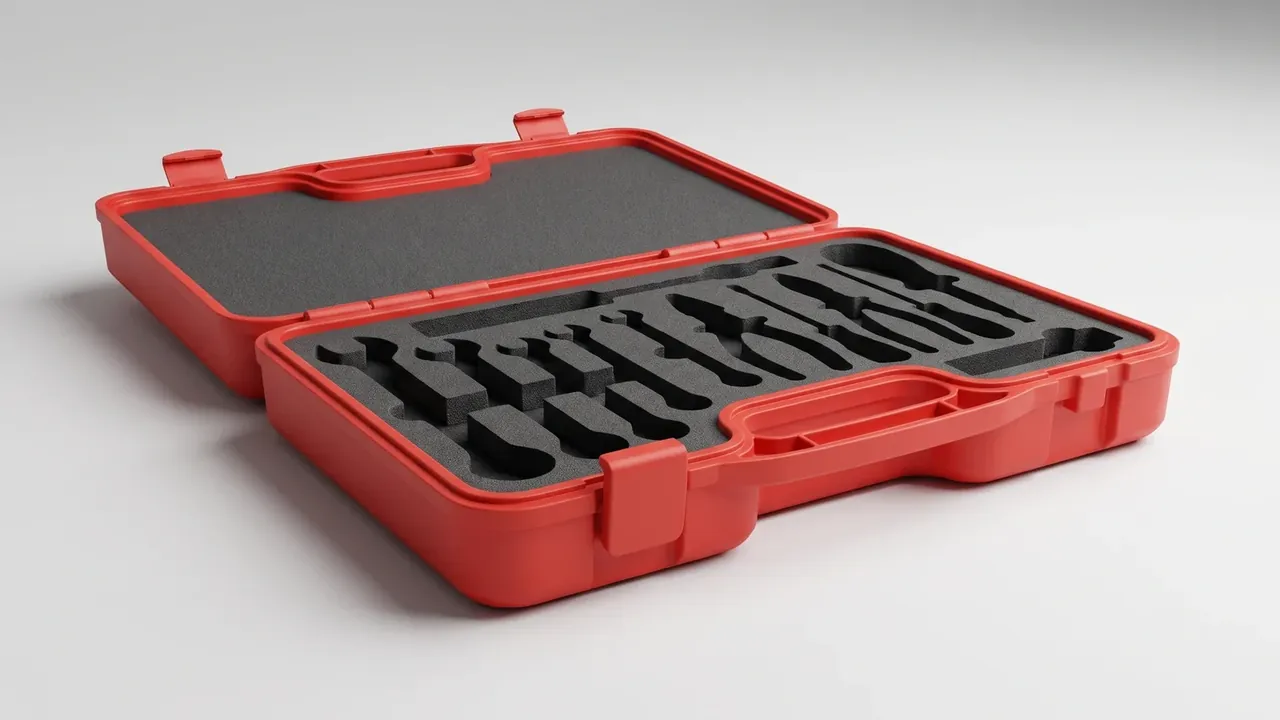
Quick answer: A tool chest is a rigid body that pins every tool to a fixed position and routes weight along four separate paths. Judge one by hinge and latch stress points, flanges and ribs, foam density, and whether static, stacking and drop loads are rated apart.
Table of contents
- What a Tool Chest Is: Four Loads One Body Must Carry
- Hinge and Latch: Two Stress Points in Every Cycle
- Body Stiffness: Flanges, Ribs and Wall Thickness
- Partition Logic: How Foam Divides the Interior
- Reading Load Ratings: Static, Stacking, Drop
- FAQ
1. What a Tool Chest Is: Four Loads One Body Must Carry
A tool chest splits four loads instead of absorbing them together: tool weight, torque between lid and body, the pull at the handle, corner impact after a drop. The paths never help one another, so a thick base cannot rescue a weak latch.
| Load path | Parts | Typical failure |
|---|---|---|
| Static | base, feet | base dishes at the centre |
| Opening | hinge, latches | boss cracks at the parting line |
| Lifting | handle bosses | mount tears out beside the handle |
| Drop | corner caps | corners chip |
A 480 mm by 380 mm by 180 mm body holds its centre within 2 mm under 25 kg spread evenly for 24 hours.
2. Hinge and Latch: Two Stress Points in Every Cycle
A 6 mm pin through ears on body and lid decides whether the lid still lines up. Forty openings a day is about 70,000 in five years; once the bore wears 0.3 mm the lid meets one side first and the opposite latch closes at an angle.
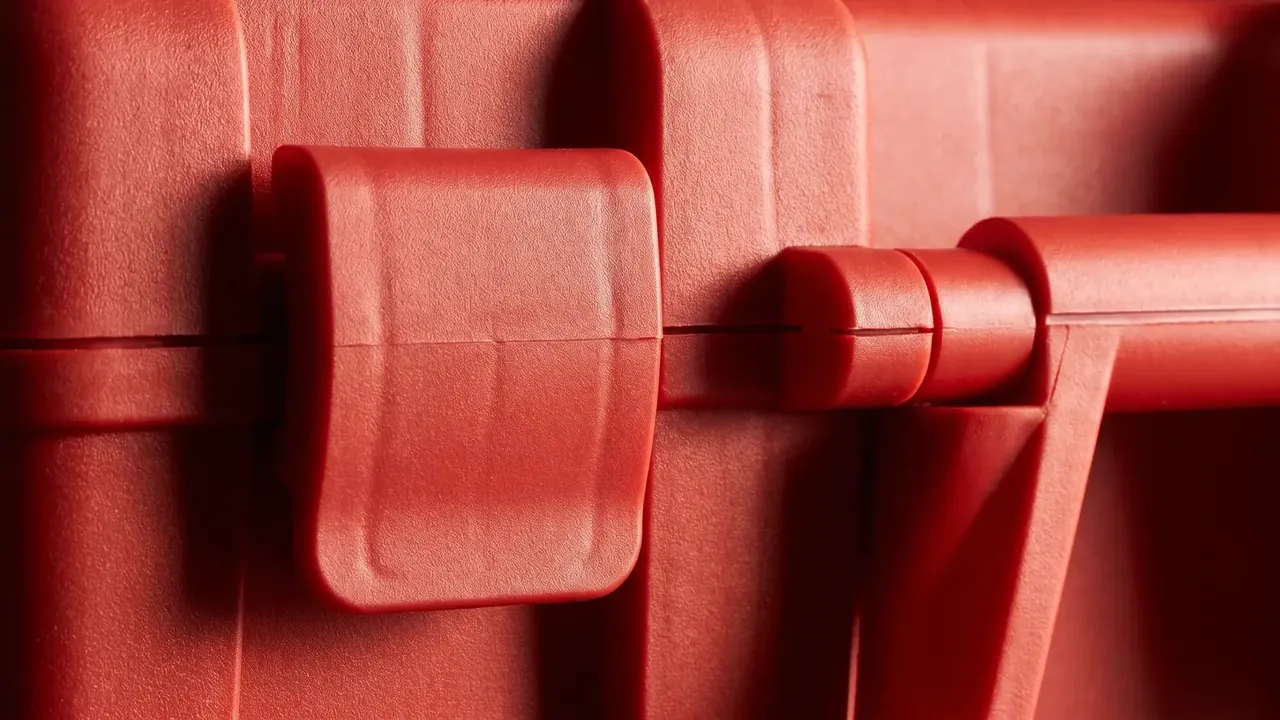
Preload beats latch strength. A tongue that merely rests on its catch micro-moves in transit and wears at one point; press the closed lid, and visible movement means the catch position must change.
3. Body Stiffness: Flanges, Ribs and Wall Thickness
Shape carries stiffness. Across a 400 mm span, 1.5 mm sheet with a 15 mm flange resists bending far better than flat 2 mm plate, and steel bodies run a 12 to 15 mm fold with an R2 radius.
Moulded bodies use 8 mm ribs at 60 mm pitch, bringing a 3 mm wall close to a 5 mm flat wall for 18 percent more weight.
| Method | Size | Relative stiffness | Cost |
|---|---|---|---|
| Thicker plate | 2 to 3 mm | 2.8 times | half again the weight |
| Flange | 0.8 mm steel, 15 mm | 4 times | radius at the fold |
| Ribs | 3 mm wall, 8 mm | 3 times | sink marks, blocks foam |
4. Partition Logic: How Foam Divides the Interior
Zoning follows order of use. The zone the eye lands on first carries the three to five tools used daily, about 40 percent of the interior.
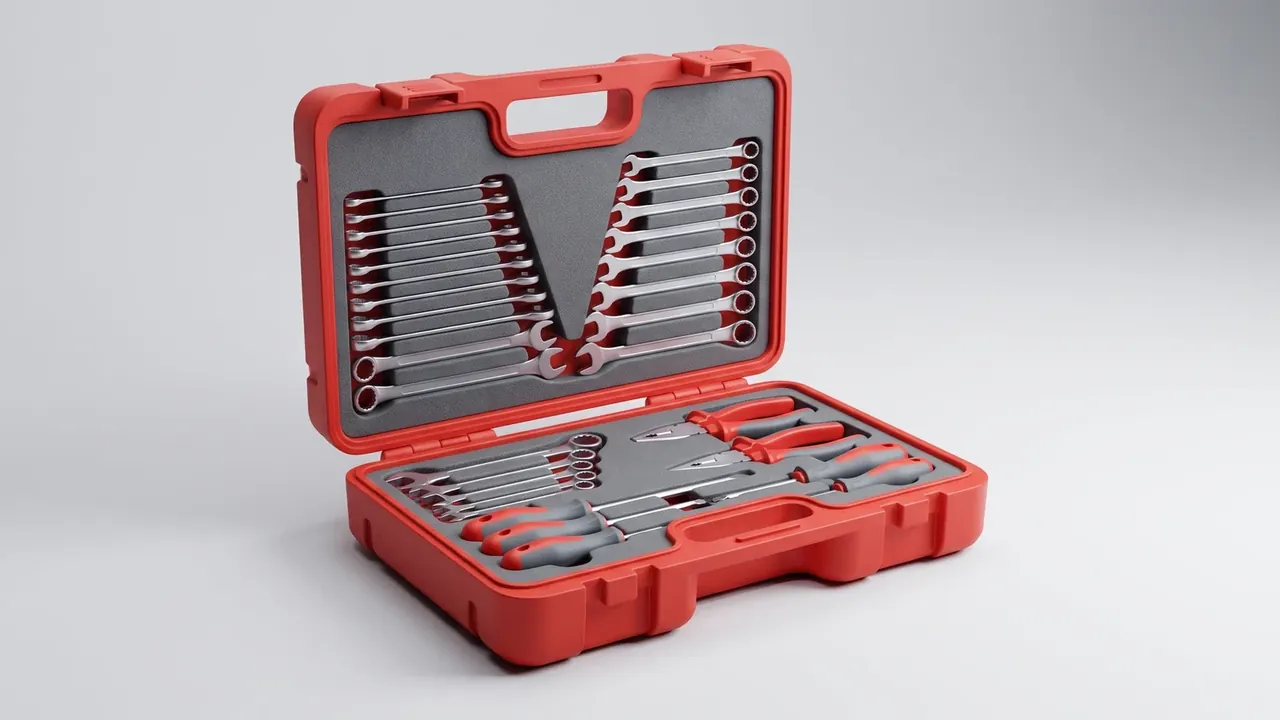
Density decides whether a pocket keeps its shape. EVA at 30 kg per cubic metre loses 0.5 mm at the edge after 5,000 insertions; 20 kg material sags to 2 mm.
5. Reading Load Ratings: Static, Stacking, Drop
One load number misleads: the three do not convert. Static is weight spread inside, stacking is weight on the lid, drop is the height and face that lands first.
| Rating | Figure | Pass |
|---|---|---|
| Static | 25 kg for 24 h | centre within 2 mm |
| Stacking | 25 kg per unit | no set, latches hold |
| Drop | 1.2 m | no through crack |
| Handle | 1.5 times load | no crack at the mount |
A 2.5 kg wrench in a 250 mm by 100 mm pocket sits at about 1 kPa, but a 30 times impact factor turns the drop peak into 30 kPa and the pocket floor fails first.
Conclusion
A tool chest splits its work four ways: base for static load, hinge and latches for opening, flanges and ribs for stiffness, foam zoning for access. Load figures belong in three columns, and what separates a sound tool chest from an ordinary case is whether each path has a part built for it.
This article discusses only the container (case body) side of specifications and design intent, and does not cover any handling, loading or use of the contents.
Related Reading
- How to read tool chest specifications
- How a tool chest is used at different workstations
- Metal tool chests against the alternatives
- Maintenance checks for a metal tool chest
Related Products
- 8 Series — Gun Cases; Military Equipment Cases; Camera Equipment Cases; Drone Cases; Watch Cases; Knife Cases; First Aid Cases; Electronics Equipment Cases
- WL8-2812 PP Gun Case — model WL8-2812
- All protective cases and toolboxes: 7 series, 158 models