

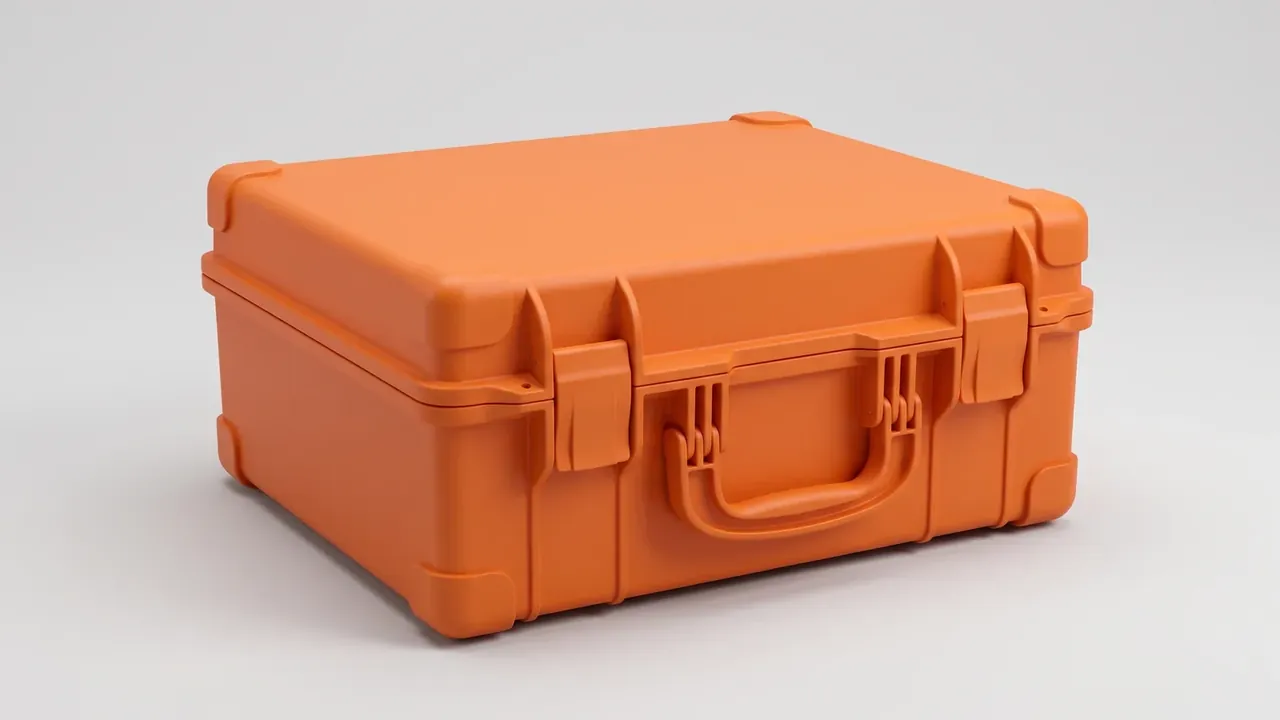
Quick answer: A Tool Kit Chest specification closes like a chain: cavity, wall, outer size, pallet. Each link carries a tolerance and a gauge, so the drawing can be measured instead of argued about.
Table of contents
- Building the Tool Kit Chest Dimension Chain
- Allocating Wall Thickness
- Back-Calculating Bottom Thickness from Load
- Tolerances and Gauges
- A Spec Sheet That Can Be Inspected
- FAQ
1. Building the Tool Kit Chest Dimension Chain
A Tool Kit Chest specification is a chain, not a list of numbers. The cavity comes first: length from the longest item plus 20 mm at each end, width from the widest plus foam, depth from the tallest plus 40 mm of lid cushion.
With a 500 x 340 x 190 mm cavity, a 3.2 mm wall and 2.0 mm of rib relief give 510 x 350 mm outside, while 190 plus a 4.0 mm floor, a 60 mm lid and a 1.0 mm joint gap gives 258 mm high.
| Chain link | Value | Source |
|---|---|---|
| Cavity | 500 x 340 x 190 mm | 460 mm item plus 20 mm each end |
| Outer | 510 x 350 x 258 mm | Cavity plus wall, floor and lid |
| Pallet fit | 4 per layer, 20 at five high | 1200 x 800 mm pallet |
At 560 mm long it still fits four per layer, but the pallet is wasted.
2. Allocating Wall Thickness
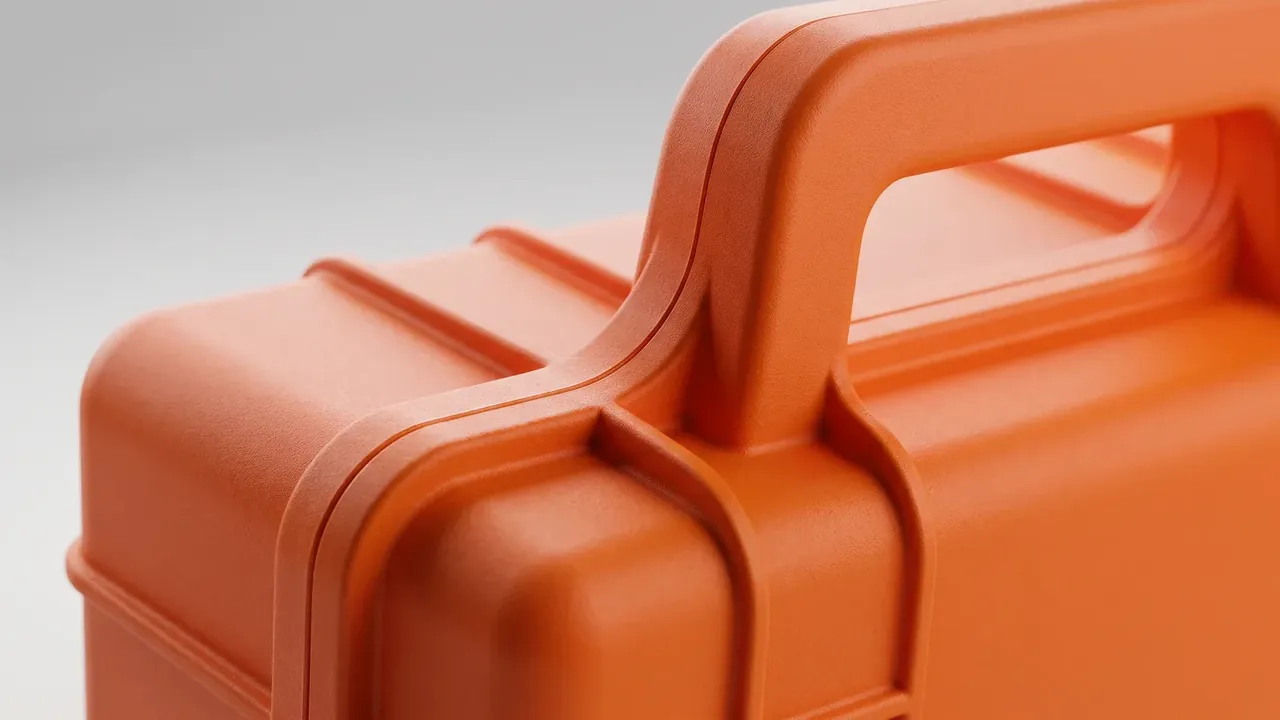
One Tool Kit Chest carries six thicknesses: 3.2 mm main wall, 4.0 mm floor, 3.0 mm lid, 2.0 mm rib roots, 6.5 mm handle root, 6.0 mm hinge bosses.
Three rules govern the split. Adjacent walls stay within 1.5 times, or a 20 mm transition is needed. A rib root runs 0.6 times the wall, so 2.0 mm stays flat while 3.2 mm shadows the face. Every vertical face gets 1.5 degrees of draft, about 5 mm over 190 mm.
Polypropylene flows 200 times its wall, so 3.2 mm fills a 640 mm path. Thicker is not stronger: 4.5 mm adds forty percent in weight for under twenty percent in stiffness.
3. Back-Calculating Bottom Thickness from Load
Load is derived, not declared. A Tool Kit Chest carrying 28 kg in a four-high stack puts 84 kg on the lowest top face; over 0.17 square metres that is 4.9 kPa, and across a 340 mm span the L/200 limit is 1.7 mm.
A 4.0 mm floor deflects 1.5 mm and passes, while 3.2 mm gives 2.9 mm. Ribs beat thickness: three lengthwise and two across at 120 mm pitch cut the span to 120 mm, and deflection falls with the fourth power of span. The handle takes 28 kg times a 1.8 dynamic factor, so 50.4 kg at a 6.5 mm root.
4. Tolerances and Gauges
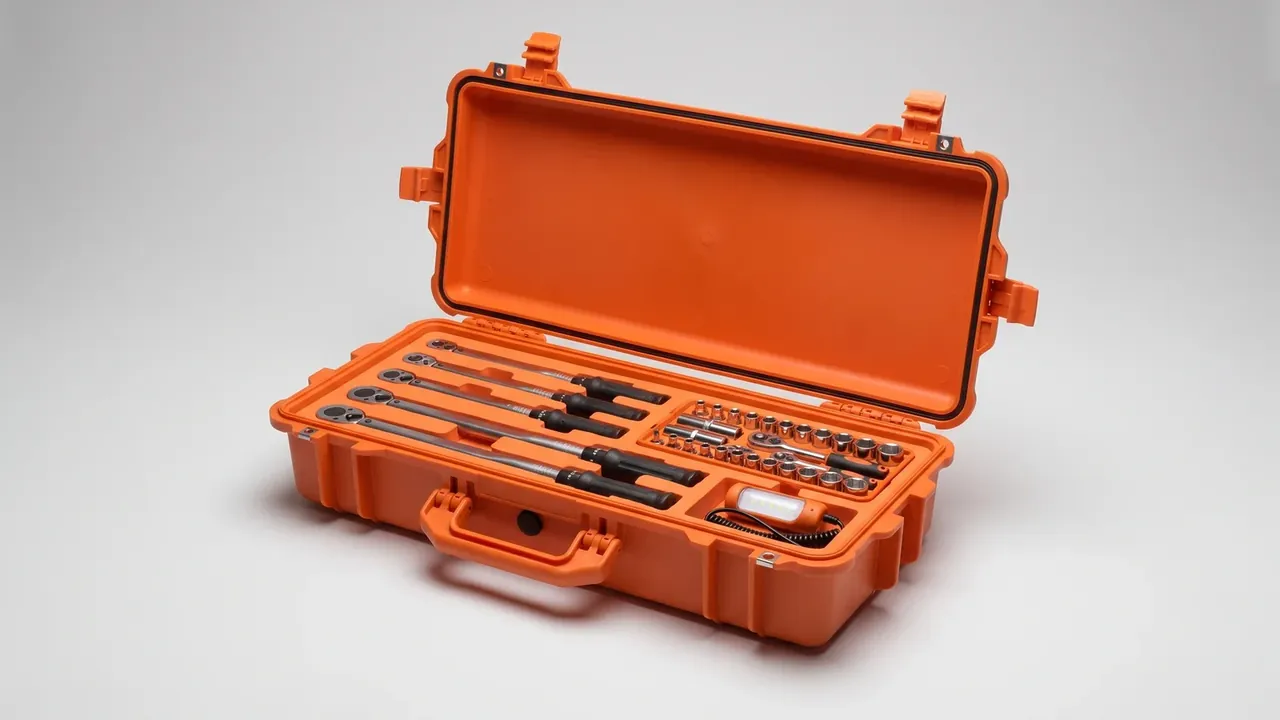
Tolerance follows function: the cavity mates with foam, so ±0.8 mm; the outer meets pallets, so ±1.2 mm; height ±1.5 mm; lid mismatch 0.3 mm or light escapes the gasket groove; floor flatness 0.6 mm.
Polypropylene shrinks about 1.6 percent, so the mould is cut 1.016 times nominal and corrected from the first shot. Three gauges cover the drawing: a go/no-go frame, where 500 x 340 mm enters and 1.6 mm oversize does not; an ultrasonic gauge at three points each on floor, wall and lid; a plate and indicator at four corners.
A no-go failure means recutting the cavity, not polishing it.
5. A Spec Sheet That Can Be Inspected
Three columns plus a gauge column beat prose, because purchasing, tooling and inspection then read the same table.
| Item | Nominal | Tolerance | Gauge |
|---|---|---|---|
| Cavity | 500 x 340 x 190 mm | ±0.8 mm | Go/no-go frame |
| Outer | 510 x 350 x 258 mm | ±1.2 mm | Calipers |
| Wall | 4.0 floor, 3.2 side | +0.3 mm | Ultrasonic, 9 points |
| Floor load | 84 kg, 1 hour | 1.7 mm maximum | Plate, indicator |
The datum is what sheets forget: which face the 500 mm starts from, or whether thickness is read on a rib. Pin datum, gauge and frequency, and the Tool Kit Chest sheet becomes a decision rule.
Conclusion
Four steps close the chain: cavity from the load, outer size from cavity plus wall, floor and ribs from the stack, tolerances and gauges from the mating function. Skip one and the drawing returns at trial moulding. Put all four on a page and the size, wall and load of a Tool Kit Chest are finally fixed.
This article discusses only the container (case body) side of specifications and design intent, and does not cover any handling, loading or use of the contents.
Related Reading
- What a tool kit chest is
- Setting tool chest body specifications
- How protective case size ranges are split
- Injection machine tonnage and case bodies
Related Products
- 8 Series — Gun Cases; Military Equipment Cases; Camera Equipment Cases; Drone Cases; Watch Cases; Knife Cases; First Aid Cases; Electronics Equipment Cases
- WL8-2812 PP Gun Case — model WL8-2812
- All protective cases and toolboxes: 7 series, 158 models