

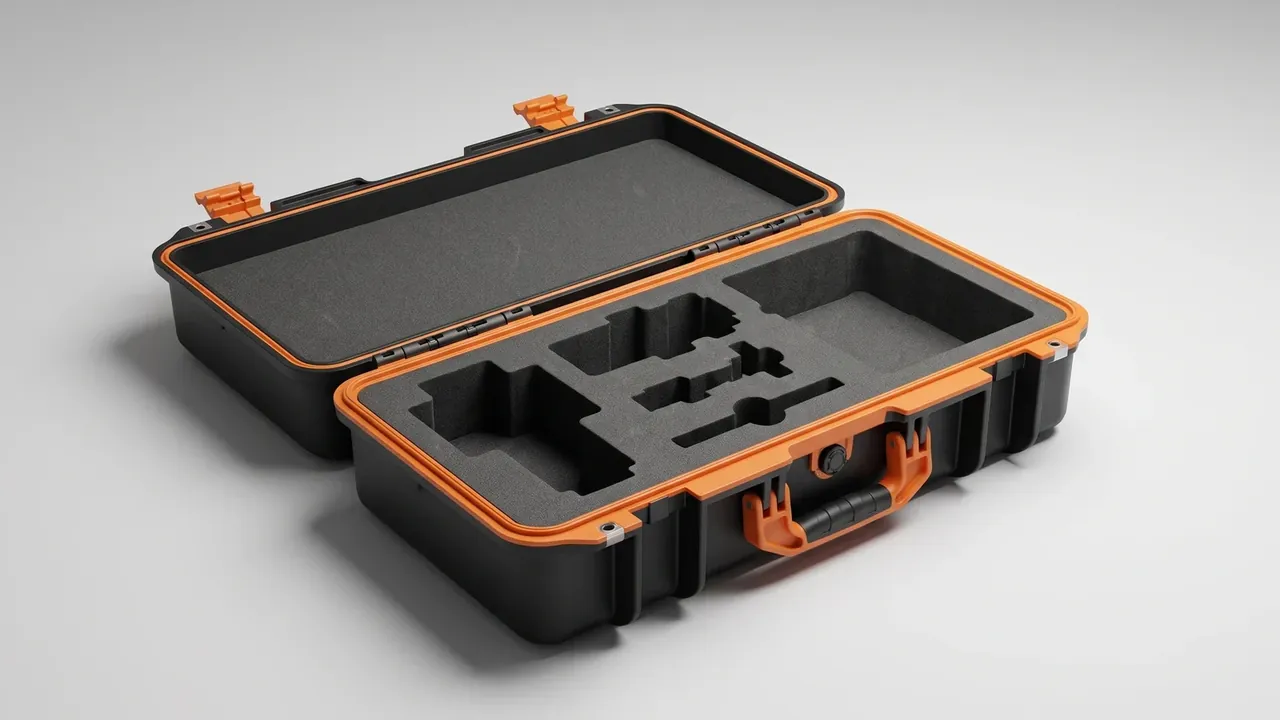
Quick answer: A touring lighting case is consumed in cycles, not years: 200 shows bring 800 lid closures, 32 km of wheeling and four-high stacking.
Table of contents
- What 200 Shows Take Out of a Case
- Latch and Hinge Life in Cycles
- Console Protection: Foam and Moisture
- Flight Case or Rotomoulded Case
- Tour Numbering, Labels and Load Efficiency
- FAQ
1. What 200 Shows Take Out of a Case
Four handling steps per show: load-in, set-up, strike, back to the truck. Two hundred shows is 800 lid closures and 800 lifts, so a touring lighting case ages by count.
Each opening works two latches, so one latch runs 800 cycles a season, and an extra opening at set-up pushes it near 1000.
Wheeling runs 40 m a show, 32 km a season, over backstage concrete and wet gravel. A φ76 mm solid PU wheel loses 1.5 mm of diameter in 12 months.
Impact lands on corners: a set-down at twice the loaded weight is roughly 90 kg, and 800 drops thin the corner moulding from 6 mm to 4.5 mm.
Stacking is the quiet cost. Four high puts 135 kg on the bottom unit, and vibration works the lid rim into a 0.8 mm step after four years.
2. Latch and Hinge Life in Cycles
A latch is rated 10,000 closures, which at 800 a year reads as 12 years. Wear is not linear, so judgement rests on three measurable values rather than the rating.
Tongue travel: a new tongue seats 6 mm deep, and at 5.5 mm clamping force is down about 15%, enough for the lid to breathe 1 mm.
Spring preload: a gauge reads 55 N new and 44 N at 20% loss, where the lever feels soft but looks intact.
Closed gap: a feeler gauge past 1.5 mm means the gasket is crushed flat, and this warns earlier than the latch itself.
Hinges are the overlooked end. A φ6 mm stainless pin in a glass-filled PA66 bore wears 0.2 mm over 800 closures, dropping the open lid 0.8 mm until the latch pulls on one side.
Replacement splits three ways on a touring lighting case: tongue and spring at 3000 cycles or 18 months, pin at 5000, latch at 8000, so a tour carries tongues and pins.
3. Console Protection: Foam and Moisture
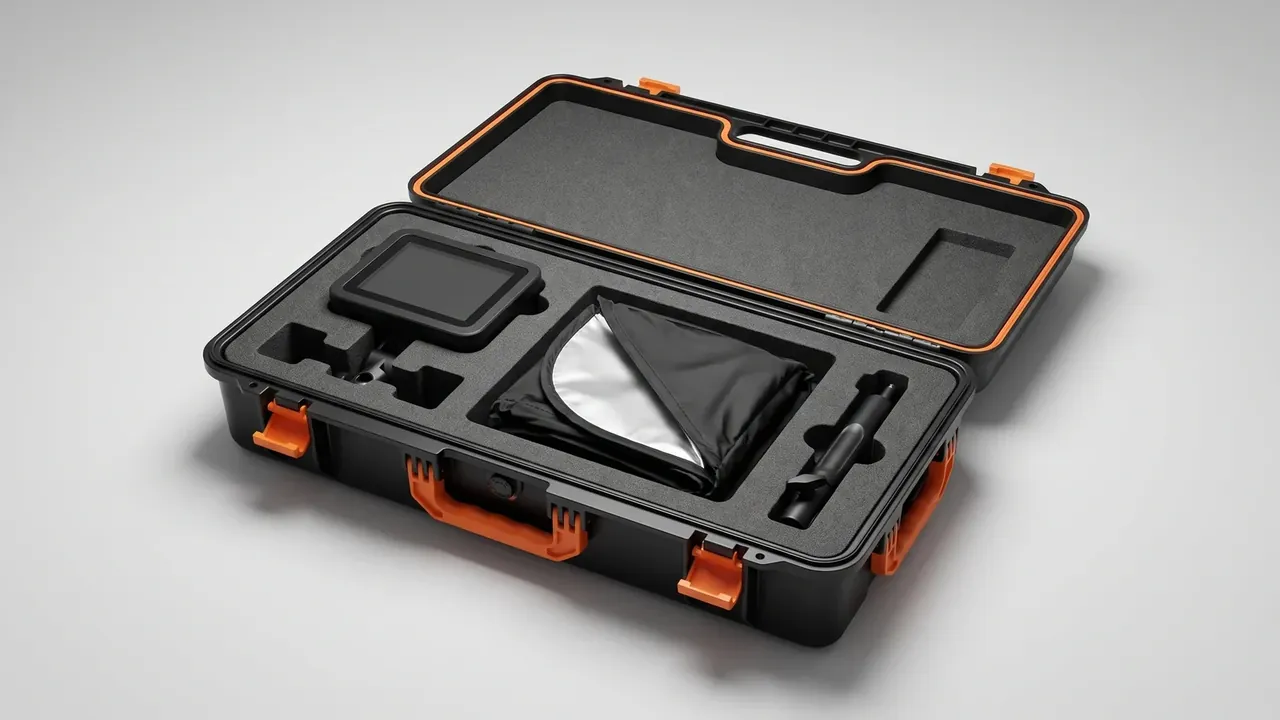
A console fears point loading, moisture and fast temperature change. A 30 mm EVA lining answers the first, closed cells the second.
EVA runs at 45 kg/m³ and 38 Shore A. Below 35 kg/m³ the compression set passes 8% in two months and pockets slump; above 60 kg/m³ the foam barely absorbs energy.
Touring lighting case pockets are cut with 2 mm depth clearance and 1.5 mm width clearance. At zero the foam grips the unit and the side coating wears through.
The closed case reaches IP67, and 50 g of silica gel holds 40 days at 25 °C and 60% RH; longer runs change the gel every 30 days. Storage is rated -10 to 45 °C.
| Lining | Density | Compression set | Insert cycles | Where used |
|---|---|---|---|---|
| Closed-cell EVA | 45 kg/m³ | 8% at 50 °C, 22 h | 2000+ | Console pocket |
| EPE | 25 kg/m³ | 15% | 800 | Lamp and cable layers |
| PU foam | 30 kg/m³ | 22% | 400 | Lid pad |
| Crosslinked XPE | 50 kg/m³ | 6% | 2500 | High-value faceplate |
Lamp and cable layers do not need EVA. EPE costs a third as much and only slumps after 800 pulls.
4. Flight Case or Rotomoulded Case
The two shells solve different problems. A flight case is aluminium extrusion on panel, wide opening, removable lid; a rotomoulded case is one shell with better impact, its opening fixed by the tool.
ATA 300 sorts flight cases into Cat I under 3 trips a year, Cat II for 3 to 10, Cat III above 10. A 200-show year lands in Cat III, tested for vibration, drop and stacking.
A rotomoulded case carries no ATA category, but its one-piece shell still seals after a 1 m drop, which suits a single high-value unit.
| Item | Flight case | Rotomoulded case | Decided by |
|---|---|---|---|
| Opening | Full lid, removable | Single lid, tool-fixed | Set-up speed |
| Empty weight | 18–24 kg | 9–14 kg | Truck loading |
| Impact | Corner bumpers | One-piece shell | Drop height |
| Repair | Panel or extrusion | Whole shell | Spares cost |
| Best fit | Mixed loads | Single unit | Show density |
Selection starts with opening frequency: at 800 closures a tour wants a flight case that sets up in under 6 minutes, at ten shows a year a sealed shell wins. Stacking splits them again: posts must not bow 1 mm at 135 kg, lid deflection must stay under 2 mm.
5. Tour Numbering, Labels and Load Efficiency
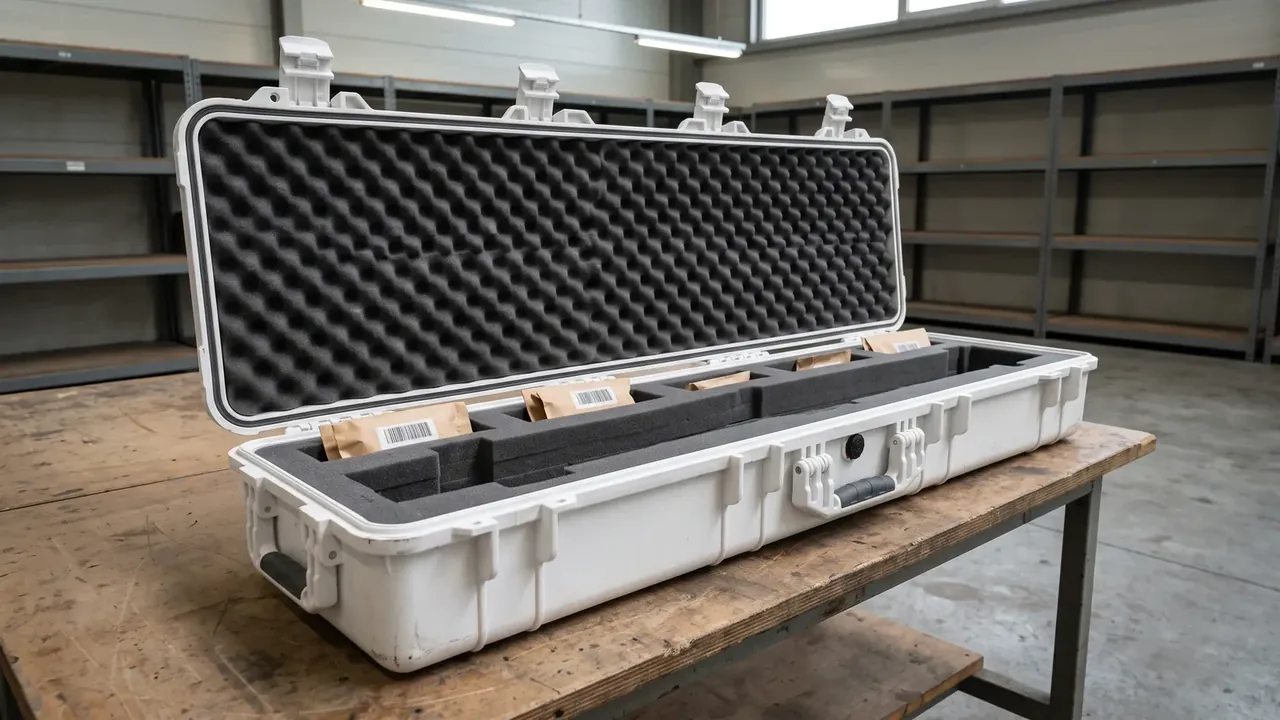
Labels set the pace of loading. A night dock runs near 50 lux, so a touring lighting case carries a code read at 5 m, characters no shorter than 40 mm.
The code takes three parts: two letters for the tour, one for type, three for sequence, as in A7-L-014, which covers 999 units per type before a fourth digit is needed.
The label sits high on the front at 100×50 mm with an 8 mm border, clear of the bumper and the stacking line.
A touring lighting case holds empty weight under 28 kg against a 45 kg load: a 45 ft trailer takes 52 cases a tier, 208 at four high, and every 2 kg costs 6 cases.
Casters are φ76 mm on twin bearings, 60 kg each, changed every 12 months. Breakaway force is 36 N on concrete, 66 N on gravel, past a comfortable push.
Conclusion
The life of a touring lighting case is set by three replacement clocks, not by wall thickness. Eight hundred closures mean 800 latch cycles, and a tongue at 5.5 mm, a 44 N opening force or a 1.5 mm rim gap each calls for a swap; a pin every 5000 cycles stops the lid sagging 0.8 mm; bearings every 12 months recover the 1.5 mm a 32 km season takes off the wheel.
This article covers the container (case) side only: specifications and design meaning, with no instruction on handling, loading or use of contents.
Related Reading
- Stage lighting and audio case configurations
- Touring equipment case selection and spares
- DJ and stage event equipment cases
Related Products
- 8 Series — Gun Cases; Military Equipment Cases; Camera Equipment Cases; Drone Cases; Watch Cases; Knife Cases; First Aid Cases; Electronics Equipment Cases
- WL8-2812 PP Gun Case — model WL8-2812
- All protective cases and toolboxes: 7 series, 158 models