

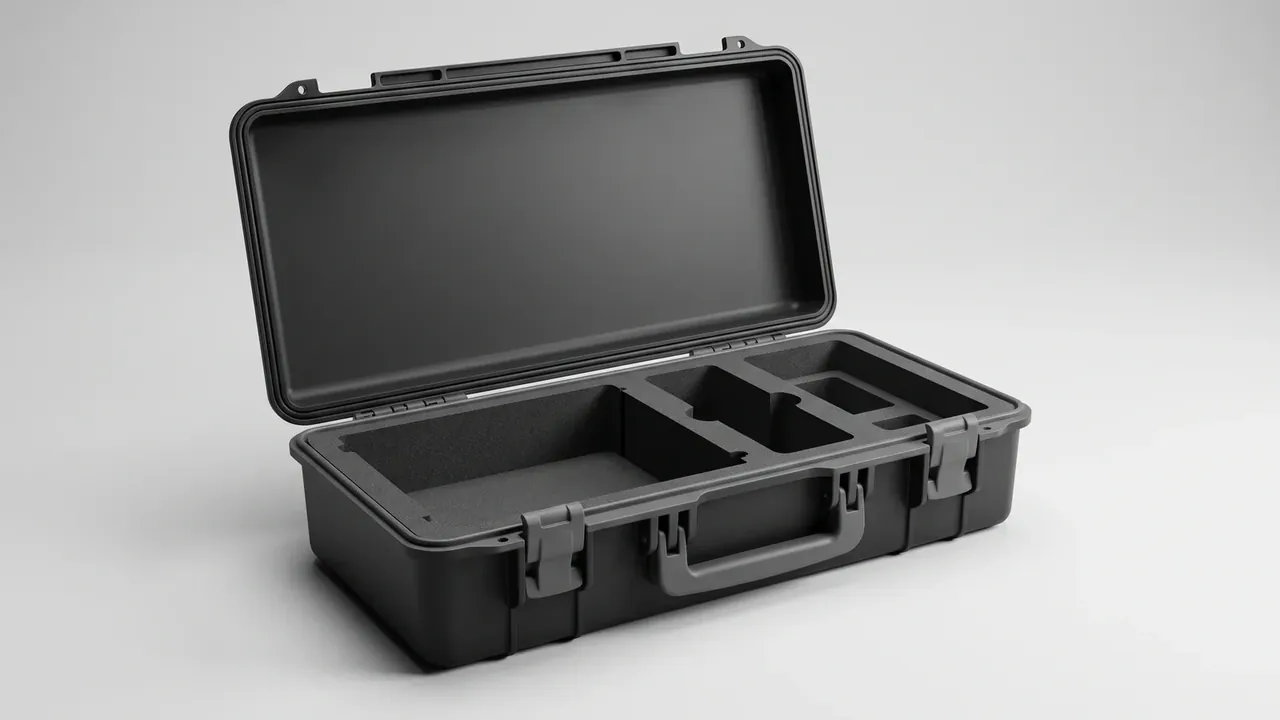
Quick answer: Plastic Cases earn their place on a lighting console when the empty shell weighs under 12 kg, the lid holds open in wing draughts, and three units stack in a 13.6 m trailer.
Table of contents
- Why Plastic Cases Fit a Lighting Console
- Shape and Weight: 300 mm Longer Than a Standard Case
- Load-In Rhythm: Lid Openings in a 90-Minute Window
- Truck Stacking: Bays and Layers in a 13.6 m Trailer
- Wing Space: Landing and Turning in a 1.8 m Walkway
- FAQ
1. Why Plastic Cases Fit a Lighting Console
A 60-stop tour opens and closes the console four times a day, plus a load and an unload, which comes to 480 lid movements. A plywood flight case absorbs impact and can be repaired on site, but it pays in dead weight: 26 kg empty for a 1.2 m console, 105 kg loaded, past the 50 kg two-person limit. Plastic Cases with a 4 mm wall and 12 mm ribs bring that to 11 kg empty.
The console is also the least regular object on the truck: the panel slopes from 120 mm at the front to 180 mm at the rear, the fader block sits 30 mm proud, the connector panel sticks out 45 mm. A console case is built around those three numbers.
| Item | Plywood flight case | Rotomoulded case |
|---|---|---|
| Outer size (mm) | 1350×850×450 | 1280×800×420 |
| Wall (mm) | 9 ply plus aluminium extrusion | 4 moulded, 12 ribs |
| Empty weight (kg) | 26 | 11 |
| Loaded weight (kg) | 105 | 62 |
| Handling | Ramp or three people | Two people |
A 4 mm wall sounds thin until you count ribs: six across the base, six across the lid, a double curve at each corner. Drop tests to the IEC 62262 IK08 rubric leave a dent but no split.
2. Shape and Weight: 300 mm Longer Than a Standard Case
A 1200 mm panel at 700 mm deep needs a cavity of 1210 by 710 mm, so the usual 600 by 400 case is irrelevant. The finished shell runs 300 mm longer than a case of similar volume, all of it in corner bumpers and hinge blocks.
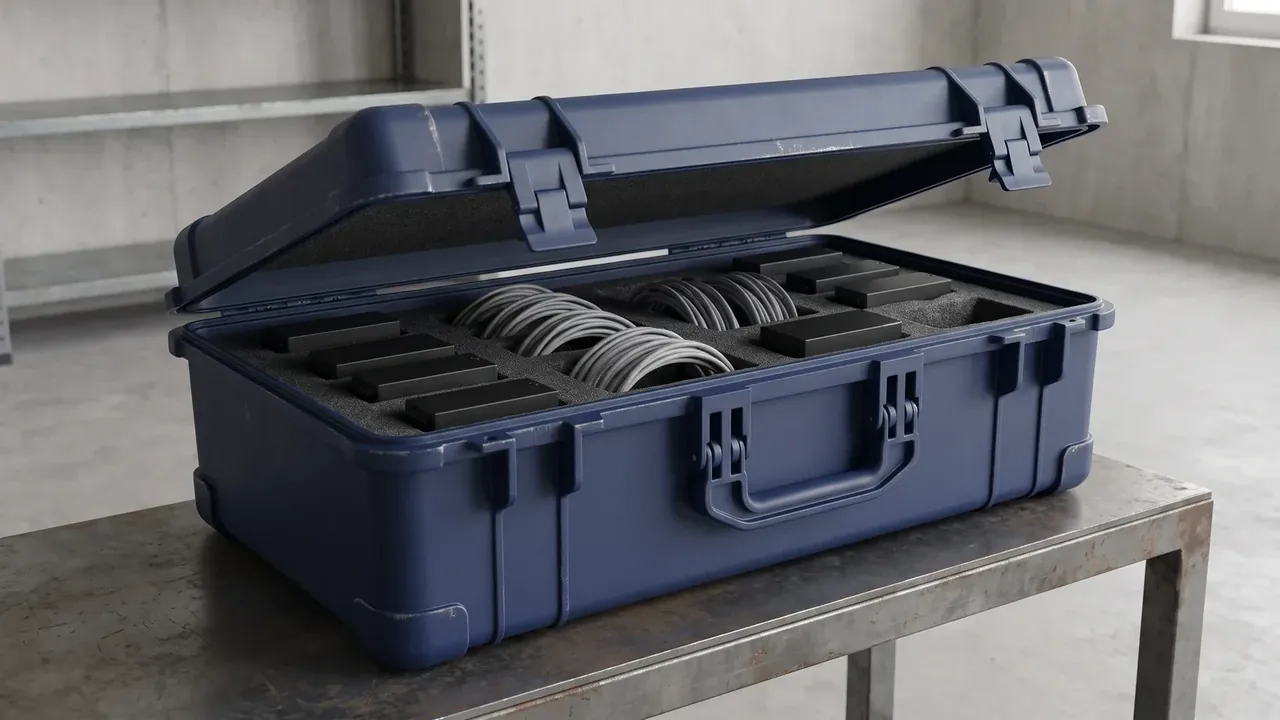
Handles follow the centre of gravity, not the centre of the case. The console balances 420 mm back from the front edge, so the side handles sit 110 mm behind the midpoint, each rated to 40 kg static pull. One person fore, one aft, and the case stays level over 13 m.
The weight splits as 11 kg shell, 3.2 kg foam and 38 kg console, 52.2 kg total; the 10 kg gap to the loaded figure is accessories and cable. Two people take 26 kg each between truck and monitor position, a load a crew will carry without setting down.
Aluminium extrusion is where plastic cases win by default: a timber case carries 6.5 kg of extrusion and rivets that returns nothing at load-in.
3. Load-In Rhythm: Lid Openings in a 90-Minute Window
Lighting gets 90 minutes from truck to power-up, and the console sits 28 m from the stage. Unload to power is 22 minutes, of which 9 minutes is case handling; the rest is levelling and cable. Fewer openings is not the goal — each one needs a reason.
| Stage | Minutes | Case action |
|---|---|---|
| Truck to floor | 4 | Two-person lift, four feet levelled |
| First opening | 3 | Stay at 105 degrees, power and data out |
| Self-test, lid closed | 2 | 50 mm gap at the rim for cable |
| Pre-show check | 3 | Full open, desk lamp and backup drive |
The third opening is where tours get hurt. If the stay has not locked, a wing draught folds the lid onto the faders, and a panel repair costs two dark days. A stay needing a 10 mm lift before release is why plastic cases survive tent roofs and crosswinds.
Strike runs in reverse: cable out, lid closed, truck. Thirty seconds checking the faders are parked saves three reworks across 60 stops.
4. Truck Stacking: Bays and Layers in a 13.6 m Trailer
A 13.6 m trailer gives 2.45 m of internal width. Two bays of the 1.28 m by 0.8 m console case take 1.6 m, leaving 0.85 m for the walkway. Layers follow the lid rebate: two for timber, three for moulded, the third carrying only identical units.
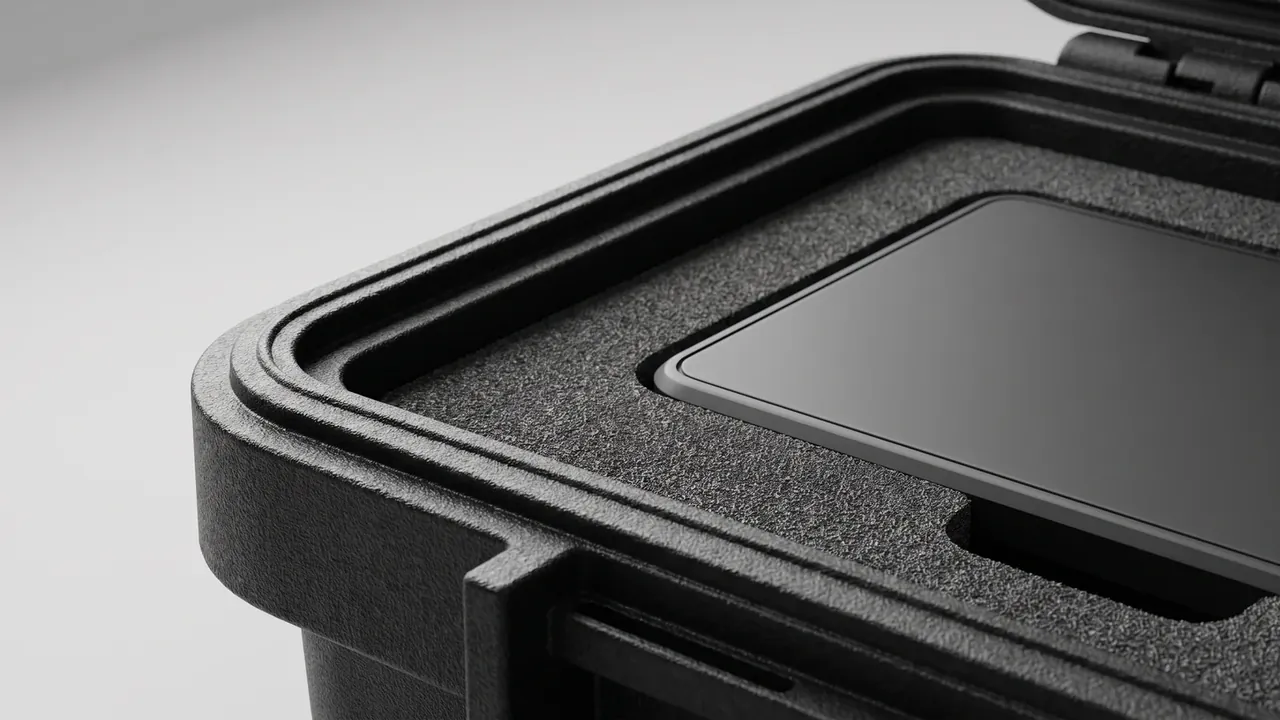
Stacking relies on four moulded locating bosses. Feet of the upper case drop into the lid recesses with no more than 5 mm of play, so a strap cannot pull the stack out of line. Straps cross the top edge, never a handle.
Top load is rated at 240 kg for 24 hours with the lid deflecting under 2 mm, stricter than three-high stacking, because the real load is the truss leaning on the stack overnight.
| Configuration | Layers | Top load (kg) | Anchors |
|---|---|---|---|
| Timber case | 2 | 80 | Aluminium corner blocks |
| Moulded case | 3 | 240 | Four moulded holes |
| Mixed stack | 2 | 60 | Needs a spreader board |
5. Wing Space: Landing and Turning in a 1.8 m Walkway
Wings often sit 1.8 m from the set, and an 0.8 m wide case needs 1.6 m to turn, leaving 200 mm of margin. In practice it goes in at 45 degrees on 50 mm skids, which cut friction and keep the base off the stage paint.
A tent roof over a monitor position may leave 0.9 m of headroom while a top-opening lid needs 1.1 m. Those venues want removable hinges, so the lid comes off and stands against a wall; the set costs under 5 percent of the case.
Exposure runs two hours per show, with wind, rain and dust. Sealing follows the IEC 60529 IP67 rubric, a double-lip gasket compressed 30 percent, a drainage channel at the rim. A 50 g desiccant pack takes humidity from 80 percent to 55.
Conclusion
The console alone defines where Plastic Cases can replace a flight case: a long footprint, an off-centre balance, a lid that opens fully in a wing. Three tests decide it — two people carry it 13 m, the stay holds against draught, three-high stacking deflects under 2 mm. Pass all three and the swap works.
Related Reading
- Cases for stage lighting and audio rigs
- Road case practice on tour and in transit
- ATA 300 ratings for airline transit cases
- Choosing a plastic case instead of a flight case
Related Products
- 8 Series — Gun Cases; Military Equipment Cases; Camera Equipment Cases; Drone Cases; Watch Cases; Knife Cases; First Aid Cases; Electronics Equipment Cases
- WL8-2812 PP Gun Case — model WL8-2812
- All protective cases and toolboxes: 7 series, 158 models