

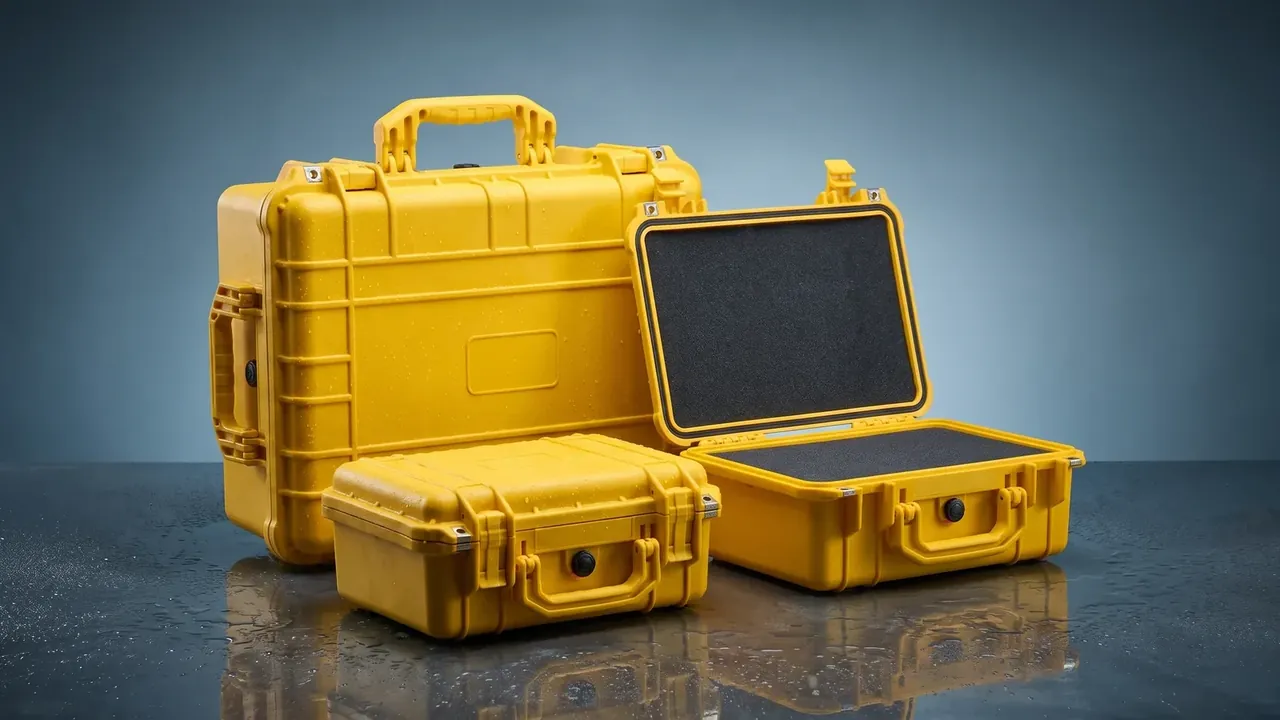
Quick answer: Do not start with wall thickness or price. Work through five criteria in order: transit stage and dwell time, internal dimensions and fill rate, sealing and dust, handling and stacking, then markings and traceability. The first two decide whether the load fits, the middle two whether the hardware survives.
Table of contents
- Five Criteria for Transit Case Selection
- Criterion One: Transit Stage and Dwell Time
- Criterion Two: Internal Dimensions and Fill Rate
- Criterion Three: Sealing and Dust Protection
- Criteria Four and Five: Handling, Stacking and Marking
- FAQ
1. Five Criteria for Transit Case Selection
Buyers ask about wall thickness, then price. Both come last: a Transit Case is shaped by its duty cycle, and the same 600 mm body can sit two grades apart on latches when the application changes.
| Criterion | What it fixes | Wrong call |
|---|---|---|
| Dwell time | Openings, latch type | Latches fatigue |
| Fill rate | Size, dividers | Extra truck runs |
| Sealing | Gasket, ports | Dust ingress, rework |
| Handling | Handles, lifting points | Cannot be lifted |
| Marking | Label recess, code | Labels tear the shell |
The first two are hard constraints; the last three trade against budget.
2. Criterion One: Transit Stage and Dwell Time
Band dwell time first. Under 4 hours at a hub, a batch averages 8 openings a day; four to 24 hours averages 12 to 15; overnight stays run past 20. Each band wants its own latch: single draw, wider twin, then a lock eye with a damped lid and dust lip.
Then ask whether each handover opens the case. Two batches with identical dwell but different opening points differ twofold in latch life. Where all three handovers open it, specify screwed rather than riveted bases.
3. Criterion Two: Internal Dimensions and Fill Rate
Work inward from the loading unit. A 600×400×320 mm Transit Case with a 6 mm wall and 8 mm base ribbing gives a 552×352×272 mm cavity, about 64% of the envelope. That is the ceiling for fill rate.
| External mm | Internal mm | Fill | Totes that fit |
|---|---|---|---|
| 400×300×220 | 356×256×180 | 62% | Two 200×150 |
| 600×400×320 | 552×352×272 | 64% | One 400×300, two 200×150 |
| 800×600×400 | 748×548×348 | 66% | One 600×400, two 400×300 |
Waste follows two patterns. Dropping 400×300 mm totes into a 600×400 mm case leaves 20 mm at each corner and pulls fill to 52%; foam pockets per item with 15 mm clearance cost two items a case. Movable dividers beat item-by-item alignment here.
Below 60% fill, do the truck maths first. A truck carrying 48 units gains 6 when fill rises from 64% to 72%, which dwarfs the case price at 20 runs a month. A batch moving three times a year never repays it.
4. Criterion Three: Sealing and Dust Protection
Sealing follows exposure, not price: the gasket, the latch compression and every port in the body decide it, and one weak element sets the rating for the case.
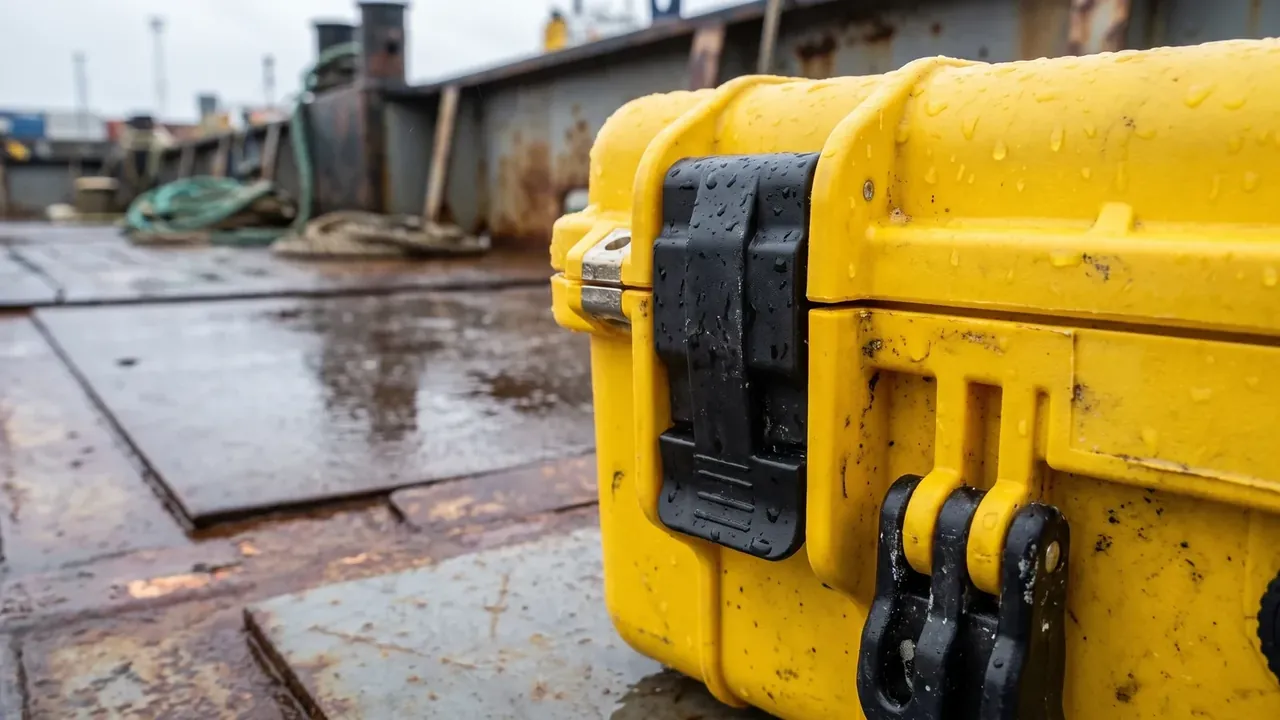
Indoors is a dust problem: IP54 with a solid silicone gasket at 25% compression is enough. Open yards need IP65, a hollow gasket at 30%, and four latches so pressure stays even along the joint. Past 35% the gasket takes a permanent set and leakage worsens. Exposure time matters too: under 4 hours open, a cover sheet will do; overnight, dust settles into divider slots.
5. Criteria Four and Five: Handling, Stacking and Marking
Handling depends on full weight. One person is limited to 15 kg, a two-person lift to 25 kg, anything heavier needs lifting eyes or forklift pockets. A 600×400×320 mm case weighs 5.2 kg empty and often 28 kg loaded: two people can lift it, but they will drag it after twenty metres.
Stack from the bottom layer, then drop one. A case rated five layers at 22 kg should run at four on a transit floor; a 30 mm offset raises corner stress by roughly 10%.
Markings matter more than they look. A case changes labels three or more times per loop, and stickers on a textured wall lift the skin on each peel. A recess 0.8 mm deep keeps the label flush; keep codes at 25 mm for a 0.6 to 1 m scan.
Conclusion
The hard part is not the datasheet but the duty cycle behind it: how long the load sits, whether each handover opens it, which tote module it carries. Dwell time fixes the latch and lid, internal dimensions fix fill and truck runs. A Transit Case chosen this way is rarely the most expensive, and usually the one that comes back for repair least often.
This article discusses only the container (case body) side of specifications and design intent, and does not cover any handling, loading or use of the contents.
Related Reading
- What a Transit Case is: its role in the chain
- Transit Case configurations for distribution and field transfer
- Case configurations for ammunition transfer points
- Shipping case selection: load, stacking, forklift and lifting
Related Products
- 8 Series — Gun Cases; Military Equipment Cases; Camera Equipment Cases; Drone Cases; Watch Cases; Knife Cases; First Aid Cases; Electronics Equipment Cases
- WL8-2812 PP Gun Case — model WL8-2812
- All protective cases and toolboxes: 7 series, 158 models