

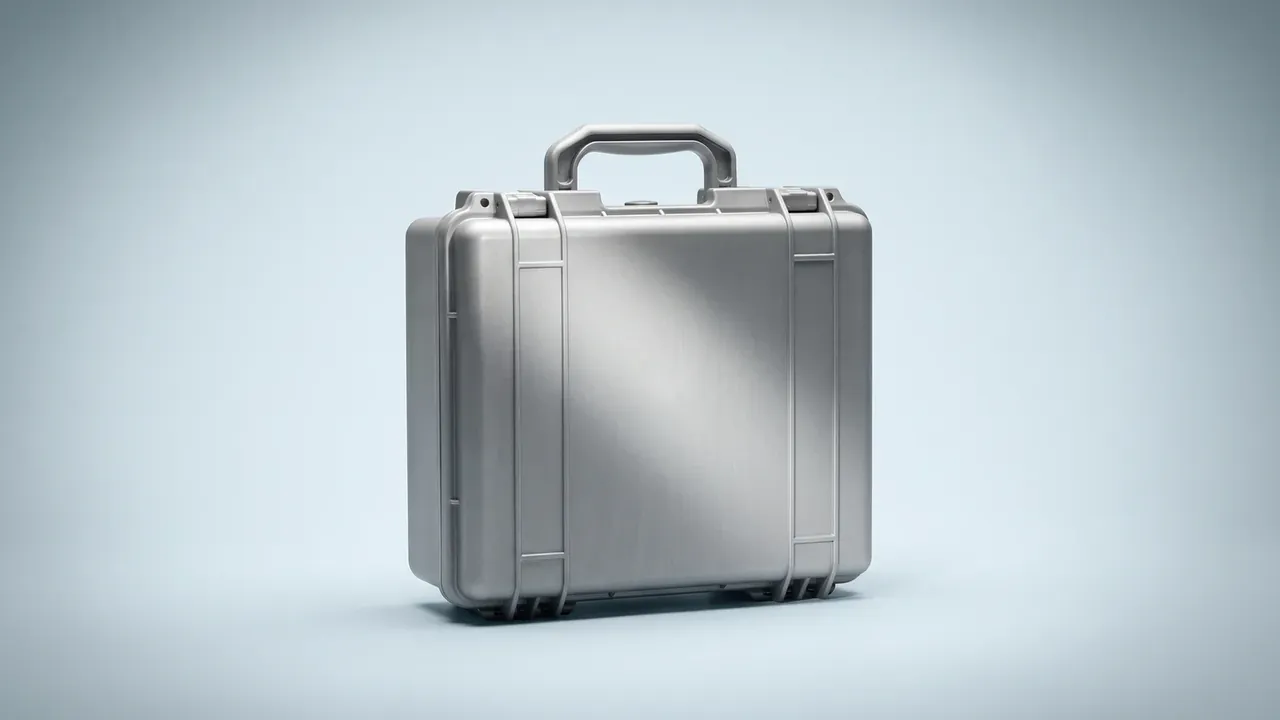
Quick answer: That batch came back because acceptance was thin, not because the mould was wrong: three units sampled, one dimension measured, fatigue never run. Lift the sample to 125, write the verdict in millimetres and cycles, and classify the defects.
Table of contents
- How travel case production sign-off failed on an 1800-unit batch
- Dimensions and appearance: three gauges decide
- Travel and drop: two separate lines
- Handles and trolleys: the fatigue curve
- Disposition: rework, concession, rejection
- FAQ
1. How travel case production sign-off failed on an 1800-unit batch
In November, 1800 cases shipped north and 214 came back within 14 days: 96 cracked wheel housings, 71 loose trolleys, 47 burst handle seams. All three items had been ticked as passed.
The outgoing check was visual only: the travel rig pulled 3 units from 200, the trolley rig 2 units twice a week. That proves the machine turns, not that the lot is sound.
Travel case production has to state its verdict as a number. "Moves freely" gives two inspectors two answers; 1.9 mm, 3000 cycles and 2 mm give one.
| Item | Field method | Verdict line |
|---|---|---|
| Cavity | Tape, 3 points per axis | 520 mm nominal, within 2 mm |
| Shell wall | Ultrasonic, 5 points | 1.9 mm nominal, 1.7 mm floor |
| Wheel travel | 23 kg payload, 32 km | Tread loss 1.5 mm or less |
| Trolley | 3000 cycles, 300 N side | Top play 2 mm or less |
Sampling follows GB/T 2828.1 level II, where 1800 draws 125. Major defects at AQL 1.5 accept 5 and reject 6; minor at AQL 2.5 accept 7 and reject 8. Eight defectives inside 125 and the lot stays outside.
Travel case production then gives three failures their own lines. The corner wall drops from 1.9 mm to 1.6 mm and keeps the stress; a burr inside the tube never shows up in a 3-unit pull; stitch density slides from 8 per 25 mm to 6.
2. Dimensions and appearance: three gauges decide
Travel case production cannot judge size by eye. The cavity is 520 by 360 by 240 mm, taped at 3 points per axis, and any point past 2 mm fails. Keep the diagonal spread under 3 mm, or the frame loads one side and latch life halves.
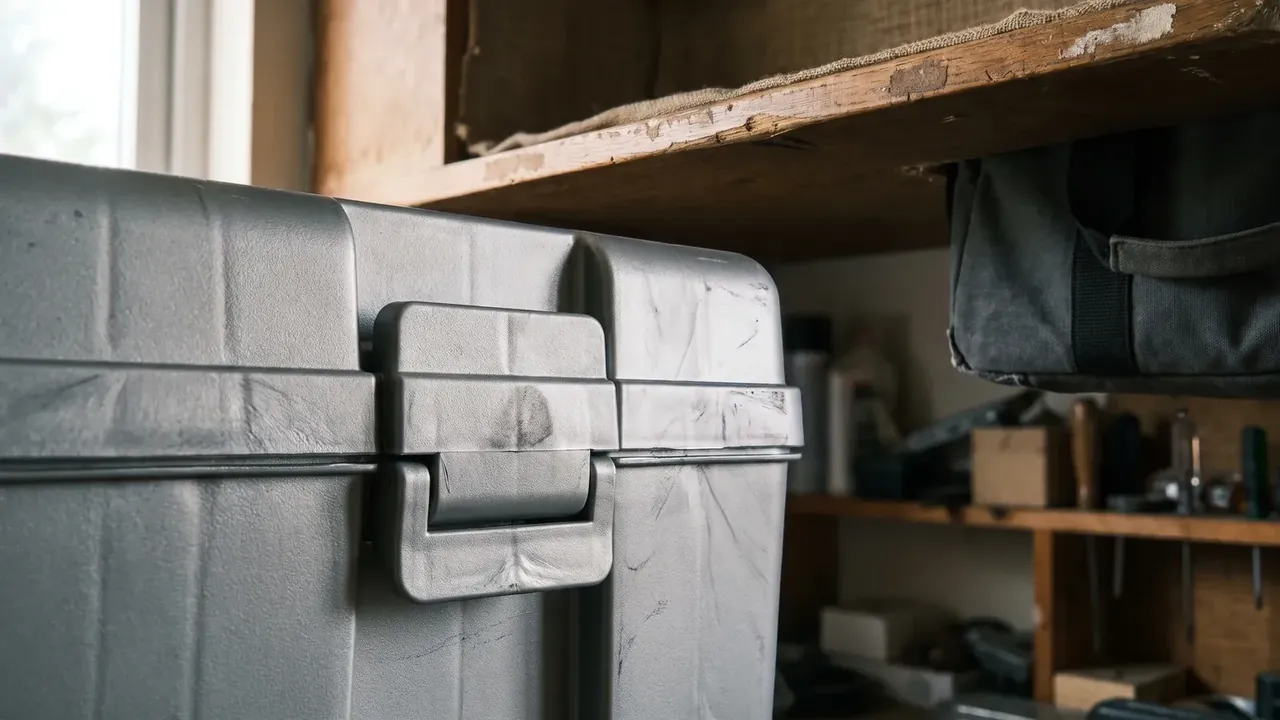
A 1.9 mm wall with a 1.7 mm floor needs an ultrasonic gauge at 5 points; a 1.6 mm corner cracks at -20℃ and the crack runs 40 mm along a rib.
Colour reads ΔE 1.5 within a lot, 2.0 across lots. A 0.3 mm feeler catches the parting line; the zip-to-frame gap stays at 0.5 mm, or a 23 kg load bows the frame.
3. Travel and drop: two separate lines
Travel is 32 km of small repeated shocks; drop is one peak event. A single rig cannot read both.
| Test | Sequence | Verdict |
|---|---|---|
| Travel | 23 kg at 4 km/h over 1000 obstacle bars | 32 km clean, tread loss 1.5 mm |
| Drop | 1.2 m, 6 faces 3 edges 1 corner | No through crack, latch shut |
| Cold drop | -20℃ for 4 hours, then 1.2 m | Crack 5 mm or shorter |
Travel case production runs 32 km, not 8: eight kilometres only skins the tread, and the housing crack starts after 20 km. Torque the axle nut to 1.2 N·m. Drop from 1.2 m, hand-carried height, and release a cold case within 30 seconds of the chamber.
4. Handles and trolleys: the fatigue curve
A trolley is judged on a curve. After 3000 cycles the top play grows from 0.8 mm to 1.6 mm; at 2.4 mm the wall is thin and 500 more cycles will rattle.
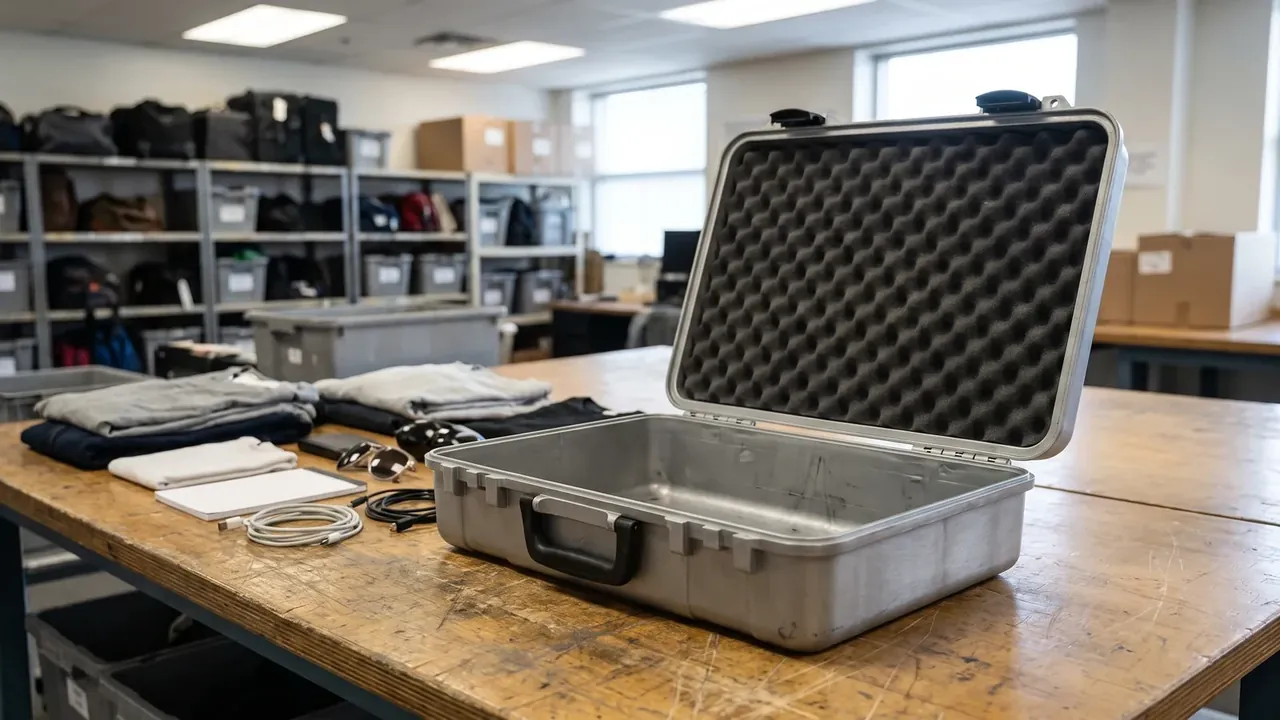
Run 3000 cycles at 30 per minute with a 400 mm stroke and 300 N hanging at the top, mimicking a turn with a loaded case. Handles take 500 N for 60 seconds, then 3000 lifts at 8 stitches per 25 mm in 210D polyester; at 6 stitches the static test passes and the lifts burst by 2000.
Temperature belongs in the line. At 60℃ the same 500 N leaves 3 mm of set instead of 1.2 mm, so write the limit against the hot result.
5. Disposition: rework, concession, rejection
| Class | Examples | Action |
|---|---|---|
| Critical | Latch failure, trolley pull-out | Quarantine, inspect every unit |
| Major | Cavity out of tolerance, wall under 1.7 mm | Rework or reject the lot |
| Minor | 0.3 mm parting line, light scuff | Concession or down-grade |
Travel case production reworks at about 38 yuan a unit, while returning a lot costs 96 yuan a unit with freight and storage. Critical defects sit outside that arithmetic.
Concessions need written consent, a capped quantity and a separate lot number, or nine units inside a clean 1800 become a traceability problem. Stop the line when the lot pass rate falls under 96%.
Conclusion
Those 214 units went back as a full rework at 38 yuan each, two orders of magnitude above the cost of sampling 125 before the container left. An acceptance line earns its keep not by the bad cases it catches but by the figures nobody can argue with: 1.9 mm of wall, 32 km of travel, 3000 trolley cycles, 2 mm of play. Put them on the drawing and the station card, and travel case production becomes repeatable.
This article discusses only the container (case body) side of specifications and design intent, and does not cover any handling, loading or use of the contents.
Related Reading
- A return post-mortem and its checklist
- Shell moulding, wheel assembly, trolley testing
- Writing verdict lines into the work instruction
- Drop and latch acceptance for airdrop cases
- Lot verdicts and sampling for ammunition boxes
Related Products
- 8 Series — Gun Cases; Military Equipment Cases; Camera Equipment Cases; Drone Cases; Watch Cases; Knife Cases; First Aid Cases; Electronics Equipment Cases
- WL8-2812 PP Gun Case — model WL8-2812
- All protective cases and toolboxes: 7 series, 158 models