

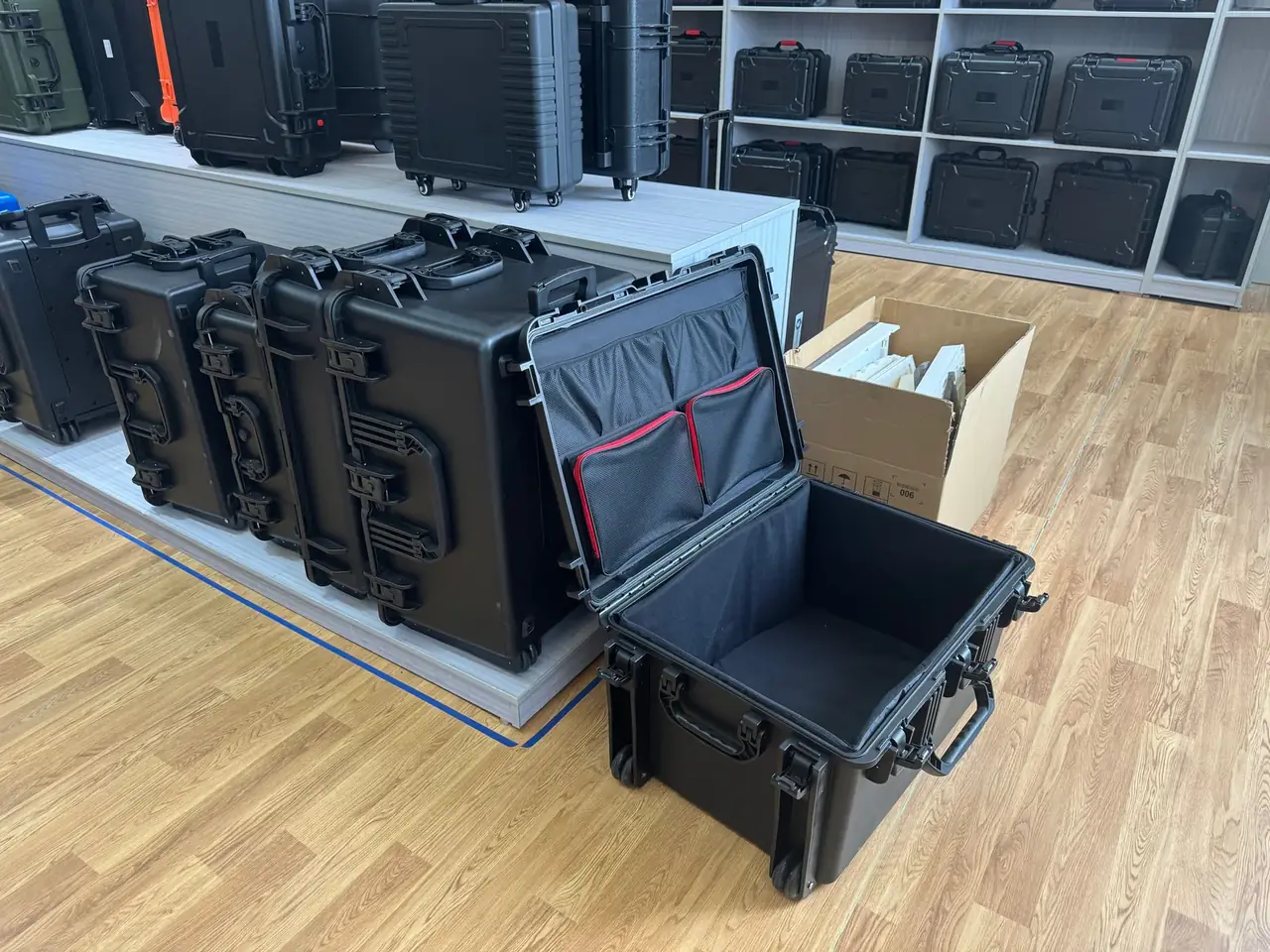
Quick answer: An ultrasound equipment transport case rolls on 4 castors of 75 mm and 7 floor ribs of 12 mm, and each latch must still hold 350 N after a 3–200 Hz sweep.
Table of contents
- Rolling Duty of an Ultrasound Equipment Transport Case
- Castor Layout and Bearing Life
- Floor Ribs and the Pallet Contact Face
- Latch Holding Force Under Road Vibration
- Handover Checkpoints
- FAQ
1. Rolling Duty of an Ultrasound Equipment Transport Case
Eighty metres of concrete separate the store from the loading bay, and an ultrasound equipment transport case is pushed over all of it. Three obstacles sit on that route: a speed hump at the door, a 15 mm step at the dock, and raised tie rings on the van floor. Shock travels through the castors into the ribs.
An ultrasound equipment transport case measures 620 × 450 × 280 mm outside and 570 × 400 × 240 mm inside, on a 5.0 mm wall at 11.5 kg empty, taking a quarter of a standard pallet. The low centre of gravity steadies it in a turn, but ground clearance is 75 mm, so anything taller is taken head-on.
2. Castor Layout and Bearing Life
Four castors of 75 mm diameter and 28 mm tread carry the shell, each rated 60 kg dynamic, so the set holds 240 kg against 11.5 kg plus cavity load and keeps a factor of three. A smaller wheel steepens the impact over a 15 mm step; a larger one lifts the base with it.
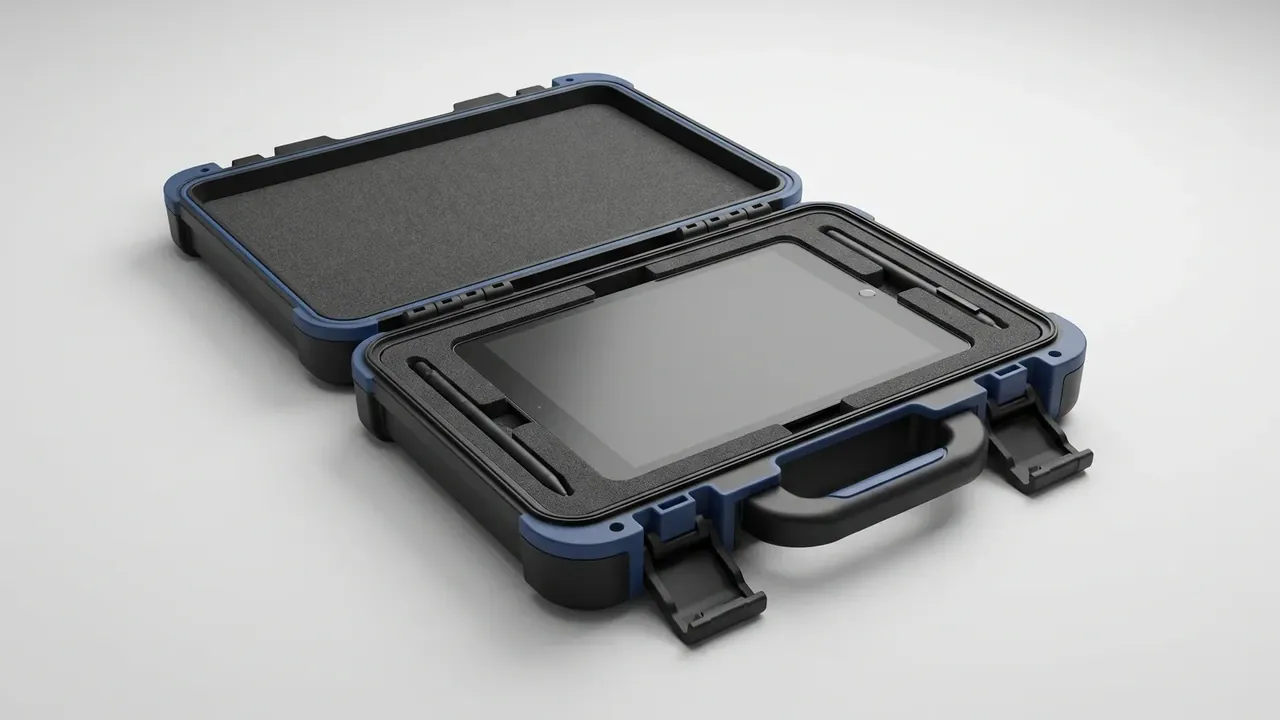
Each hub holds a 608ZZ bearing, 8 mm bore by 22 mm outside by 7 mm wide, rated 3.45 kN dynamic and 1.37 kN static. One wheel at 60 kg comes to about 0.59 kN equivalent load, and with a life exponent of 3 the rated life runs far past any pushing distance; grease gives out before the raceway. A 75 mm wheel covers 236 mm per turn, so a kilometre is about 4,200 turns, and replacement rests on feel: an empty case should coast two turns, with axial play under 0.3 mm.
| Castor layout | Surface it suits | Where the load lands |
|---|---|---|
| 4 × 75 mm swivel | Concrete, ramps, thresholds | Even at four corners |
| 2 × 75 mm plus tow frame | Flat hard floor, short moves | Front pair carries the bias |
| 4 × 75 mm braked | Inside a van, dock holding | All four grounded when parked |
3. Floor Ribs and the Pallet Contact Face
Seven ribs cross the short side at 12 mm high and 0.6 times the main wall thick, forming parallel beams under the cavity of an ultrasound equipment transport case. Gaps between pallet boards land between two ribs, so no span of the base hangs free.
Each corner of the base keeps a 40 mm square pad on a pallet board, while the middle rides on the ribs and drains rainwater between them. Polypropylene shrinks 1.5% to 2.5%, so the cavity of an ultrasound equipment transport case is cut oversize and each rib root carries 1° of draft, otherwise the rib tops lift and bow the base. The shell holds dimensions from −25 ℃ to +60 ℃, though PP turns brittle in the cold.
| Rib density | Rib height | Contact with the pallet |
|---|---|---|
| 7 ribs (this build) | 12 mm | Band contact, four corner pads |
| 5 ribs | 12 mm | Wider bands, middle sags |
| 9 ribs | 10 mm | Tighter contact, slower drain |
4. Latch Holding Force Under Road Vibration
A latch is the only tie between lid and body, and on a rough road it works open and shut thousands of times. An ultrasound equipment transport case is rated at 350 N here, the peak force that pulls the tongue from its seat. Below that, a loaded case bouncing on a van floor pops the lid open.
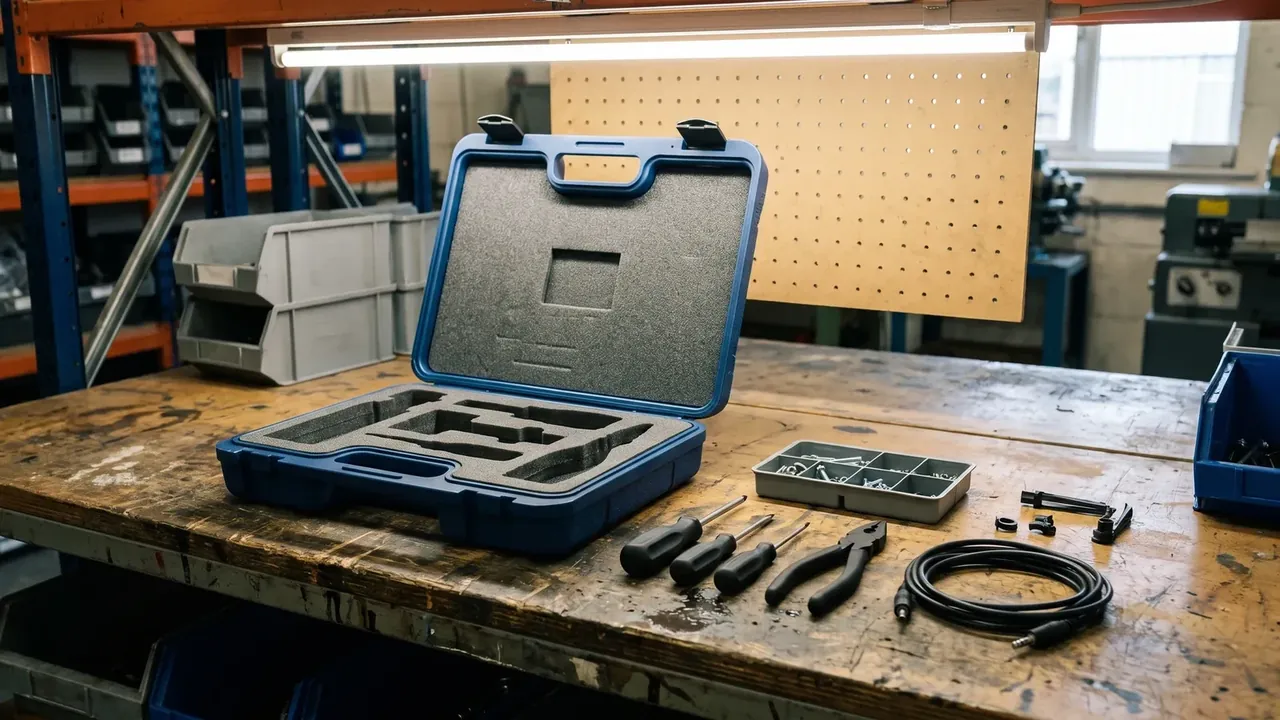
Once a gap appears the gasket loses preload. IP67 means 1 m of immersion for 30 min with no harmful ingress, and that grade needs gasket compression and latch-seat stiffness together. Vibration runs as a 3–200 Hz sweep at 30 min per axis; ISTA 3A covers 1–200 Hz at 0.5 to 1.0 Grms over the same 30 min, spreading energy across the band while a sine sweep walks each resonance. Latch tongues resonate between 40 and 70 Hz, so 4 castors of 75 mm must still hold 350 N after a 30 min sweep before the case leaves the plant.
5. Handover Checkpoints
A handover check on an ultrasound equipment transport case is not a look inside; it is one action at four fixed points. At the store door, push two metres and listen. At the dock, run a hand under the four corners. On the dock stand, press a latch once. Before opening, read the gasket imprint.
| Handover check | Action | Limit |
|---|---|---|
| Store door | Push two metres, listen | Any rumble, change the wheel |
| Dock loading | Feel the four base corners | Rib worn through, take it out |
| Dock stand | Press the latch, hear it seat | Not seated, clean it |
| Before opening | Read the gasket imprint | Imprint broken, re-inspect |
Records for an ultrasound equipment transport case are filled per trip. A flat force curve says the latch seat was sized correctly, while a sudden drop over a few trips points to a new road surface. Scrapping follows the batch: when most units sit on the 350 N floor, the seat for that build was low. Stacked 3 high, the bottom lid carries the two above, so the round also checks its face for a shallow dish.
Conclusion
Life on a rolling route is set by the castor layout, caught by the rib density, then confirmed at four handover points. Fix 4 castors of 75 mm on 608ZZ bearings, seven 12 mm ribs and a 350 N latch hold, and an ultrasound equipment transport case comes through eighty metres of concrete and a 3–200 Hz sweep intact.
Related Reading
- The Usable-Volume Calculation
- Plastic Case versus Wooden Crate
- EVA Lining for Precision Instrument Cases
Related Products
- 8 Series — Gun Cases; Military Equipment Cases; Camera Equipment Cases; Drone Cases; Watch Cases; Knife Cases; First Aid Cases; Electronics Equipment Cases
- WL8-2812 PP Gun Case — model WL8-2812
- All protective cases and toolboxes: 7 series, 158 models