

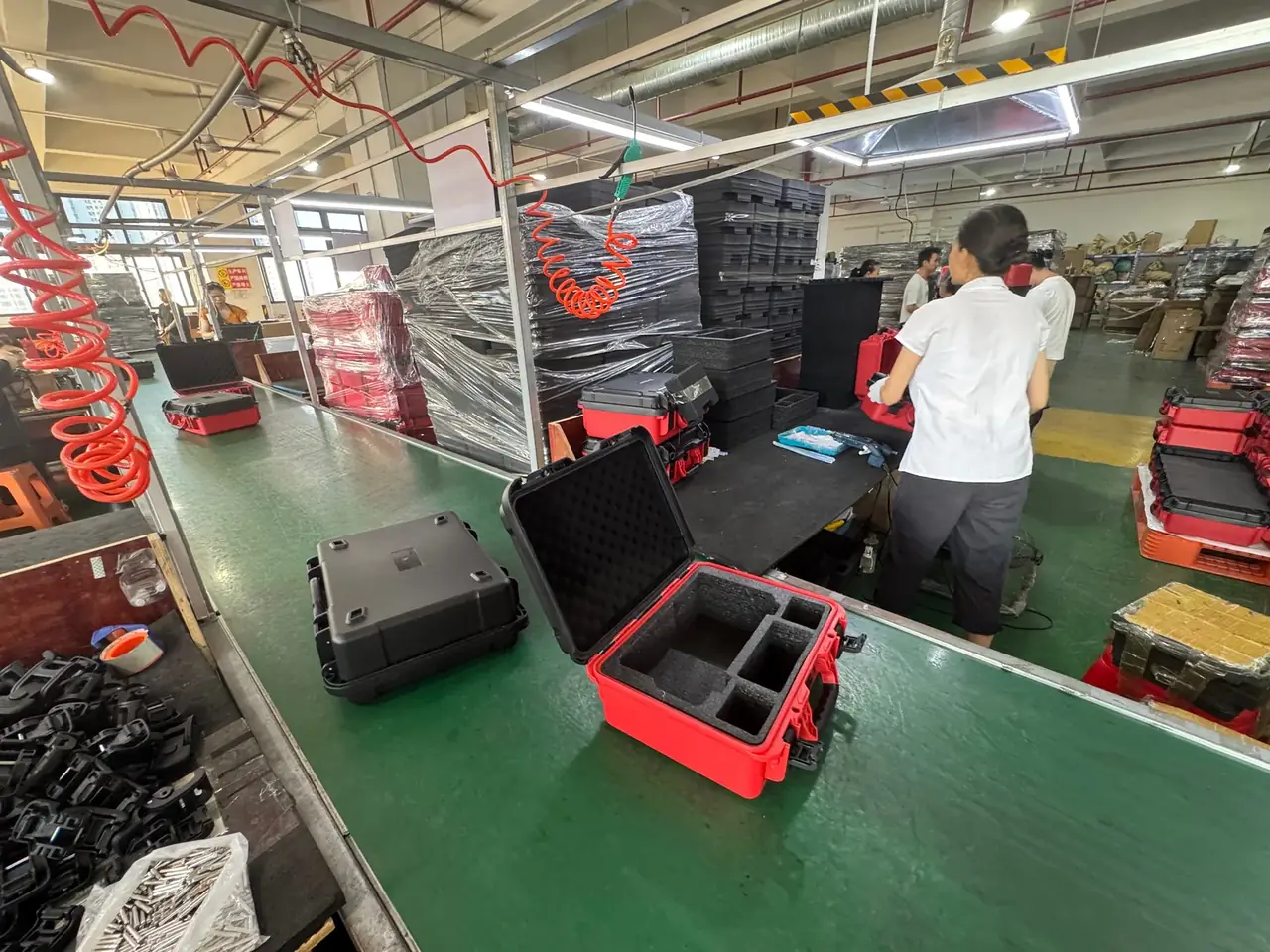
Quick answer: The Vehicle side-mount camping shockproof box holds bracket loosening to 0.5 mm after a 10-55 Hz shaker run via a 210 mm hole pitch and a 55 A pad.
Table of contents
- Bracket hole spacing of the Vehicle side-mount camping shockproof box
- Damping pad hardness under the base
- Looseness read off the vibration rig
- Seal pressure decay after bolts are re-torqued
- Freezing the pitch for vehicle batches
- FAQ
1. Bracket hole spacing of the Vehicle side-mount camping shockproof box
Mounted at the tail, a side-hung case takes long small-amplitude shaking; bracket hole pitch decides which panel carries the load, and pad hardness decides how much reaches the lid seam. This Vehicle side-mount camping shockproof box seats its brackets between two base ribs at 210 mm trial spacing: shorten it and vibration drives into the base centre, scrubbing the seal; lengthen it and the bolts work loose first. A 600x420x260 mm shell, 530x355x190 mm cavity and 4.3 mm wall shift the looseness reading once the pitch moves.
The rig locked three brackets, short, middle and long, on one shell. The short pitch held steadiest but the mouth leaked past 0.3 kPa in 10 min. The middle pitch pushed both readings to the lower bound. The long pitch shed load to the walls yet its bolts gapped past 0.5 mm. All three weighed 6.8 kg empty. The trial log of the Vehicle side-mount camping shockproof box splits by pitch tier, so a wear mark maps to one bracket.
| Hole-pitch tier | Bracket looseness | Mouth pressure loss / 10 min |
|---|---|---|
| Short pitch | 0.2 mm, preload held | 0.4 kPa, seal leaks first |
| Middle pitch | <=0.5 mm | <=0.3 kPa, pass |
| Long pitch | 0.7 mm, bolt backs off | 0.2 kPa, bracket rejected |
2. Damping pad hardness under the base
The four base pads use Shore 55 A; harden them and vibration goes straight to the bracket, soften them and the pad eats too much travel, leaving both seals short of 21% compression. This Vehicle side-mount camping shockproof box fixes pad thickness with pitch because a 10-55 Hz sweep isolates the low band through the pad and the high band through bracket stiffness.
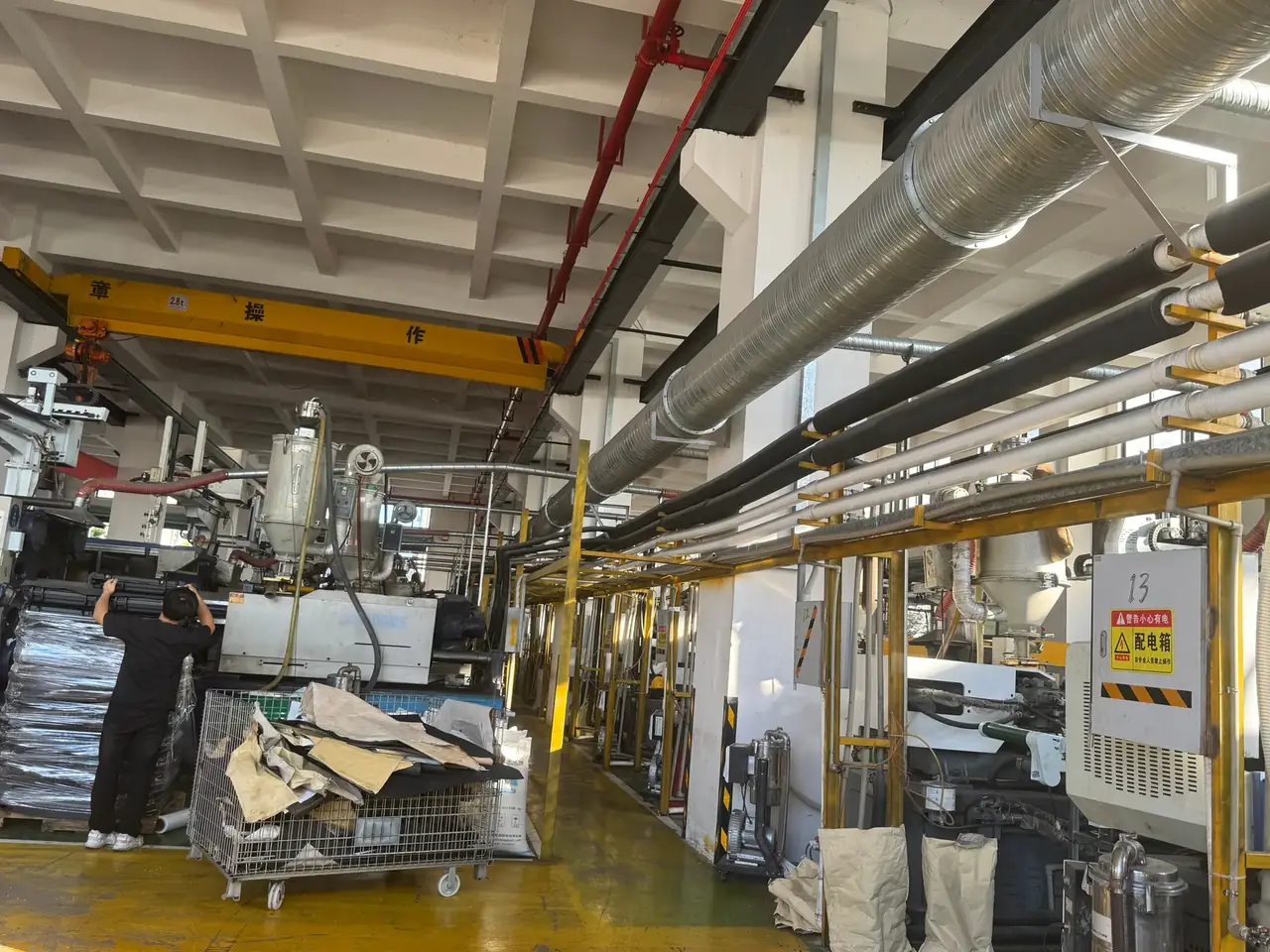
A pad sits best at half its travel; any softer and the lid seam loses support.
Each pad is pre-compressed alone before fitting, and the log reads residual set. Bracket bolts are re-torqued twice on the diagonal with looseness noted each time; a tier still moving after the 200 km equivalent run is returned whole. Four 420 N latches press the mouth edges, and a soft pad collapses both seals after 4300 cycles.
3. Looseness read off the vibration rig
The rig sweeps 10-55 Hz over a 200 km equivalent, then logs the largest bolt displacement at four bracket corners. The Vehicle side-mount camping shockproof box books only the settled figure, not the in-run peak: the middle pitch holds to 0.5 mm, the long pitch gaps at the same band. Sliding along the pitch axis is charged to the bracket, lift off the base to the pad.
One run is empty at 6.8 kg, one at the rated 16 kg; the loaded state carries more inertia yet the 0.5 mm ceiling stays. Sweeping low to high matters because low-band travel belongs to the pad and high-band load to the bolts. The vibration log of the Vehicle side-mount camping shockproof box is kept cell by cell across band, pitch tier and load state.
| Vibration band | Load state | Looseness, middle pitch |
|---|---|---|
| Low band from 10 Hz | Empty 6.8 kg | 0.3 mm, pad absorbs |
| High band to 55 Hz | Rated 16 kg | 0.5 mm, bolts loaded |
| Worst across sweep | Rated 16 kg | <=0.5 mm, pass |
4. Seal pressure decay after bolts are re-torqued
After the sweep the bolts are re-torqued, the mouth charged to slight positive pressure, and the decay over 10 min read rather than the instant fill. This Vehicle side-mount camping shockproof box holds re-torqued loss to <=0.3 kPa / 10 min, tighter than the pre-run seal figure, since bracket creep may have drawn a hairline at the lid edge.
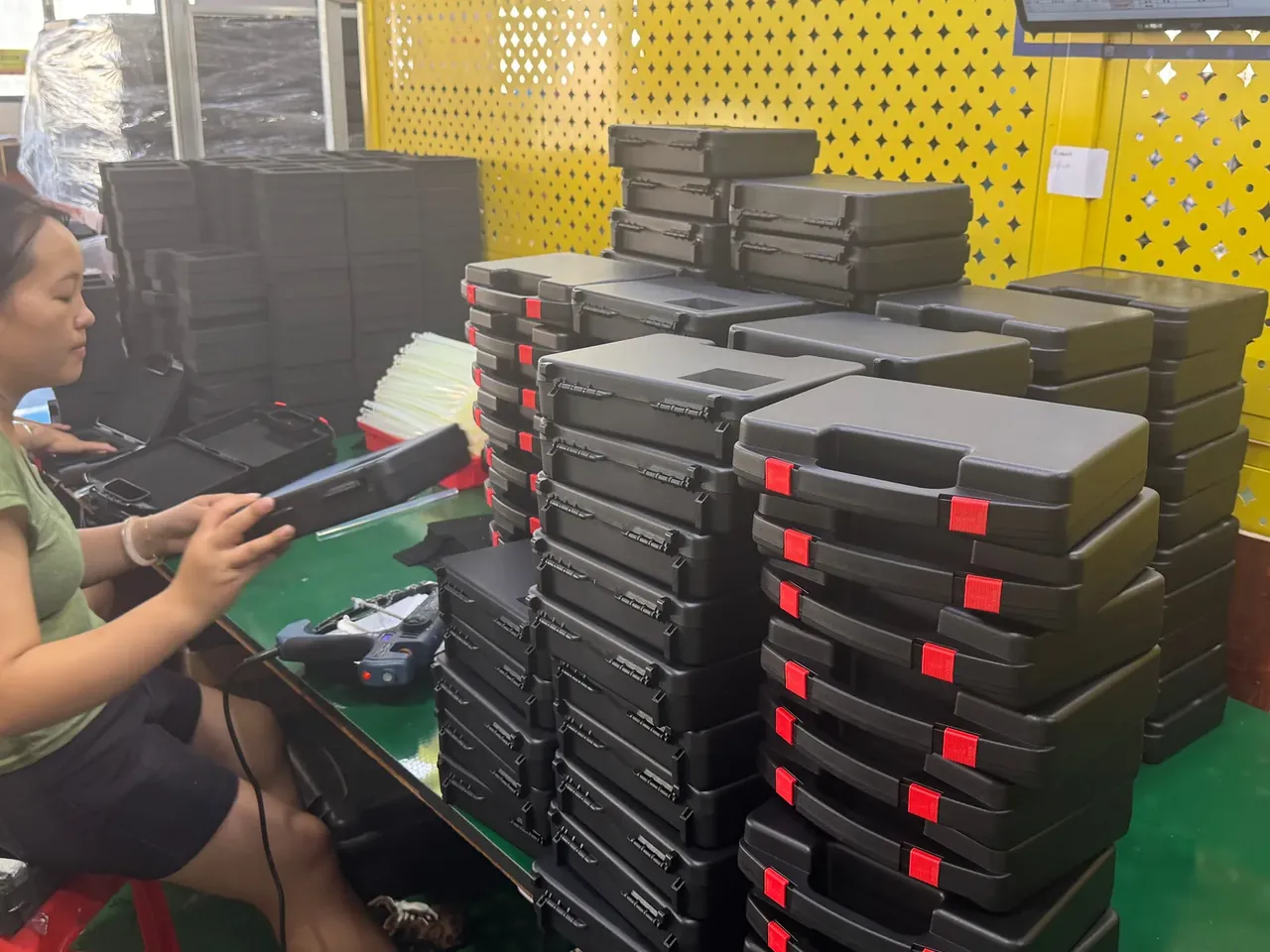
Pressure loss is read alongside the seals: a shifted pitch presses the two 21% gaskets unevenly and the biased side vents first. A pressure tab on each of four mouth edges sends any lid with a 0.1 kPa spread to bracket rework. The readings repeat after 4300 cycles to confirm decay is not growing, and the IP66 spray check follows only once the re-torque passes.
5. Freezing the pitch for vehicle batches
The pitch setting is the shortest tier whose looseness after the run stays within 0.5 mm, and any longer spacing stays out of the side-mount configuration. On the log the middle pitch is kept, the long pitch goes back for tool changes, and the side-mount batch of the Vehicle side-mount camping shockproof box accepts only the former drawing. Release follows the worst of 18 boxes.
Three columns, bracket pitch, pad hardness and re-torqued pressure loss, are signed together, and a missing column denies the side-mount drawing. JUNZHIJIA shells are trialled by Kexin New Materials (Guangdong) Co., Ltd. on one tool; once approved, later lots keep a 10-55 Hz sample and mouth re-torque only. The record for the Vehicle side-mount camping shockproof box thins to looseness and pressure loss, with the 4.3 mm wall and 600x420x260 mm envelope in the first-article file.
| Looseness reading | Tier | Lot disposition |
|---|---|---|
| 0.2 mm | Short pitch | Keep, recheck soft seal |
| <=0.5 mm | Middle pitch | Release to side-mount spec |
| >0.5 mm | Long pitch | Whole lot to tool rework |
Conclusion
The Vehicle side-mount camping shockproof box rests its side-mount spec on 210 mm pitch, a Shore 55 A pad, <=0.5 mm looseness and <=0.3 kPa / 10 min pressure loss. Only the middle tier holds bracket and mouth together; shorter leaks at the seal, longer loosens at the bolts. With band, pitch tier and load logged cell by cell, later lots need only a sweep sample and mouth re-torque. With pitch and pad hardness fixed, assembly is just building to the drawing.
Related Reading
- How to choose a camping storage box: volume, sealing and vehicle fit
- Portable camping plastic trunk for the vehicle
- Outdoor camping storage box with lid, stackable
- Camping cooking case and portable stove case protection
Related Products
- 8 Series — Gun Cases; Military Equipment Cases; Camera Equipment Cases; Drone Cases; Watch Cases; Knife Cases; First Aid Cases; Electronics Equipment Cases
- WL8-2812 PP Gun Case — model WL8-2812
- All protective cases and toolboxes: 7 series, 158 models