

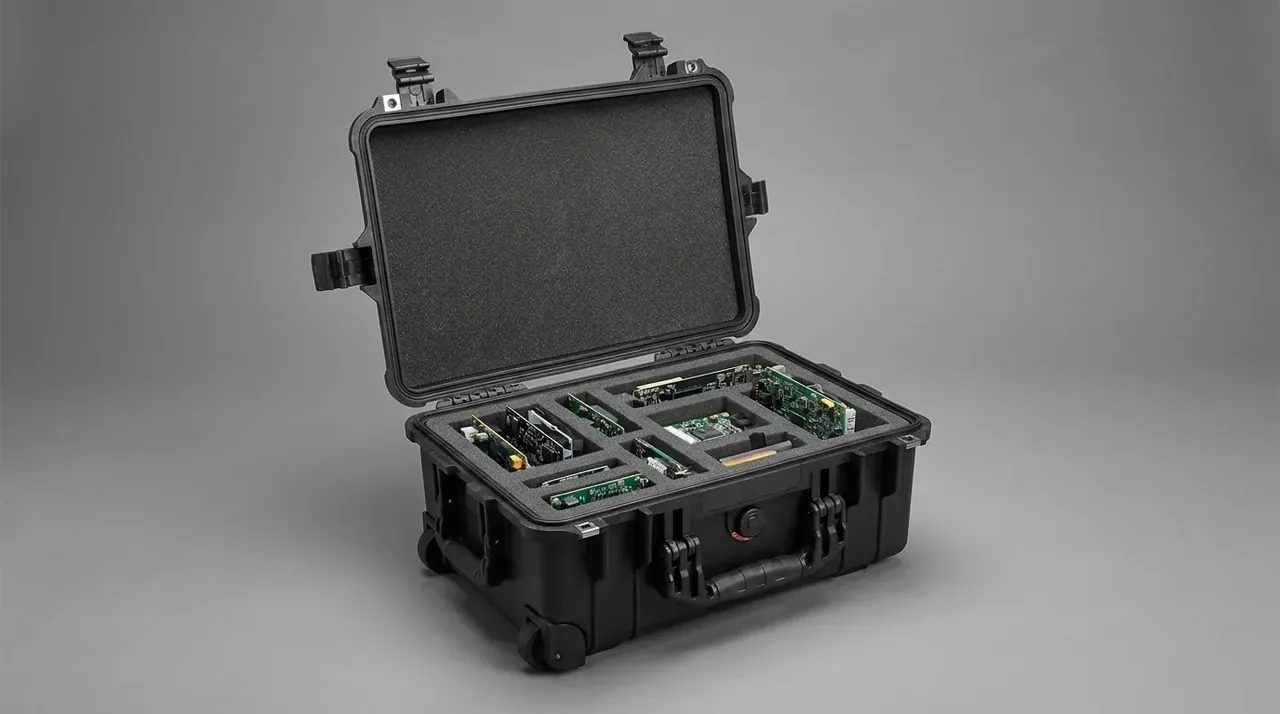
Quick answer: Portable camping plastic trunk container stops 25 kg from sliding at 0.8 g braking with 4 base detents 8 mm deep and a 0.4 friction floor.
Table of contents
- The braking load case behind a Portable camping plastic trunk container
- How detent grooves and the base friction value absorb horizontal inertia
- Why 3-layer stacking stays aligned and the lid carries 80 kg
- What two latches and two handles mean under carry loads
- Benchmarking IP54, the temperature band and the 1.0 m drop
- FAQ
1. The braking load case behind a Portable camping plastic trunk container
The governing load for a Portable camping plastic trunk container is not a fall but the horizontal inertia of a slowing vehicle. Outer size 700 x 450 x 350 mm and cavity 640 x 390 x 300 mm fix the depth it takes; a 3.5 mm wall and 6.6 kg empty mass fix its own weight; 25 kg is the rated load. One question remains: under 0.8 g braking, will that 25 kg slide forward.
A drop is an accident; braking repeats every trip. Built on drop logic, a Portable camping plastic trunk container piles material into walls and corners yet leaves the horizontal direction unconstrained. What works is base-to-surface engagement plus a load path through lid, base and wall: uneven support lets one detent disengage first, while a 3.5 mm wall only stops base sag, never replacing the groove wall.
Braking sets the constraint.
2. How detent grooves and the base friction value absorb horizontal inertia
Four detents, each 8 mm deep, are the first constraint a Portable camping plastic trunk container uses against 0.8 g braking; once they engage the surface ribs, horizontal inertia is stopped by the groove walls instead of friction alone.
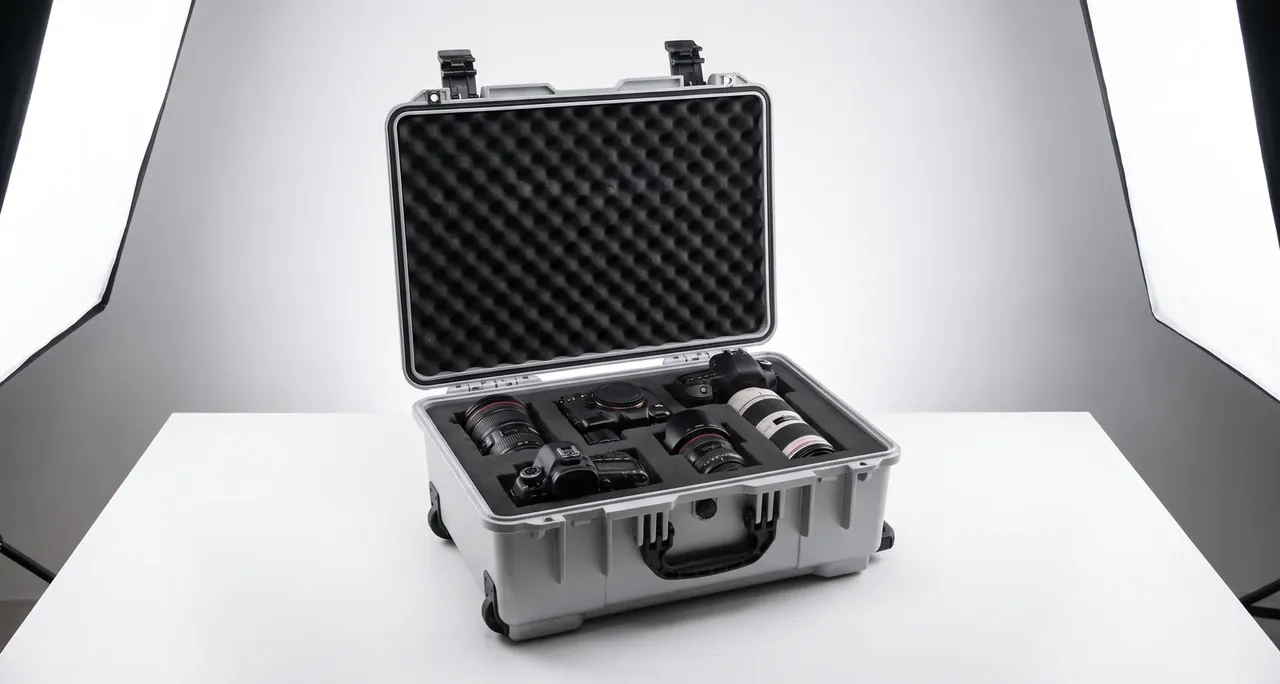
The 0.4 base friction coefficient is the second constraint, measuring the base-to-support interface rather than extra shell mass. The groove walls take most of the braking load, friction covers the remainder, and the box shows no visible shift. A depth of 8 mm balances stopping the slide with seating against the lid below when stacked.
| Vehicle state | Main load | Corresponding value |
|---|---|---|
| Steady running | Vertical static | Load 25 kg, empty 6.6 kg |
| 0.8 g braking | Horizontal inertia | 4 detents 8 mm deep, friction 0.4 |
| 3-layer stacking | Upper press load | Lid carries 80 kg |
| Carry transfer | Single-point lift | 2 handles at 350 N each |
A Portable camping plastic trunk container is not specified by picking a material first; 0.8 g and 25 kg come first, then groove depth and interface value are derived backwards.
3. Why 3-layer stacking stays aligned and the lid carries 80 kg
Three-layer stacking is the second state a Portable camping plastic trunk container meets in a trunk. The lid is both the bearing face above and the closure below. The 80 kg lid load measures whether the face takes the press load of two upper boxes through the walls without permanent dish. For three layers to stay aligned, the lid rim and base detents must share one datum; otherwise each layer adds an offset and the step stops the top latches closing.
The 3.5 mm wall passes force rather than stopping it: lid load travels down the vertical ribs to the base, then spreads through the four detents. A rebate between lid and body, clamped by two latches, also limits lateral drift. Chaining rebate, ribs and grooves into one load path, a Portable camping plastic trunk container turns the stacking question from collapse into shift.
| Constraint | Measured condition | Acceptance wording |
|---|---|---|
| No slide | 0.8 g braking, 25 kg load | Groove engagement, friction 0.4 |
| No shift | 3-layer stacking | Lid rebate and base grooves share datum |
| No dish | Lid carries 80 kg | 3.5 mm wall, ribbed lid |
| No pop-open | Single lift at 350 N | 2 latches at 350 N each |
The four constraints interact: thicken the lid for 80 kg and the no-shift line fails first.
4. What two latches and two handles mean under carry loads
Two latches at 350 N each and two handles at 350 N each apply once a Portable camping plastic trunk container leaves the vehicle: the first measures holding force after closing, the second grip strength for a one-hand lift.
The two latches sit symmetrically along the long mouth edge, and 350 N per latch answers internal load pushing the lid open; two rather than more lets one closing motion finish with no missed latch. Two handles at 350 N each answer a single-person lift, with grip points in the same vertical plane as the centre of gravity so one mouth side does not gape first. A 1.0 m drop is the slip case, judged by latches not springing and handle roots not cracking.
The working range of -15 °C to 60 °C covers an outdoor-parked vehicle: cold embrittles latch material, heat cuts wall stiffness, and both erode the 350 N holding force. IP54 gives the mouth sealing wording under rain and dust, benchmarked against the matching method rather than stated as a grade already obtained.
5. Benchmarking IP54, the temperature band and the 1.0 m drop
The 1.0 m drop, the -15 °C to 60 °C band and IP54 each map to one method: free-fall inspection of shell and latch state, closure and handle rechecks after hot and cold storage, and the matching dust and splash method on the mouth seal. Every benchmark here is phrased as verified against a named method.
| Design value | Belongs to | Benchmark method |
|---|---|---|
| 700 x 450 x 350 mm | Outer size | Measure against drawing |
| 640 x 390 x 300 mm | Cavity | Measure against drawing |
| 3.5 mm | Wall thickness | Spot-check thickness |
| 1.0 m | Drop | Benchmark by free-fall method |
| IP54 | Mouth seal | Benchmark by IP54 method |
Drawing measurement and thickness spot-checks are box-side geometric checks; the free-fall benchmark tests whether the shell cracks after 1.0 m. All numbers come from the fixed set for this piece.
Conclusion
The value chain of a Portable camping plastic trunk container starts at 0.8 g braking and 25 kg of load, runs through four 8 mm base detents and a 0.4 friction coefficient, and ends at 3-layer alignment and an 80 kg lid. The 700 x 450 x 350 mm outer size, 3.5 mm wall and 6.6 kg empty mass are boundary conditions. Check two latches and two handles at 350 N each, then benchmark IP54, -15 °C to 60 °C and the 1.0 m drop, and this box-side specification holds together.
Related Reading
- Three-mode portable transport box with hand, shoulder and wheels
- Selection criteria for portable protective cases
- Single-hand, shoulder and cabin three-tier plastic carrying case
- Cooler versus protective case comparison
Related Products
- 8 Series — Gun Cases; Military Equipment Cases; Camera Equipment Cases; Drone Cases; Watch Cases; Knife Cases; First Aid Cases; Electronics Equipment Cases
- WL8-2812 PP Gun Case — model WL8-2812
- All protective cases and toolboxes: 7 series, 158 models