

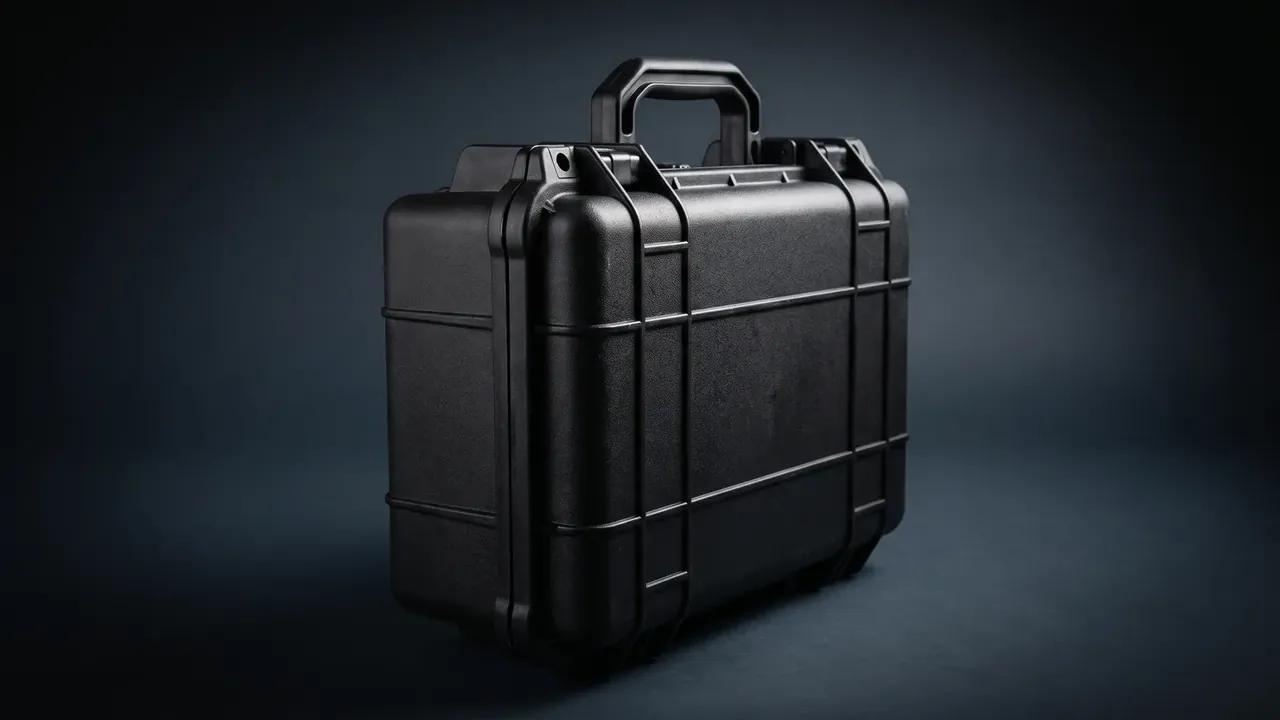
Quick answer: A Veterinary Equipment Protective Case drains through one 12 mm valve on a 4° floor in under 90 s, holding three water traps and a 4 mm gasket groove.
Table of contents
- Wash-Down Conditions a Veterinary Equipment Protective Case Meets
- Drain Valve Bore and Emptying Time
- Three Places Water Stays Inside the Case
- Mildew Treatment in the Gasket Channel
- Standing Time Before the Lid Goes Back On
- FAQ
1. Wash-Down Conditions a Veterinary Equipment Protective Case Meets
The smell that greets you the morning after a wash-down seldom comes from the gasket. It comes from the corners at the bottom.
A Veterinary Equipment Protective Case meets a hose and a stiff brush, not a cloth. At the usual 0.3 MPa wash pressure, water rebounds off the wall and carries mud, grass and dust into every gap within reach. The shell is 540 × 400 × 240 mm outside on a 4.8 mm wall, the cavity is 495 × 355 × 200 mm, and 2 latches at 320 N hold the gasket closed.
Water inside has four routes: down the side wall, sideways along a rib, slowed at the corner radii, and finally into the drain. The first three decide where it stops, the fourth how long it stays.
Jet angle matters as much as pressure. Held at an angle, water pushes debris along the wall; held square, it spreads at impact and drives debris into seams. Practice sits near 30°, sweeping from the far end toward the valve.
The lid liner is most often overlooked. Once wet it will not dry on its own, and closing the lid traps the moisture. A Veterinary Equipment Protective Case uses a liner that lifts out in one piece to stand on edge after a wash.
2. Drain Valve Bore and Emptying Time
One valve, 12 mm across, sits at the lowest point of the floor, with a 15° flare so water cannot hang as a film at the outlet. The floor runs at 4°, near seventy millimetres of fall per metre, letting gravity carry the last stretch.
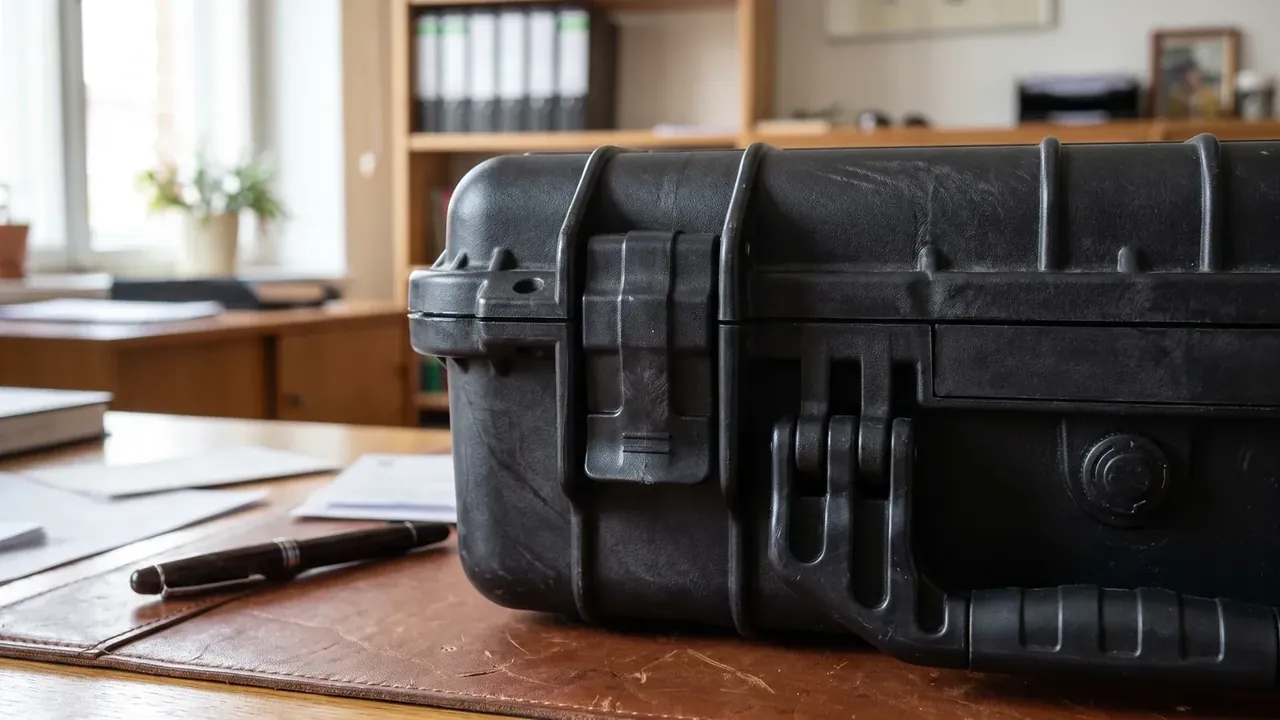
On a Veterinary Equipment Protective Case, emptying is set at 90 s. Across a 495 × 355 mm floor at that slope, flow through a 12 mm bore is fastest with the cavity full and slows as the head drops.
| Emptying time | Valve bore | Floor slope | Valve state |
|---|---|---|---|
| under 90 s | 12 mm | 4° | clear, no film at the flare |
| around 120 s | 12 mm | 3° | drip phase visibly longer |
| above 150 s | 10 mm | 4° | bore half blocked |
Self-draining structures are commonly laid out at 3° or more. This case takes 4°, and the extra degree is margin for debris: one blade of grass on the slope drops the effective fall below 3°. If the valve is 12 mm and emptying runs past 90 s, the floor never reached 4°.
On a Veterinary Equipment Protective Case, the slope lives in the mould rather than in shims. The floor is drawn as an equal-wall surface and an angled ejector block carries the angle into the moulding.
3. Three Places Water Stays Inside the Case
In a Veterinary Equipment Protective Case, traps never sit on a flat face. They sit where two faces meet, and this cavity has 3 that need separate attention.
| Trap | Location | Water left per wash | Treatment |
|---|---|---|---|
| Corner radii | four upright corners | 3 to 5 mL | radius opened to R12 |
| Rib roots | floor ribs meeting the wall | 8 to 12 mL | 6 mm relief notch |
| Groove ends | where the gasket cord closes | 2 to 4 mL | 2 mm chamfer |
Water clings to each corner radius as a thin ring that no slope moves; only the radius can steer it onto the curve. Rib roots block the path, so water pools along one side and the strip hazes first. Groove ends are least visible: once the cord is pressed in, both ends close and residue is sealed in.
A full-water standing test settles it. Fill the cavity, wait ten minutes, open the valve; residue still under 20 mL means the three faces work.
4. Mildew Treatment in the Gasket Channel
The channel is 4 mm deep and 6 mm wide with a continuous flat floor. The cord is silicone at roughly 50 Shore A, with compression set near 25%.
| Treatment | Method | Rating | Where used |
|---|---|---|---|
| Cord compound | silicone without organic plasticiser | 0 | full gasket loop |
| Channel coating | 20 μm inorganic layer | 0 | floor and both flanks |
| Untreated control | ordinary rubber cord | 2 or worse | not used |
Rating 0 follows ASTM G21: five mixed spores, 28 °C to 30 °C, humidity at or above 85%, twenty-eight days, and no visible growth before the sample scores zero. A Veterinary Equipment Protective Case stays on silicone because ordinary rubber carries plasticisers that feed mould.
The 4 mm depth matches the cord section. At 5 mm the cord never bottoms out, compression falls short and the immersion part of IP67 fails; at 3 mm it is over-compressed, loses rebound within six months, and the channel holds water instead.
5. Standing Time Before the Lid Goes Back On
Thirty minutes is a floor, not a suggestion. After a wash the lid goes full open with both latches half engaged, air moves through, and only a liner dry to the hand gets closed in.
The 8.6 kg weight earns its place: heavy enough to stand on end without tipping, light enough for one person. The case stands floor down and valve low, so residue keeps leaving through the bore.
IP67 is quoted against 1 m of immersion for 30 min, and the standing time matching it is no accident. A gasket needs time to recover compression; close the lid inside that window and the wet cord marks the sealing face. Storage runs from −20 °C to +60 °C, and at 4 high the bottom gasket sits under permanent load, so poor drying shortens its life.
The wash log holds three entries: pressure, start of standing, time of closure. With all three recorded, a smell at the next opening becomes something you can trace.
Conclusion
Cleanliness in a Veterinary Equipment Protective Case is settled at the floor: a 4° slope, one 12 mm valve, 90 s to empty, 3 traps turned into drainage faces, a 4 mm channel around a cord rated 0. Stand it 30 min before the lid closes, and an 8.6 kg unit holds against IP67 immersion and a 4-high stack.
Related Reading
- The Usable-Volume Calculation
- Hard Case and Carton in Transit
- Case Layout for Portable Veterinary Diagnostics
Related Products
- 8 Series — Gun Cases; Military Equipment Cases; Camera Equipment Cases; Drone Cases; Watch Cases; Knife Cases; First Aid Cases; Electronics Equipment Cases
- WL8-2812 PP Gun Case — model WL8-2812
- All protective cases and toolboxes: 7 series, 158 models