

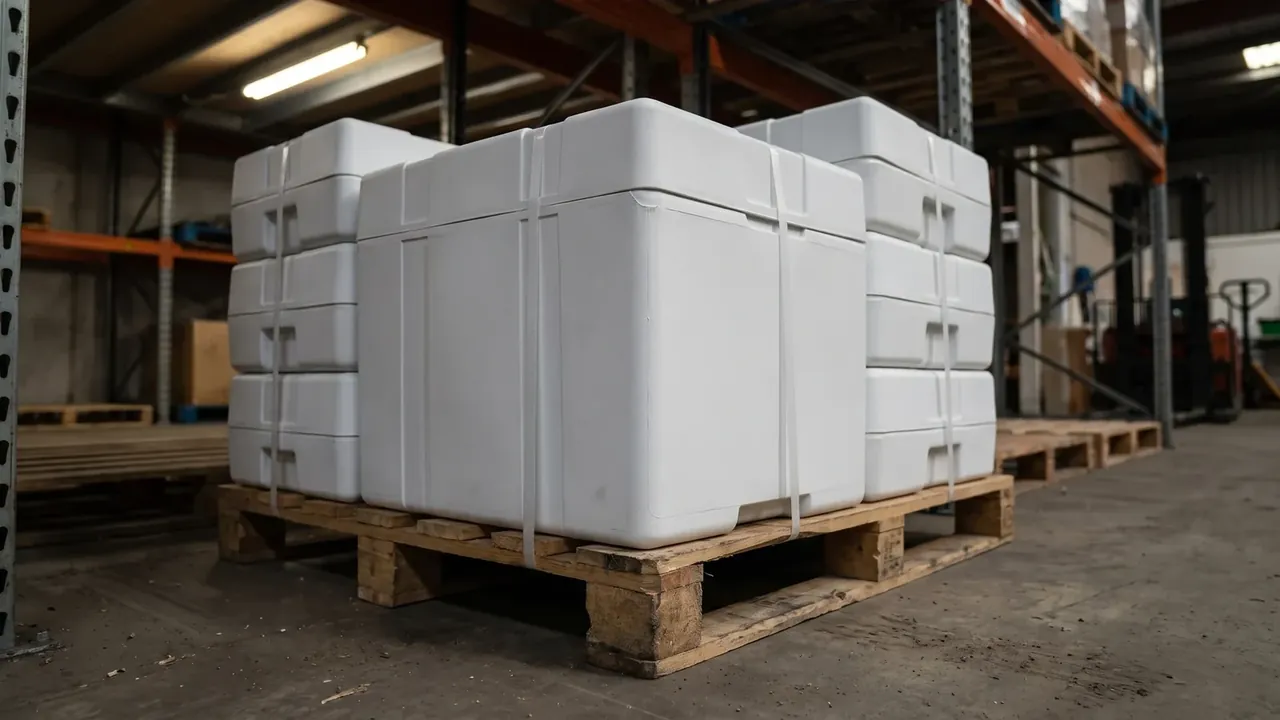
Quick answer: A War Reserve Case is configured around where it sits and how long it stays. Long-term depots trade on seal life, rotation depots on latch cycles, field sites on UV and standing water, kitting on liner layout, transfers on stacking and marking.
Table of contents
- Where a War Reserve Case Sits: Five Positions
- Long-Term Storage: Fix the Years First
- Rotation Depots and Equipment Kitting
- Field Sites and Cross-Region Transfer
- The Configuration Matrix
- FAQ
1. Where a War Reserve Case Sits: Five Positions
The same body, moved one bay over, needs a different build. The shell stays; sealing method, desiccant, stacking height, opening method and marking all change, and each one pulls on the others.
Move a single-use seal to a rotation depot and every opening costs a new seal, doubling seals and labour at sixty openings a year.
| Position | Dwell time | First constraint |
|---|---|---|
| Long-term depot | 3 to 5 years | Seal life |
| Rotation depot | 3 to 12 months | Latch cycles |
| Equipment kitting | Equipment life | Liner layout |
| Field site | 7 to 90 days | UV and water |
| Transfer | 3 to 15 days | Vibration, marks |
2. Long-Term Storage: Fix the Years First
In long-term storage the first number is the year count, not wall thickness. Under three years a single-lip gasket holds. At five years the War Reserve Case needs a double-lip EPDM gasket at Shore A55 and 25 to 30 percent squeeze; below twenty it leaks.
The interior goes below 35 percent relative humidity before the lid closes. Desiccant is charged at 8 g per litre, so a 120 L body takes 900 g in four corner bags, never one pile under the liner. Three-spot cards read 20, 30 and 40 percent.
Four-high stacking is checked at 900 kg static on the bottom unit. Creep beats compression strength: the bottom lid sags 1.5 to 2 mm in two years, an allowance built into the frame height.
3. Rotation Depots and Equipment Kitting
A rotation depot picks latches by cycle count: two latches at sixty openings a year suit a 3000-cycle rating. The gasket fails first, so compression set must stay under 20 percent after five hundred openings. Desiccant is reused, six hours at 120 °C, three cycles.
Kitting treats the War Reserve Case as a fixed carrier, so liner layout outranks shell strength. An 800 × 600 × 450 mm body at 16.5 kg empty takes a 30 mm EVA liner pocketed part by part, and survives a 1.2 m corner drop with both latches closing.
4. Field Sites and Cross-Region Transfer
A field-site case holds closure from -25 °C to 55 °C and passes 1000 hours of xenon-arc ageing. Standing water is the usual failure point: the lid carries a 3 to 5 degree drain slope and stays dry under 40 mm of water for 24 hours. Ground is never level, so stacking stops at two high, on the cones.
Transfer treats the War Reserve Case as a transport package: three high, six per pallet, 100 mm forklift openings, and a liner pressed to the walls with no gap above 5 mm.
Marking differs most: reflective plates on both end faces at a field site, 120 × 80 mm in a slot holder, against one manifest per pallet and a QR code in transfer.
5. The Configuration Matrix
Read it left to right: sealing, stacking, opening.
| Position | Sealing | Stack | Opening | Marking |
|---|---|---|---|---|
| Long-term depot | Double lip, clamp | 4 high | Numbered seal | End slot, batch |
| Rotation depot | Single lip, latch | 3 high | Hand release | Label in lid |
| Kitting | Dust lip | 3 high | Twin latches | Equipment plate |
| Field site | Double lip, drained | 2 high | Seal plus latch | Reflective plates |
| Transfer | Single lip, wrap | 3 high | Cut wrap | QR and serial |
Sending a depot case straight to a field site is the usual mistake: once cut, the seal cannot be reset, so one round trip costs a double sealing job.
Conclusion
Five positions, five builds, and the differences land on the same five settings: sealing, desiccant, stacking height, opening method and marking. Long dwell times go to squeeze, frequent opening to gasket life, field sites to drainage and ageing, transfers to marking. Settle the sequence at specification stage and fewer cases come back for rework, which is the practical value of a War Reserve Case.
This article discusses only the container (case body) side of specifications and design intent, and does not cover any handling, loading or use of the contents.
Related Reading
- What a war reserve case is and how it is sealed
- Inspection intervals and opening control for stored cases
- Stacking loads in warehouse storage
- Scenario-based layout for logistics support boxes
Related Products
- 8 Series — Gun Cases; Military Equipment Cases; Camera Equipment Cases; Drone Cases; Watch Cases; Knife Cases; First Aid Cases; Electronics Equipment Cases
- WL8-2812 PP Gun Case — model WL8-2812
- All protective cases and toolboxes: 7 series, 158 models