

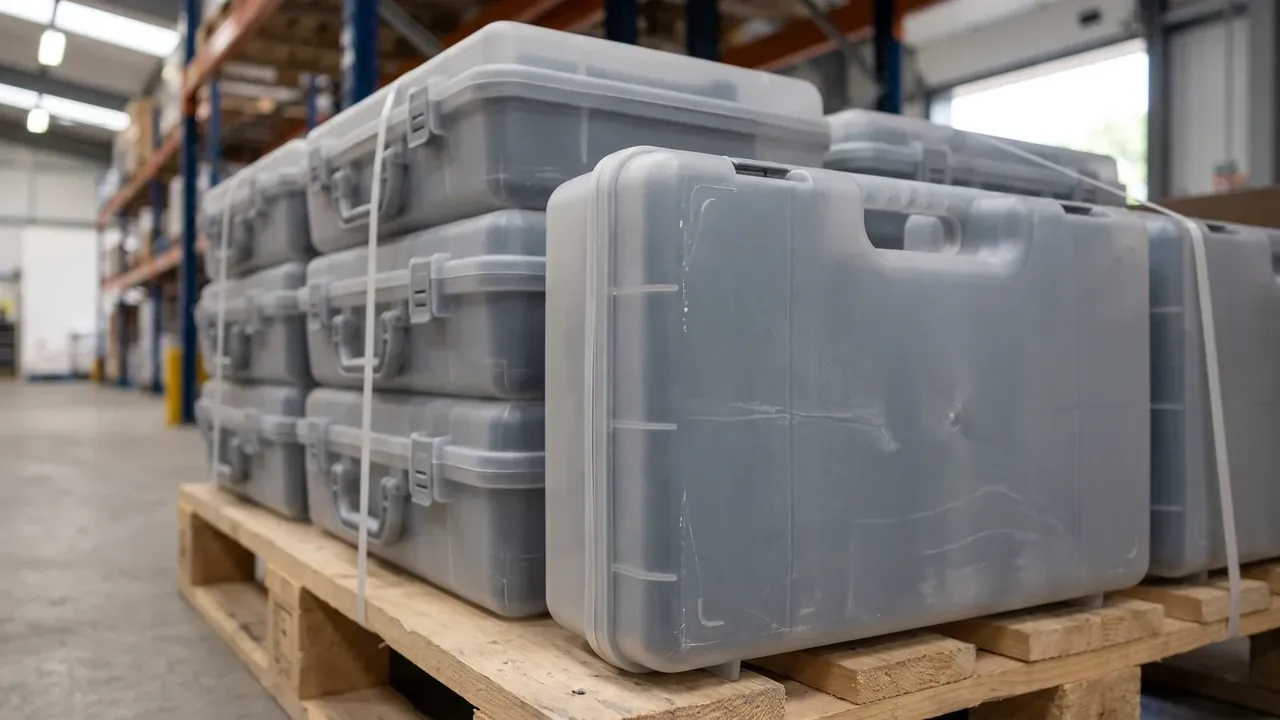
Quick answer: A War Reserve Case differs from sealed timber boxes, steel boxes, foil bags in cartons and ordinary rotomoulded cases through three mechanisms: seal transmission, shell stacking stiffness, and how the seal survives reopening.
Table of contents
- War Reserve Case Versus Four Alternatives
- Storage Life and Moisture Holding
- Reopening Tolerance and Stack Strength
- Weight, Volume Efficiency and Upkeep
- The Trade-off Summary
- FAQ
1. War Reserve Case Versus Four Alternatives
The five options are not one generation of product.Timber boxes and foil bags seal once and are spent once; steel boxes and ordinary rotomoulded cases reopen, but their seal interfaces are shallow. The War Reserve Case sits closer to the second group, with the seal built as a replaceable part.
| Option | Wall | Seal | Weight, same volume | Rating |
|---|---|---|---|---|
| Sealed timber box | 15 mm plywood, nailed | Paper and tape | 44 kg | Not rated |
| Steel box | 0.8 mm folded steel | Single rubber strip | 38 kg | IP54 |
| Foil bag in carton | 25 μm five-layer foil | Heat-sealed edge | 3 kg | Not rated |
| Ordinary rotomoulded | 5 mm polyethylene | Single lip | 15 kg | IP54 |
| War Reserve Case | 6 mm rotomoulded | Twin EPDM lips | 17 kg | IP67 |
Vapour transmission sets desiccant life, creep under static load sets pile height, and compression set after reopening decides whether the case still seals in year three.
2. Storage Life and Moisture Holding
A sealed timber box holds in dry weather, but once board moisture passes 15 percent the interior follows. Desiccant is changed every two years, and by the second the nail holes have opened: teardown loss reaches 35 percent.
Foil bags transmit least, under 0.01, but fail by puncture: 15 percent a year, and one hole retires the bag.
Steel fails by condensation: a 0.8 mm wall conducts fast, a 12 °C swing condenses inside at twice the rate of a rotomoulded body, and salt spray raises rust at 240 hours.
| Option | Rated life | Vapour g/(m²·d) | Failure mode |
|---|---|---|---|
| Sealed timber box | 24 months | 0.6 | Board pickup, nail holes |
| Steel box | 36 months | 0.08 | Condensation, edge rust |
| Foil bag in carton | 36 months | 0.01 | Corner puncture |
| Ordinary rotomoulded | 18 months | 0.35 | Lip ageing, latch slack |
| War Reserve Case | 60 months | 0.02 | Gasket compression set |
3. Reopening Tolerance and Stack Strength
Only reopenable bodies enter here: timber needs the nails drawn, a foil bag needs the seam cut. On steel the hinge is weak, and after a hundred cycles the bush clearance grows.
An ordinary rotomoulded case reaches 35 percent compression set after two hundred openings, still latching but no longer holding vapour. Twin lips under a clamp stay under 18 percent after three hundred.
At equal volume, timber stacks five high empty but loses 45 percent strength when wet. Steel carries more at the cost of weight and dents, and a carton stops at three high.
4. Weight, Volume Efficiency and Upkeep
Weights read 44 kg for timber, 38 kg for steel, 15 kg for ordinary rotomoulding and 17 kg here; a gap above 20 kg moves loading labour by about thirty percent.
Volume efficiency reaches 62 percent in timber, 70 percent in steel and 76 percent with a 6 mm wall and frame inserts. Upkeep follows suit: timber is resealed, bags replaced, steel derusted, and the War Reserve Case takes a gasket set every five years.
On a cost index with timber at 100, steel runs 165 to 235 over five years, foil 65 to 385 because it cannot be repaired, ordinary rotomoulding 115 to 245, the rotomoulded structure 155 to 200.
5. The Trade-off Summary
For supplies sealed under two years and opened at the destination, foil in a carton is cheapest, and its penalty only shows on a five-year horizon. For a fixed indoor store with welding available, steel can be pushed below a 235 index.
The choice reduces to three questions: how often it opens, since under twice a year a replaceable seal is overspecified; how tight the floor is, since past four high wet timber loses strength; and how long the horizon is, since beyond three years the gasket decides.
Conclusion
Each alternative has a place: timber on price, steel on stiffness, foil on transmission, ordinary rotomoulding on weight. What it buys is a five-year account levelled by a replaceable seal, paid for in price and consumables. Settle the cycle count, stack height and horizon first, and that is the advantage most often missed in a War Reserve Case.
This article discusses only the container (case body) side of specifications and design intent, and does not cover any handling, loading or use of the contents.
Related Reading
- What a war reserve case is and how it is sealed
- Comparing materials for military packing boxes
- Material and upkeep comparison for metal ammunition boxes
- How rotomoulded cases differ from alternatives
Related Products
- 8 Series — Gun Cases; Military Equipment Cases; Camera Equipment Cases; Drone Cases; Watch Cases; Knife Cases; First Aid Cases; Electronics Equipment Cases
- WL8-2812 PP Gun Case — model WL8-2812
- All protective cases and toolboxes: 7 series, 158 models