

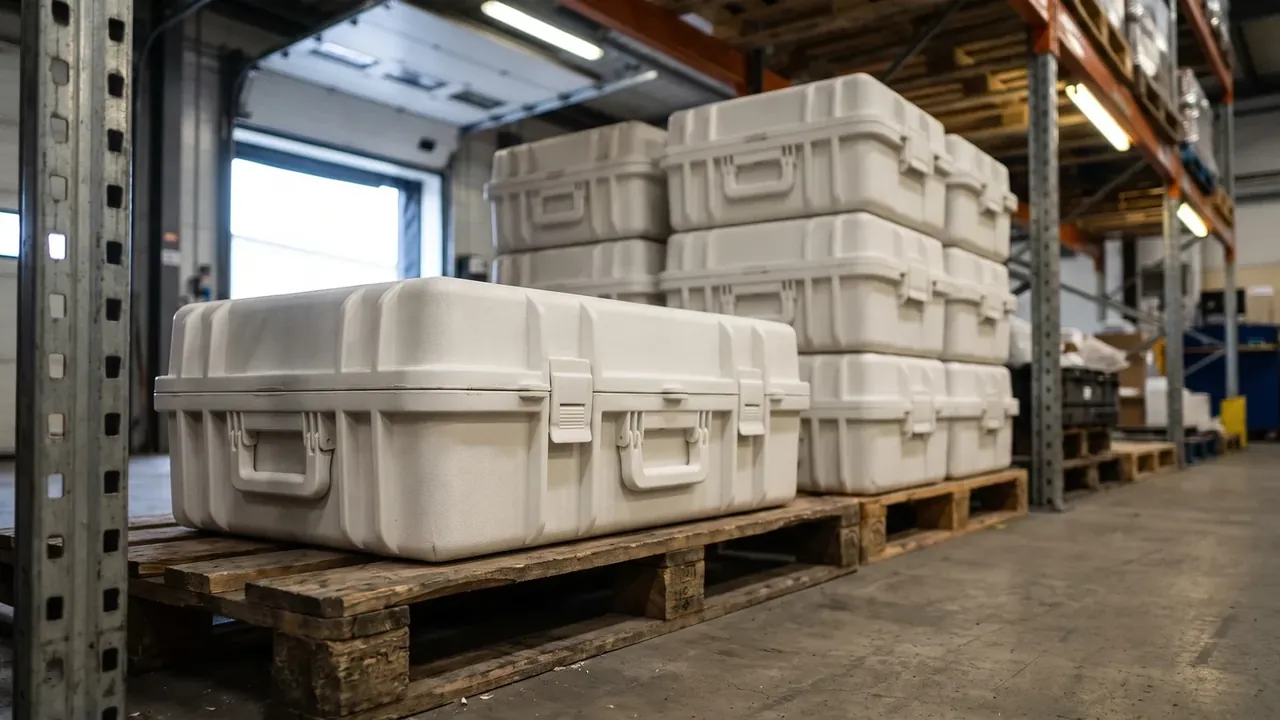
Quick answer: Choose a War Reserve Case by running five tests in order: storage life, airtightness, stack height, opening speed, then labels and records. Each constrains the next, so deciding out of order buys a case that seals well and fails in year eight.
Table of contents
- Five Tests and the Order to Run Them
- Storage Life Sets the Material
- Airtightness and Humidity Thresholds
- Stack Height and Warehouse Space
- Opening Speed, Labels and Records
- FAQ
1. Five Tests and the Order to Run Them
Buyers ask the five questions side by side and get a vague answer to each. Order matters more: storage life fixes the material, the material fixes wall thickness, airtightness fixes seals, stack height fixes ribs.
| Order | Test | Ask first | Threshold |
|---|---|---|---|
| 1 | Storage life | Years sealed, opened or not | 5, 10 or 15 |
| 2 | Airtightness | Humidity ceiling | 3 mbar, 40% RH |
| 3 | Stack | How high, rack height | 4 high, 135 kg |
| 4 | Opening | Seconds to open | 60, seal replaceable |
| 5 | Records | Trace every case | Lot, QR, 10 years |
Only the first test is outside the buyer's control, because the task cycle sets it. Fix the years before discussing the War Reserve Case price.
2. Storage Life Sets the Material
Storage life is not a round number. Polypropylene at 23 °C indoors holds 90% of its tensile strength after five years. At 40 °C and 93% RH, 28 days of accelerated ageing halves that, retention falling to 70%.
| Band | Material route | Control point |
|---|---|---|
| 5 years | Homopolymer PP, standard antioxidant | Shade only |
| 10 years | Impact copolymer, antioxidant and HALS | Under 60% RH |
| 15 years | Stabilised copolymer, metal parts 480 h salt spray | Constant humidity, 5% sampled every 3 years |
Three points follow. Below 3 mm wall, a ten-year War Reserve Case whitens at the corners before it cracks. Every rivet should pass 480 hours of salt spray; at year ten the rivet fails first. A 15-year case needs a closable φ20 port for sampling.
3. Airtightness and Humidity Thresholds
Match airtightness to the desiccant rather than pushing it higher. Charge the War Reserve Case to 20 mbar, wait three minutes, accept no more than a 3 mbar drop; that measures slow leakage, which is what storage suffers from.
Desiccant follows the threshold: 1.2 kg of indicating gel per cubic metre of free volume holds under 40% RH for a year. A 60 L War Reserve Case often has 45 L free once liner and dividers are deducted, so sizing it at 60 L leaves a third of the gel out.
Seals are consumables. Neoprene hardens in three years at 40 °C; silicone lasts eight and costs 40% more. Field resealing needs an open channel, not a groove under the hinge.
4. Stack Height and Warehouse Space
Four high is common. At 45 kg each, the bottom War Reserve Case carries 135 kg, and lid deflection after 90 days must stay within 2 mm. Put that in the acceptance clause.
Space is counted per pallet. A 600 × 400 mm footprint on a 1200 × 1000 mm pallet gives five per layer and twenty at four high, about 1.35 m. A 500 × 400 mm footprint fits six, lifting density 18% but weakening the stack.
5. Opening Speed, Labels and Records
Opening is specified at 60 seconds, because past that people pry. Four latches at 4 N·m open one-handed in gloves, and a break-away seal numbered to the stamped lot shows the War Reserve Case was opened.
Resealing needs the seal and gel replaceable on site: one spare bag, one seal, a hex key. Write date and operator on the label.
| Layer | Position | Content | Retention |
|---|---|---|---|
| Stamped lot | Non-load face | Lot, year, tool | Life of case |
| QR label | Top right of lid | Seal date, openings | 10 years |
| Paper ledger | Store office | Tests, humidity | 10 years |
The three layers have to agree: stamp is root, QR speeds a check, ledger holds the evidence. The usual failure is a QR label on a load face, rubbed off in two handlings.
Conclusion
Order matters more than numbers: life, airtightness, stack height, then opening and records. Inflate the life band and material is wasted; inflate airtightness and the desiccant is under-sized. Written into an annex in that order, every item can be judged at acceptance, which is what a War Reserve Case is bought for.
This article discusses only the container (case body) side of specifications and design intent, and does not cover any handling, loading or use of the contents.
Related Reading
- What a War Reserve Case is and how storage is designed
- Long-term storage, inspection intervals and opening control
- Preventing crush damage and distortion in the store
- Stacking and stocktaking in warehouse storage
Related Products
- 8 Series — Gun Cases; Military Equipment Cases; Camera Equipment Cases; Drone Cases; Watch Cases; Knife Cases; First Aid Cases; Electronics Equipment Cases
- WL8-2812 PP Gun Case — model WL8-2812
- All protective cases and toolboxes: 7 series, 158 models