

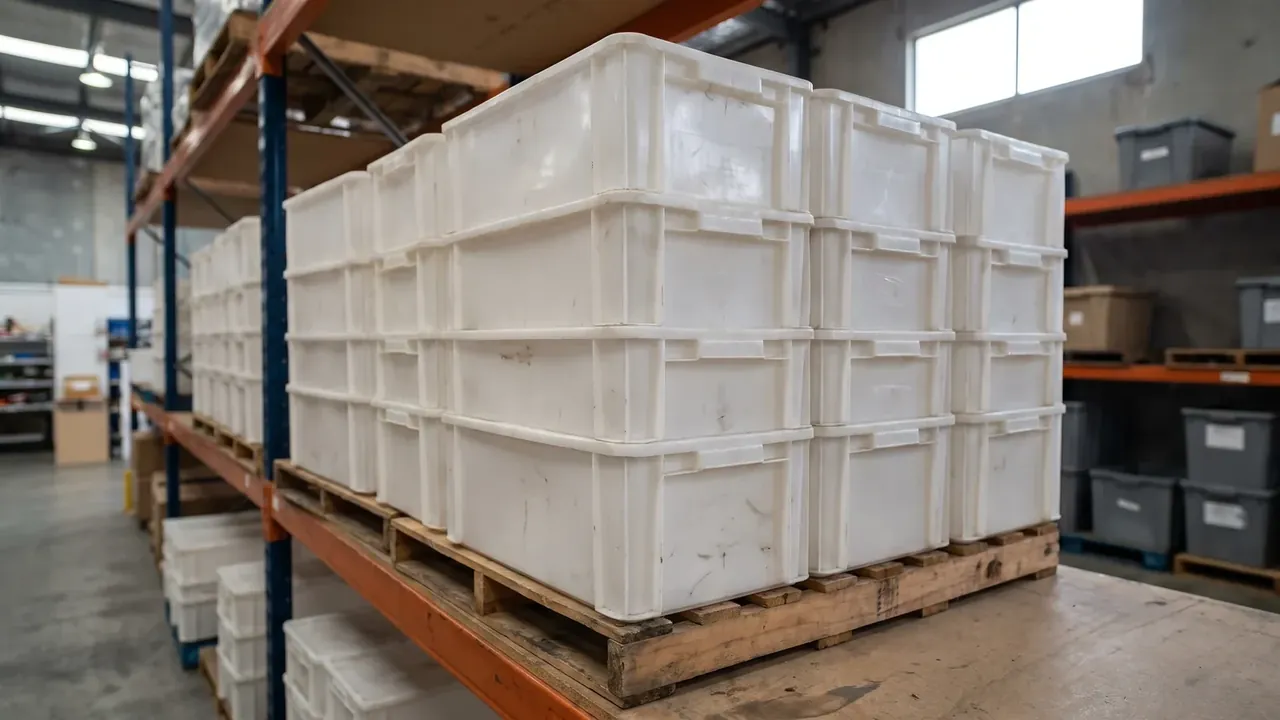
Quick answer: A War Reserve Case is specified backwards: fix internal volume from a load module, derive wall thickness from volume and tier count, then lock the gasket with a pressure drop and a storage life. Tare and load rating are results.
Table of contents
- Why War Reserve Case Specs Start With Internal Volume
- Wall Thickness, Tare Weight and Load Rating
- Airtight Pressure Drop: Test Method and Limit
- Storage Life Drives Material and Gasket Choice
- Temperature, Humidity and Tier Arithmetic
- FAQ
1. Why War Reserve Case Specs Start With Internal Volume
Internal volume is the one line nobody can fix later: the space left after ribs and insert compression, not the moulded cavity. A case drawn at 1200 by 500 by 400 mm measures 1188 by 488 by 392 mm across the rib crests.
A load module divides it into cells: at 290 by 240 mm, a 1200 by 500 mm interior takes a 4 by 2 grid of eight cells, an 86 percent area yield. Tolerance reads +3/0 mm, since shrinkage of 1.4 to 1.8 percent already moves that length by 17 to 22 mm.
| Internal mm | Outside mm | Module | Yield |
|---|---|---|---|
| 600×400×300 | 660×460×345 | 2×1 | 0.72 |
| 1200×500×400 | 1265×565×450 | 4×2 | 0.86 |
| 1200×600×500 | 1265×665×555 | 4×2 | 0.83 |
2. Wall Thickness, Tare Weight and Load Rating
PP copolymer at 0.91 g/cm³ gives 4.1 kg/m² at 4.5 mm, and a 1.35 rib factor raises it to 5.5 kg/m². With 3.4 m² of developed surface the shell is 18.7 kg, plus 2.3 kg of hinges and latches for a 21 kg tare.
The rating needs a definition: uniform lid load on a full case at 40 °C for 30 days, base sag under 2 mm. It is not crush load, which runs 2.5 times higher. At 5.2 mm a War Reserve Case rates 470 kg rather than 380 and loads the bottom unit 14.4 kg harder at four high.
| Wall mm | Tare kg | Rating kg | Tiers |
|---|---|---|---|
| 3.8 | 18.2 | 260 | 3 |
| 4.5 | 21.0 | 380 | 4 |
| 5.2 | 24.6 | 470 | 5 |
3. Airtight Pressure Drop: Test Method and Limit
Pressure drop is the only figure on a War Reserve Case an instrument can reproduce: pump the interior to minus 30 kPa gauge, close the valve, wait 5 minutes, pass at 1.5 kPa loss or less. Soak 4 hours at 20 plus or minus 5 °C first, since gas pressure drifts 3.4 percent per 10 °C and a case off a 35 °C floor reads falsely good.
Volume is corrected in proportion: a 240 L interior is judged at 2.0 kPa. Gasket squeeze sits at 25 to 30 percent: an 8 mm cord in a 6 mm groove gives 2 mm. Beyond 35 percent EPDM keeps only 70 percent of its rebound after two years; below 20 percent it hardens at minus 40 °C and a 0.2 mm score leaks.
4. Storage Life Drives Material and Gasket Choice
Storage life is the first blank on the sheet. Five years suits PP copolymer with NBR; ten needs EPDM and a 4.5 mm wall, since creep under static load appears on that timescale; fifteen moves to glass-filled PP; twenty leaves stainless or aluminium.
The longer the life, the more the replacement path matters: the lid seal should be a separate ring in a groove, not over-moulded. Desiccant follows volume, not years, so 200 g per 100 L means 500 g for 240 L; compression set under 25 percent after 24 hours at 70 °C is the real ten-year gate.
5. Temperature, Humidity and Tier Arithmetic
The band reads minus 40 to plus 60 °C, but the rating needs a derating factor: PP keeps only 60 percent of its modulus at 60 °C, so allowable stress is taken at 0.62, and at minus 40 °C drop height falls from 1.2 to 0.8 m. At 95 percent RH the interior stays under 40 percent after 30 days.
Tier count takes two steps. Room 4.2 m, case 450 mm, pallet 144 mm: 4056 mm of height gives nine tiers, so eight. Then the load check: 45 kg a case puts 315 kg on the bottom unit at eight high, above the 236 kg left after derating, so a War Reserve Case stack drops to five.
Conclusion
Three lines decide the sheet: whether the interior divides by the module, whether the wall carries the tier count after derating, and whether the gasket survives the storage life. Settle them and tare, pressure drop and climate band become arithmetic. Fix the three first, and a War Reserve Case still measures the same after trial moulding.
This article discusses only the container (case body) side of specifications and design intent, and does not cover any handling, loading or use of the contents.
Related Reading
- What a war reserve case is and how long it stores
- War reserve case maintenance: checks and replacement lines
- Inspecting a military supply case: items and pass limits
- Injection machines and how a case body is moulded
Related Products
- 8 Series — Gun Cases; Military Equipment Cases; Camera Equipment Cases; Drone Cases; Watch Cases; Knife Cases; First Aid Cases; Electronics Equipment Cases
- WL8-2812 PP Gun Case — model WL8-2812
- All protective cases and toolboxes: 7 series, 158 models