

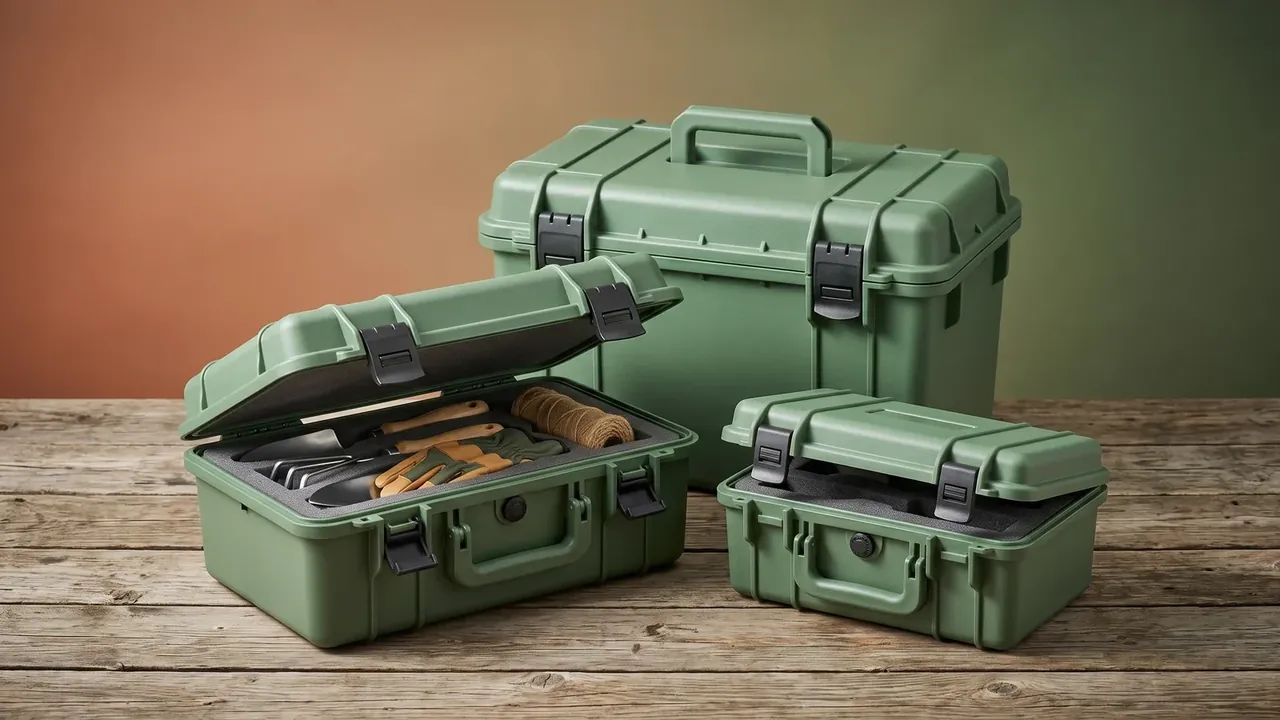
Quick answer: At 95% RH, stacked four high for six months, waterproof box storage is accepted on five numbers: 25% to 30% compression, 350 N per latch, 66 kg with under 2 mm sag, a 30-minute spray, and 48 hours of salt fog.
Table of contents
- What a monsoon warehouse demands
- Seal face and latches
- Three tests without a lab
- Disposition of failures
- FAQ
1. What a monsoon warehouse demands
A tool store in southern China sits through a six-week monsoon. Indoor temperature swings between 5 °C and 40 °C daily, humidity parks at 95% RH, and waterproof box storage units stack four high with 22 kg of metal parts inside for six months. Here, waterproof box storage is not judged by one rainstorm but by condensation that forms inside the lid every night.
So the receiving sheet records five measurements, not a visual impression.
| Check | Condition | Pass line | Instrument |
|---|---|---|---|
| Gasket compression | Lid closed, latches engaged | 25% to 30% of free height | 0.05 mm feeler gauge |
| Latch retention | Static, 24 hours | 350 N per latch | Push-pull gauge |
| Stack load | 66 kg on lid | Sag under 2 mm | Height gauge |
| Spray | 4 L/min, 30 minutes | Dry interior tissue | Spray rig |
| Salt fog | Neutral, 48 hours | No through-wall rust | Chamber or lab |
Stack load is the item buyers skip, because nothing rattles when it fails. The bottom case carries 66 kg for half a year and the lid creeps down. At 2 mm the gasket still seals; at 4 mm a hairline gap opens that nobody can see.
Layout belongs on the same sheet: 120 mm pallets, 300 mm between stacks.
2. Seal face and latches
The gasket is the only barrier waterproof box storage has, and a feeler gauge is the only tool needed. Close the lid, engage both latches, and probe every 100 mm around the rim with a 0.05 mm blade. Where the blade enters, water will enter too. Where it will not enter but the latch needs force to close, the gasket is over-compressed, flattens, and stays deformed after two thermal cycles.
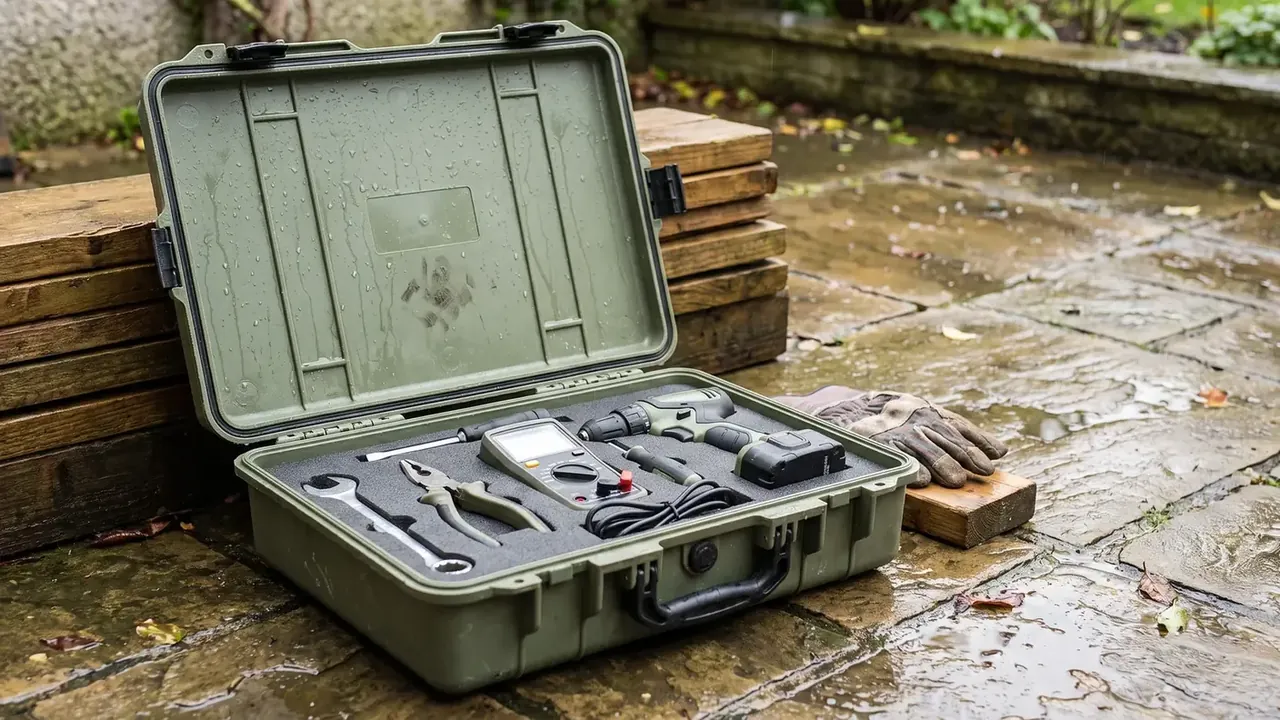
Water reaches the interior by four routes: the gasket joint, the hinge bore, the relief valve, and the latch pressure point. The joint is cut at 45 degrees and must butt within 0.3 mm; plenty of lots fail on that 20 mm seam. The hinge bore is sealed by one O-ring that leaks along the pin once it sits crooked. The valve diaphragm hardens, stays cracked, and leaves a hole in the wall. A latch that presses off-centre crushes one side and floats the other, so two latches behave like one. Order: gasket first, latch alignment second, water test last, since the first two decide whether the third is worth drying time.
Gasket compound follows temperature, not price. Below minus 20 °C, silicone costs about 1.8 yuan more per metre; a 600 mm square box uses 2.4 m.
3. Three tests without a lab
Cheapest first, and none of these waterproof box storage tests needs a chamber:
- Spray: 4 L/min from 1.5 m above the lid for 30 minutes, two layers of tissue inside. No watermark wider than 5 mm. Catches rim and latch faults; six cases an hour.
- Vacuum: minus 20 kPa at the valve port, held 60 seconds, decay under 1 kPa. A sound case dimples and springs back. Excess decay means an invisible leak.
- Immersion: sink it until water stands 300 mm above the lid, wait 30 minutes, dry, open, inspect. Closest to the worst case and slowest, so first articles only.
Order matters: immersion first skews later weighing, and vacuum right after a spray test pulls water through the valve port.
4. Disposition of failures
A 240-piece lot sampled at 13 pieces is rejected if three leak. From there the decision splits three ways, at very different cost.
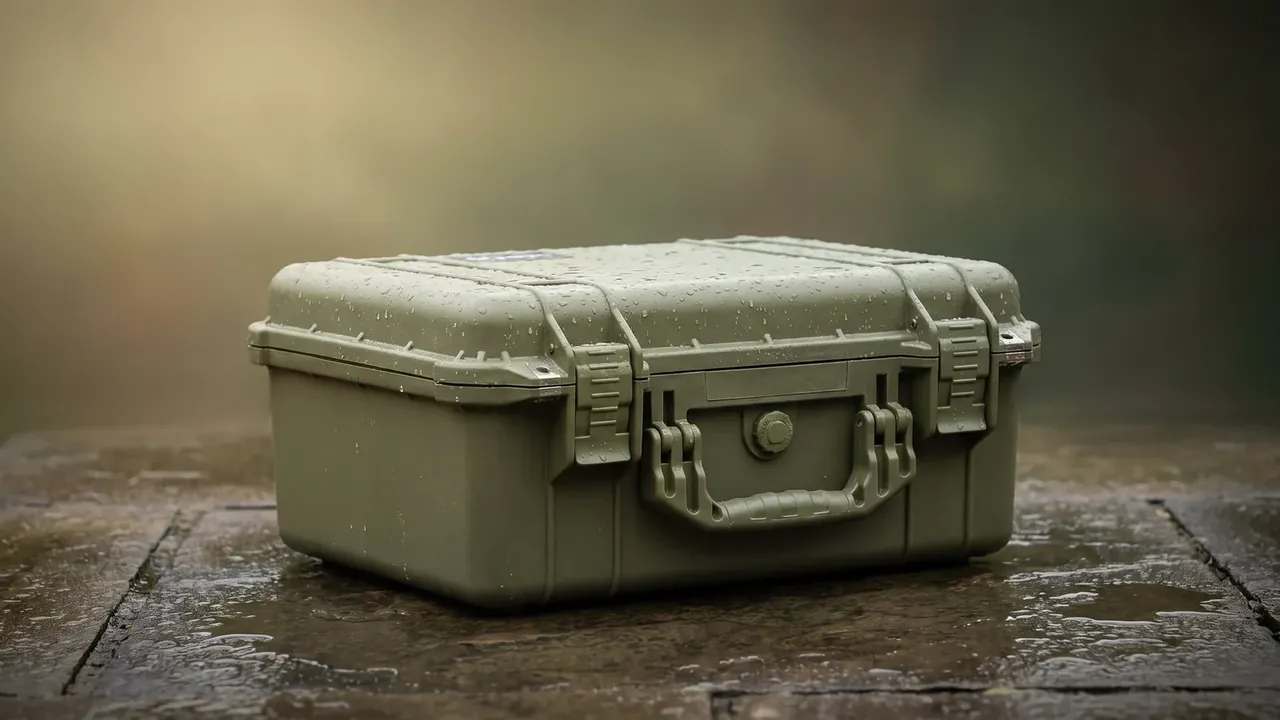
| Defect | Basis | Disposition | Cost |
|---|---|---|---|
| Split gasket joint | Watermark after spray | Return lot | 14 days |
| Weak latch | Under 350 N | Sort, swap latches | 45 min per case |
| Slight lid sag | 2 to 3 mm | Light loads only | 8% price cut |
| Valve seep | Vacuum decay over limit | New core, retest | 12 min per case |
Cosmetic defects can be bought at a discount. Sealing, latching and valve function cannot be conceded even for one piece; a bad case then sits in the rack for six months.
Reinspection of waterproof box storage is tightened: 26 more pieces, all passing; one further failure returns the lot. The record holds three fields only, defect, measured value, disposition.
Conclusion
Acceptance of waterproof box storage is five numbers on a receiving sheet: 25% to 30% compression, 350 N per latch, 66 kg for 24 hours, 30 minutes of spray, 48 hours of salt fog. Set the duty first and the thresholds follow, since a monsoon warehouse and a dry store should not share one pass line. Hand the disposition rules to the clerk and the argument at the dock ends. A year of waterproof box storage under this routine ends with soft gaskets and dry tissue.
This article discusses only the container (case body) side of specifications and design intent, and does not cover any handling, loading or use of the contents.
Related Reading
- Case mould storage standards: rust, lifting and log sheets
- Foam inventory storage standards: humidity, stack height and FIFO
- Munitions shipping and storage container standards: stacking and warehouse conditions
Related Products
- 8 Series — Gun Cases; Military Equipment Cases; Camera Equipment Cases; Drone Cases; Watch Cases; Knife Cases; First Aid Cases; Electronics Equipment Cases
- WL8-2812 PP Gun Case — model WL8-2812
- All protective cases and toolboxes: 7 series, 158 models