

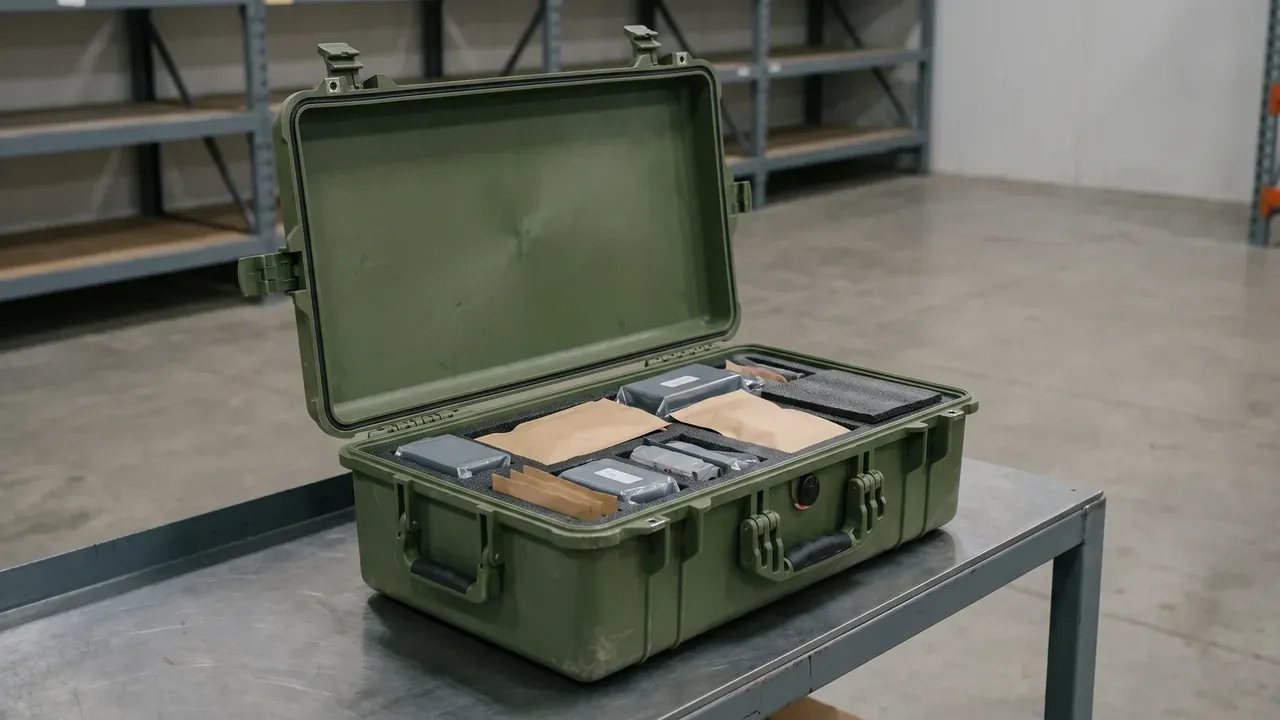
Quick answer: A waterproof case acceptance standard turns the word into measurable items: pressure drop, gasket compression, the test behind each IPX rating, salt spray hours, thermal range and sampling AQL. Each item needs a method and a threshold.
Table of contents
- What the Acceptance Standard Has to Cover
- Air-Tightness and Gasket Thresholds
- Environmental and Mechanical Judgments
- Appearance and Marking Judgments
- Sampling Plans and Batch Disposition
- FAQ
1. What the Acceptance Standard Has to Cover
An acceptance standard replaces an adjective with numbers somebody can re-measure. If incoming inspection only checks appearance and labels, a waterproof case fails in the field, and nobody can say whether body, gasket or assembly was at fault.
The usual answer is three layers: a unit check on lid gap, latch feel and marking; batch sampling for pressure drop and key dimensions; type testing at mould sign-off, material change or annual review. A fourth layer is traceability to the case batch.
| Layer | Trigger | Typical items |
|---|---|---|
| Unit check | Every case | Lid gap, latch force |
| Batch sampling | Every lot | Pressure drop, dimensions |
| Type test | Sign-off, change, annual | IPX7, drop, cycling |
2. Air-Tightness and Gasket Thresholds
Close and latch the case, charge to 20 kPa, hold 60 seconds, accept a drop under 0.5 kPa. The negative method pulls to minus 15 kPa and allows 0.3 kPa of recovery.
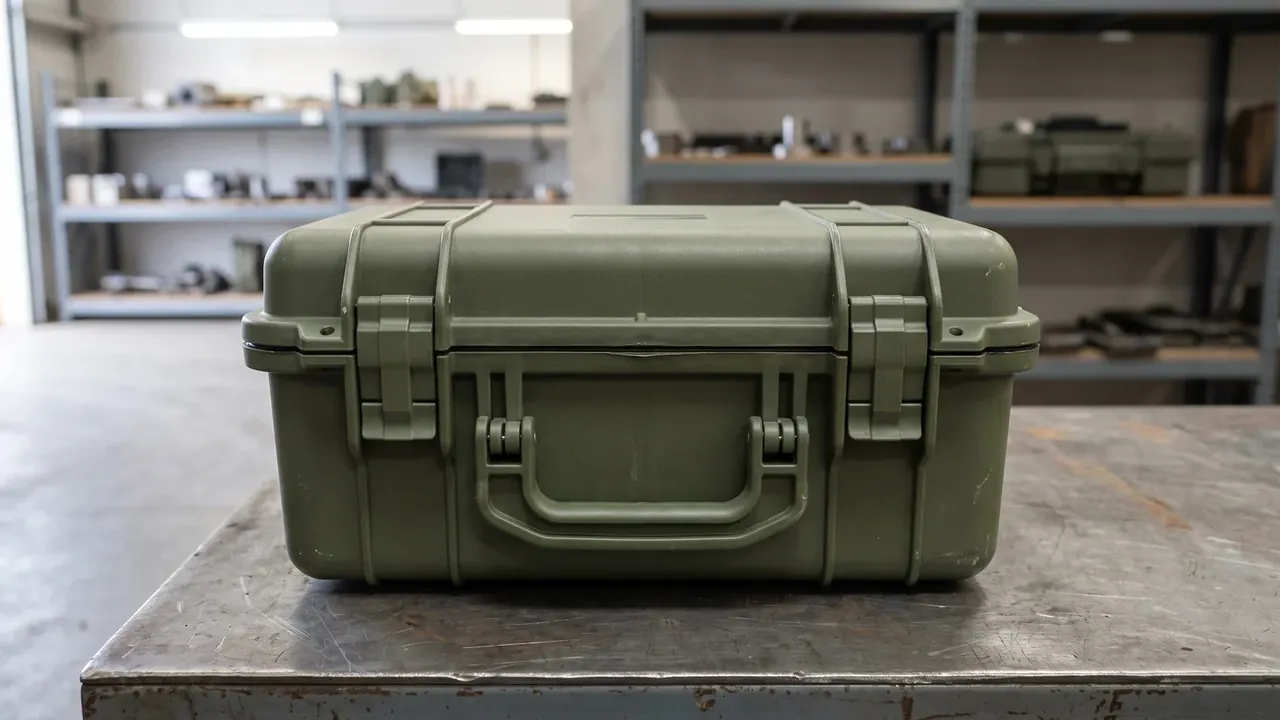
Compression comes first: an 8 mm gasket section squeezed to 5.6 mm is 30 percent, inside a 25 to 35 percent window. The rubber is 55 Shore A plus or minus 5, with set under 25 percent after 24 hours at 70 °C. Flange flatness holds 0.3 mm, checked at 100 mm, and each latch on a waterproof case holds 250 N.
| Item | Method | Threshold |
|---|---|---|
| Positive pressure | 20 kPa, hold 60 s | Drop ≤0.5 kPa |
| Negative pressure | −15 kPa, hold 60 s | Recovery ≤0.3 kPa |
| Gasket compression | 8 mm section | 25–35 percent |
3. Environmental and Mechanical Judgments
Thermal cycling runs from minus 40 °C to plus 70 °C, four hours at each end, ten cycles, then two hours at room temperature before the pressure test repeats. Here a waterproof case shows whether gasket and body expand at different rates.
Salt spray is neutral: 5 percent sodium chloride, 35 °C, 480 hours, with only metal judged, so latches show no red rust and white rust stays under 5 percent of a part. Drop testing follows four hours at minus 18 °C, then 1.2 m onto six faces and three edges. Stacking adds 300 kg for 24 hours at 40 °C, losing under 2 mm, and latches keep 70 percent of preload after 2,000 cycles.
4. Appearance and Marking Judgments
Appearance is judged against a signed sample. Colour is measured at D65, ΔE under 1.5 against the sample and 1.0 within a lot; flash stays under 0.3 mm.
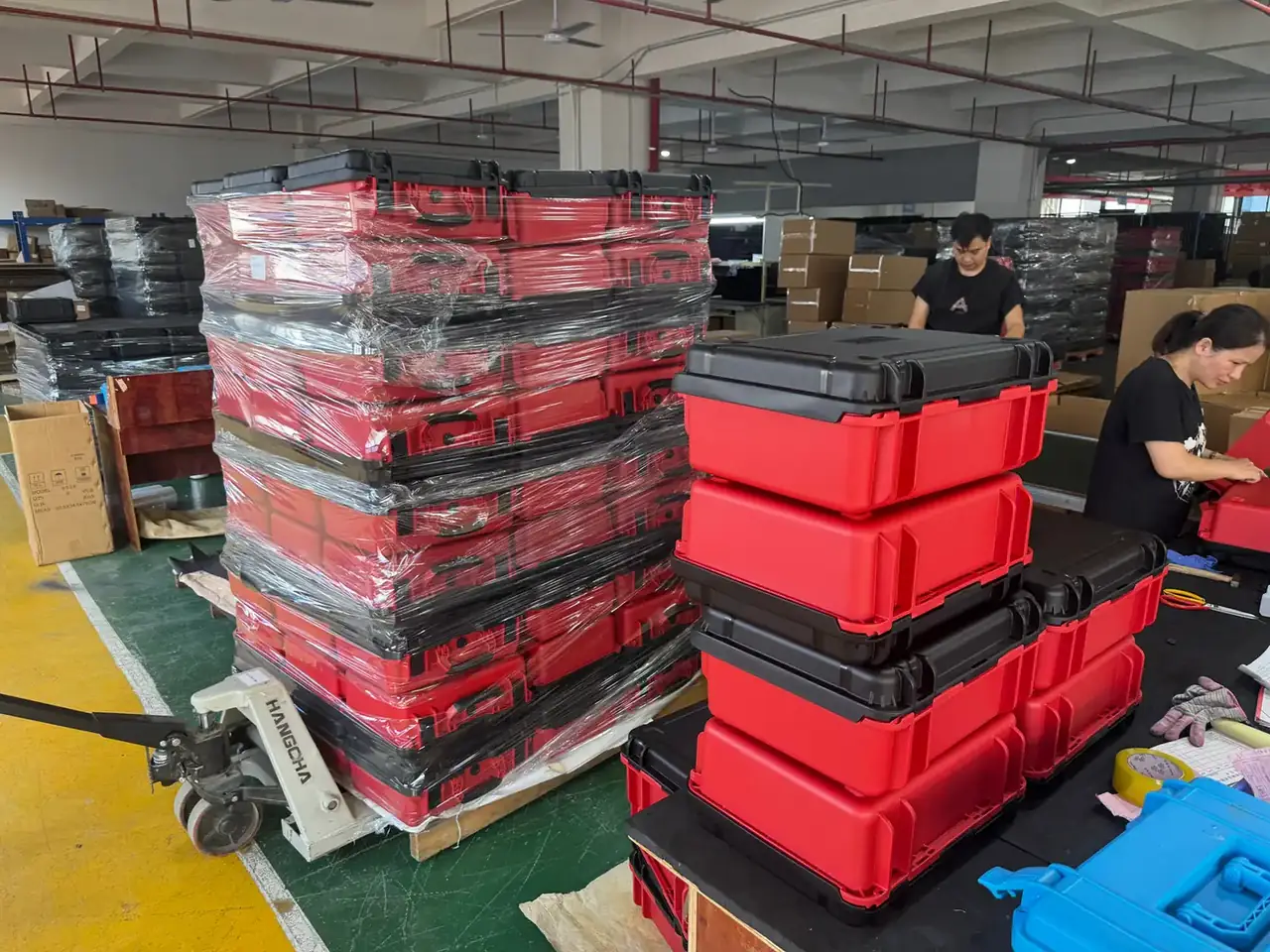
Six markings must be moulded in or etched: cavity, lot, month, resin grade, ingress rating and rated load. Labels fall off and traceability goes with them, so a waterproof case marked IPX7 cannot just say waterproof. Cracks, holes and short-shot latches are critical; flow marks pass on AQL.
5. Sampling Plans and Batch Disposition
Sampling follows ISO 2859-1, normal, single, level II. A lot of 501 to 1,200 cases draws 80 samples, 1,201 to 3,200 draws 125, from different pallets and heights.
Critical defects use Ac 0, so one finding rejects the lot. Major defects run at AQL 1.0, giving Ac 2 and Re 3 at 80 samples; minor at AQL 2.5 gives Ac 5 and Re 6.
| Class | Examples | AQL | Ac / Re |
|---|---|---|---|
| Critical | Crack, hole, seal failure | 0 | 0 / 1 |
| Major | Low latch preload, flange gap | 1.0 | 2 / 3 |
| Minor | Flow mark, slight sink, marking | 2.5 | 5 / 6 |
One failed lot allows a doubled sample; a second rejects it. Two rejections in a row bring tightened inspection.
Conclusion
A waterproof case acceptance standard converts adjectives into numbers: 20 kPa held for 60 seconds with a 0.5 kPa drop, 30 percent gasket compression, 480 hours of salt spray without red rust, AQL 1.0 at Ac 2. Once written, those numbers give inspectors a shared language and suppliers a visible boundary, so a waterproof case standard belongs in the contract.
This article discusses only the container (case body) side of specifications and design intent, and does not cover any handling, loading or use of the contents.
Related Reading
- Standards and test conditions for waterproof hard cases
- Quality control on the case assembly line
- How moisture-proof cases are designed
- Inspection flow for military supply cases
Related Products
- 8 Series — Gun Cases; Military Equipment Cases; Camera Equipment Cases; Drone Cases; Watch Cases; Knife Cases; First Aid Cases; Electronics Equipment Cases
- WL8-2812 PP Gun Case — model WL8-2812
- All protective cases and toolboxes: 7 series, 158 models