

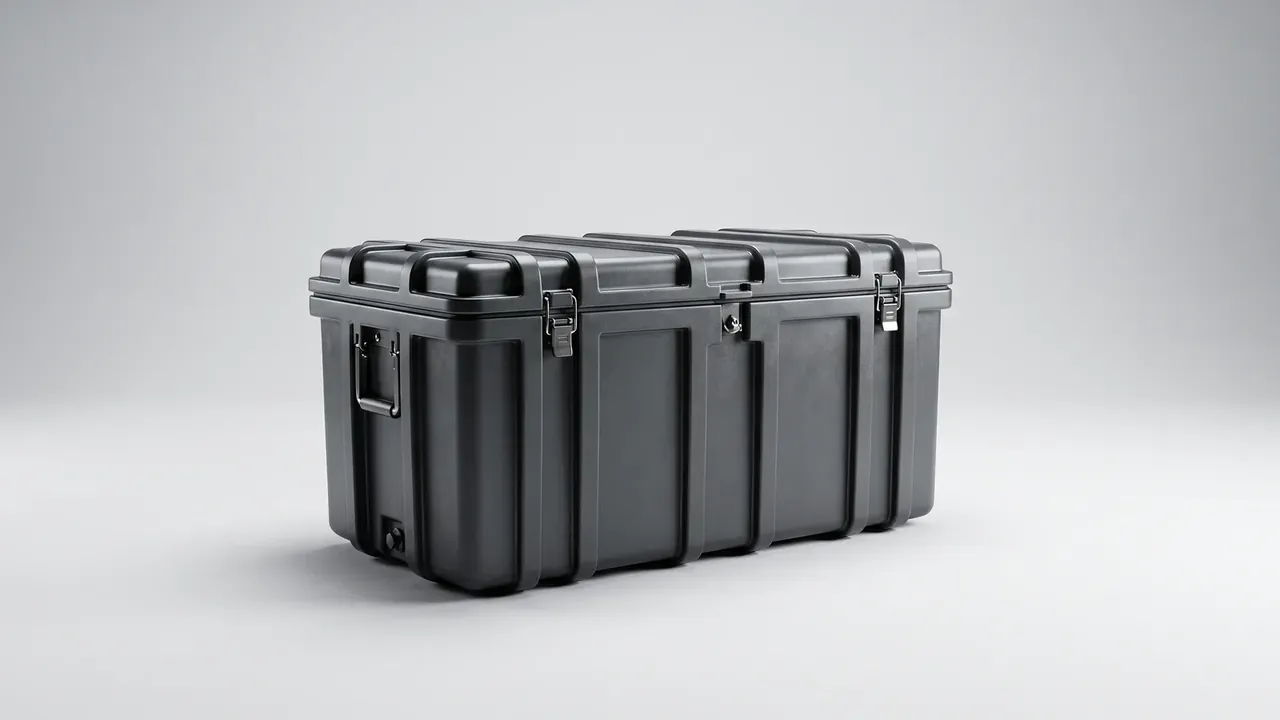
Quick answer: Most failures in waterproof plastic storage boxes with lids start at the lid-to-rim joint, not in the wall. This is one 500-unit inspection: how 32 units were drawn, which readings decided the lot, and what became of three rejects.
Table of contents
- Numbering Comes First: Sampling 32 of 500 Units
- Lid Flatness and Gasket Compression
- Latch Retention and Three Thermal Cycles
- What Happened to the Three Rejects
- FAQ
1. Numbering Comes First: Sampling 32 of 500 Units
Eight pallets landed at nine, 63 units each, plus four loose ones. Before a strap was cut, the cavity number molded into each base was copied down. Eight cavities fed the run, and a sample that misses one lets the worst lid warp hide behind a good average.
| Sample group | Units | Measured on the spot | Recorded as |
|---|---|---|---|
| Cavities 1 to 4 | 16 | Lid flatness, rim diagonals | One reading per unit |
| Cavities 5 to 8 | 16 | Latch boss wall, hinge clearance | Three points, thinnest kept |
| Whole lot, visual | All 32 | Light through the seam, colour, stamp | Position only |
Thirty-two units of waterproof plastic storage boxes with lids is 6.4 percent of the lot, small but touching all eight cavities. A lid is a thin, wide plane, and a 0.2 mm wall difference between cavities can cool into more than a millimetre of warp.
The four loose units were numbered separately. They travelled without strap tension, and lid corners take the first hit.
2. Lid Flatness and Gasket Compression
The lid of waterproof plastic storage boxes with lids goes face down on a grade 1 surface plate and a feeler gauge sweeps a 600 mm span; 1.2 mm or less moves on. Body heat softens a PP lid within ten seconds and the reading drifts lower.
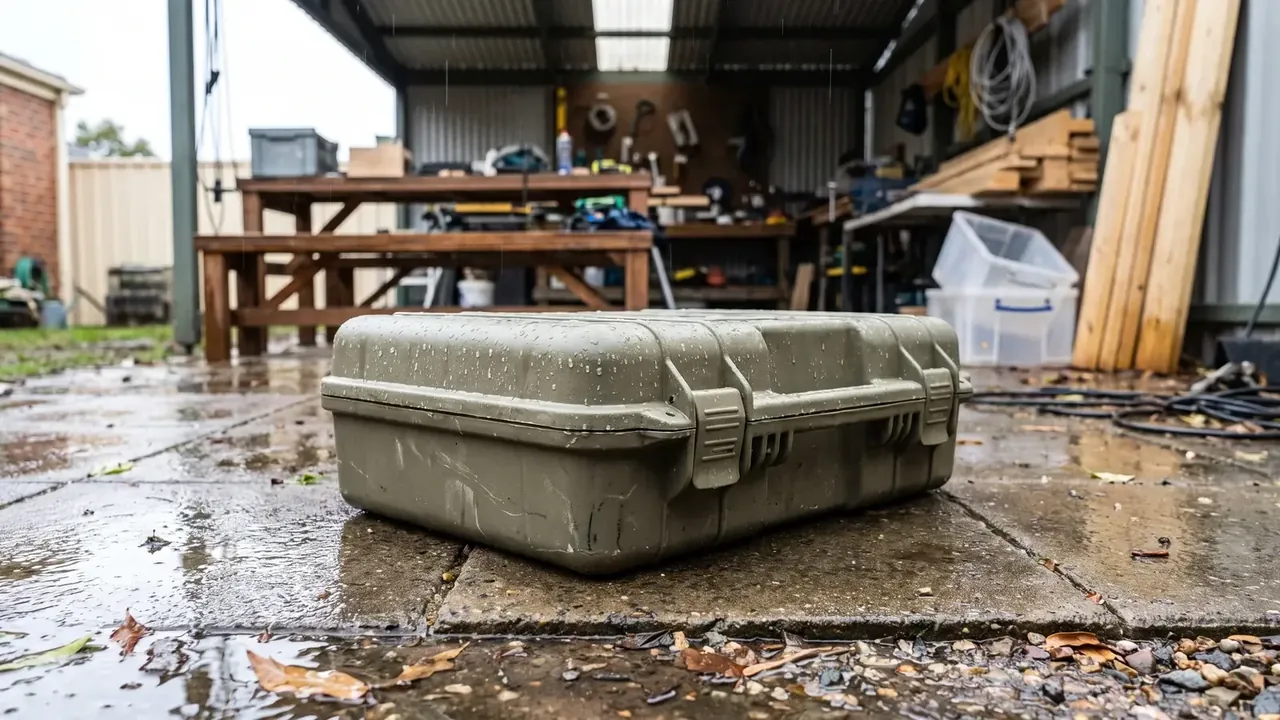
Gasket compression on waterproof plastic storage boxes with lids is judged at 30 percent, plus or minus five points. Press too hard and the rubber loses its rebound within six months; press too little and the seam opens under wind load. One point per rim side, lid closed 24 hours, then the carbon paper marks get measured.
Those four marks are not independent readings. A warped lid clamps at the corners and barely touches the middle of the long sides, so the spread can reach 2 mm. Once clamp load is uneven, driving rain walks in along the loosest stretch. The marks are laid out point by point rather than averaged. An average can look healthy while the loosest point is the leak. If the rim flange carries a weld line, the impression breaks there, and that gap is the damp corner in month three.
Rain then runs at 100 mm per hour for 30 minutes, case tilted 15 degrees. Any water film inside the rim fails the unit.
The order cannot be flipped. Rain first leaves the gasket wet enough to shift the flatness reading.
3. Latch Retention and Three Thermal Cycles
Latch retention is pulled along the opening direction with a force gauge. A latch holding 250 N without releasing, and without whitening at the boss root, passes. On waterproof plastic storage boxes with lids all four get pulled, because the end bosses carry the thinnest wall and are usually the loosest pair.
| Check | Condition | Pass mark | Usual cause of a miss |
|---|---|---|---|
| Lid flatness | Feeler gauge, 600 mm | 1.2 mm or less | Uneven cooling |
| Gasket compression | Lid closed 24 hours | 30 percent, plus or minus 5 | Wide profile tolerance |
| Rain | 100 mm per hour, 15 degrees, 30 minutes | No film inside the rim | Weld line on the flange |
| Latch retention | Pull to open | 250 N without release | Short shot at the root |
| Thermal cycling | Minus 20 C and 60 C, 8 hours each, 3 cycles | Warp recovery within 1.8 mm | Trapped molded-in stress |
Thermal cycling produced the rejects. Three cycles take 48 hours; after two hours of cooling, three units had moved from 1.1 mm to 2.4 mm.
At room temperature all three passed. Heat and cold released what the part already stored.
4. What Happened to the Three Rejects
Each reject had its own cause: a 0.5 mm sink mark at a lid-corner latch boss, 2.4 mm of lid warp, and an 8 mm gasket gap at one corner. All three were graded class B and returned for sorting, no whole-lot rework.
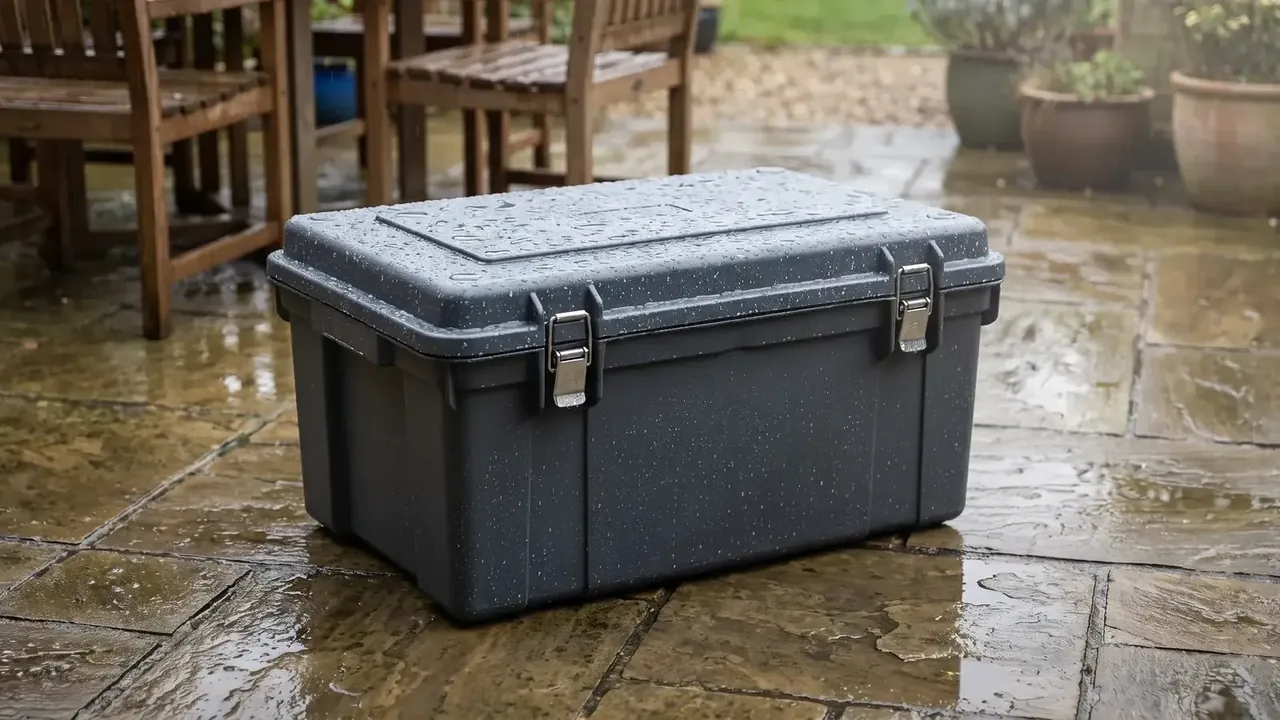
- Sink mark: check the boss root on all 63 units from that cavity; below 95 percent pass, rework the cavity
- Warp: drop cooling water by 4 C, add 3 seconds of packing, mold 8 lids, repeat three cycles
- Gasket gap: move the joint to the middle of a long side
- Re-check: twice the sample, same checks, both reading sets on one sheet
Re-checks on waterproof plastic storage boxes with lids only count with the same measuring point, gauge and operator.
A rejection note for waterproof plastic storage boxes with lids has to carry the cavity number. Without it, the defect returns from the same cavity next run.
Conclusion
Most of the six hours went into waiting, not measuring: 24 hours for the impressions, 48 for the cycles, two for the case to settle. Judgement on waterproof plastic storage boxes with lids rests on readings taken after those waits.
This article discusses only the container (case body) side of specifications and design intent, and does not cover any handling, loading or use of the contents.
Related Reading
- Storage and care rules for case molds
- Test items and pass marks for hard waterproof cases
- Specification requirements for munitions shipping and storage cases
Related Products
- 8 Series — Gun Cases; Military Equipment Cases; Camera Equipment Cases; Drone Cases; Watch Cases; Knife Cases; First Aid Cases; Electronics Equipment Cases
- WL8-2812 PP Gun Case — model WL8-2812
- All protective cases and toolboxes: 7 series, 158 models