

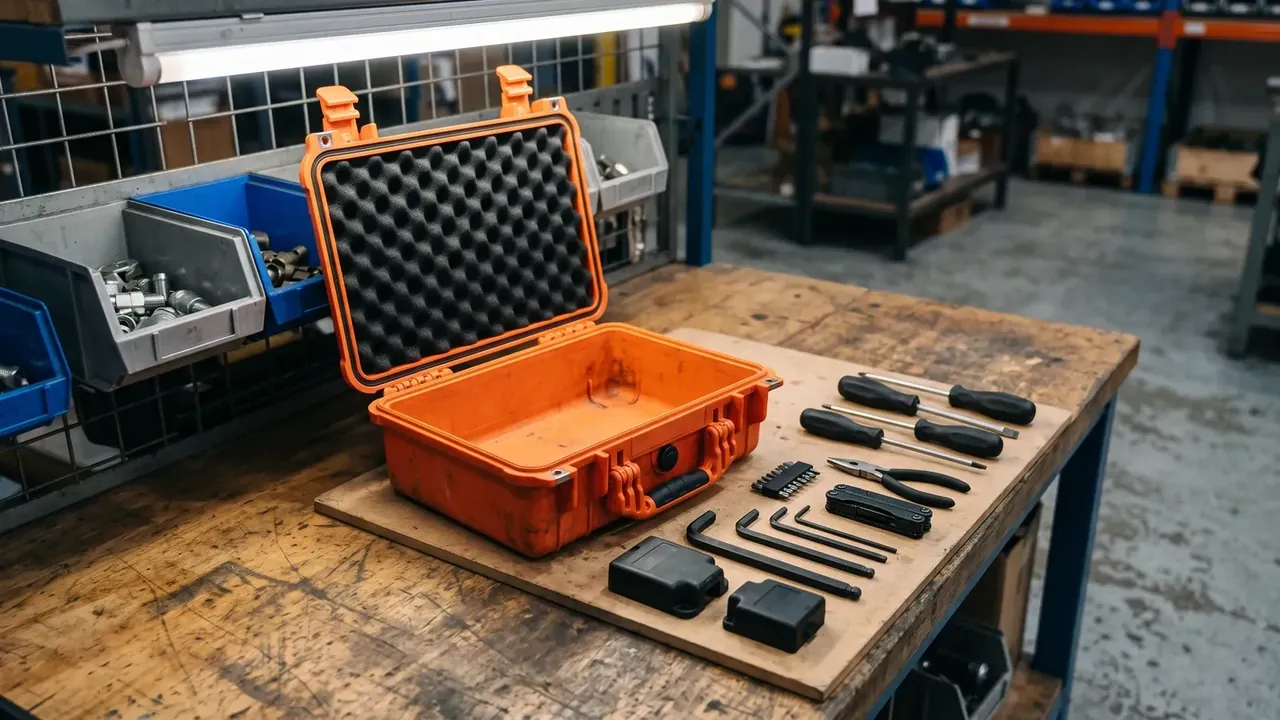
Quick answer: A weapons consolidated tool kit is configured by where it lives. Arms rooms care about stacking and facing, bench bays about lid angle and bench footprint, field camps about sealing and two-person carry, handovers about seal holes and the list window.
Table of contents
- Stacking and Access in the Arms Room
- Bench Bay: Lid Angle and Bench Footprint
- Field Camp: Sealing and Two-Person Carry
- Handover: Seal Holes and the List Window
- Four Scenarios Side by Side
- FAQ
1. Stacking and Access in the Arms Room
The arms room is the only one of the four built for static storage, so height and facing come before weight. Rack pitch is commonly 450 millimetres, keeping a case under 400 millimetres for three tiers, with a 200 kilogram static check on the top face.
Facing decides how fast a case comes off the shelf. The list window of a weapons consolidated tool kit faces the aisle, so nobody turns a case to read a number, and in a 900 millimetre aisle the depth stays under 400.
| Bay use | Case height | Tiers | Note |
|---|---|---|---|
| Rack, standard | under 400 mm | 3 | Load on perimeter ribs |
| Pallet | under 400 mm | 3 | Feet lock into deck |
2. Bench Bay: Lid Angle and Bench Footprint
A bench bay repeats one motion dozens of times a day, so the weapons consolidated tool kit is judged on the lid. A 105 degree opening holds it without a hand, and with the bench at 900 millimetres the case stays under 260 millimetres, or the rim blocks the floor.
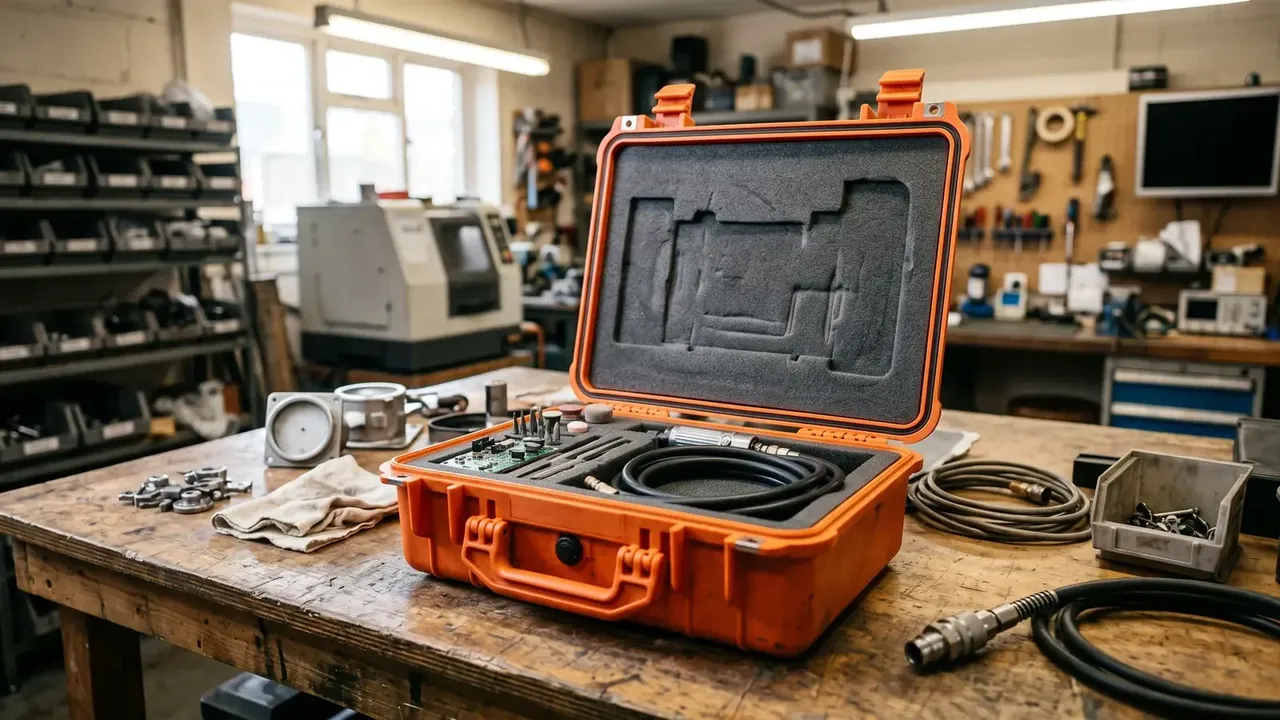
Tiers follow frequency, not size: everyday parts on top, specials in the middle, heavy parts at the bottom. Order by size and the daily items get buried, so the top tier comes out on every job.
| Bay type | Case size | Tiers | Note |
|---|---|---|---|
| Fixed bench | 460×350×220 mm | 3 | Lid clears the bench |
| Tool cart | 400×300×180 mm | 2 | One-hand carry |
| Field point | 550×420×260 mm | 4 | Two-person lift |
3. Field Camp: Sealing and Two-Person Carry
Field use loads the case with temperature and dust. Rating from minus 25 to 55 degrees Celsius points to an EPDM gasket rather than nitrile, which stiffens in cold; IP67 covers a metre of water for thirty minutes, and after a 1.2 metre corner drop the latches must still work.
Carry is the second limit. A weapons consolidated tool kit weighs 9.8 kilograms empty and 38 loaded, so anything past 25 kilograms needs a two-person lift or a wheel set. The handle stands 60 millimetres off the lid, wide enough for gloves.
For dust, the vent valve takes a capped membrane so grit does not pack onto it, and side ribs at 120 millimetre pitch stop the wall bowing in a vehicle.
4. Handover: Seal Holes and the List Window
A handover turns on one question: can anyone see the case was opened? Align the pin holes of two draw latches and pass a twelve-digit one-time seal; a broken seal is proof. The number goes onto the sheet, split three ways.
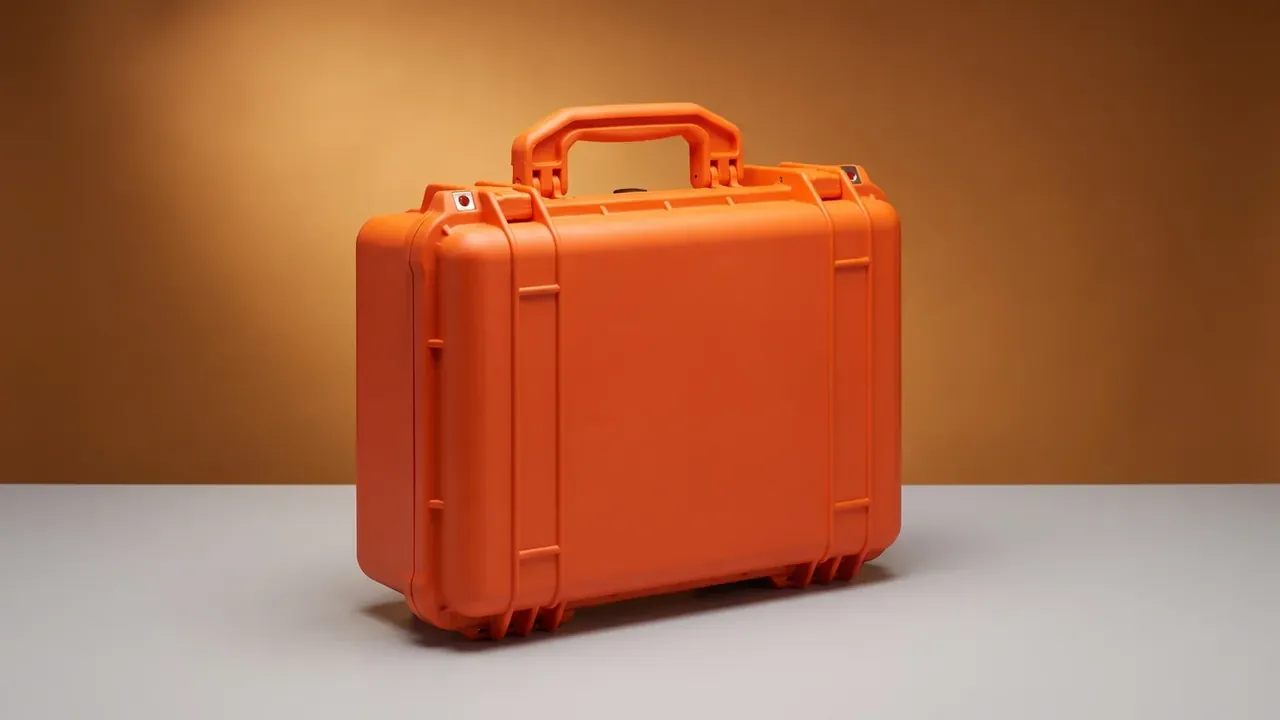
The list window is A5 with a 1.5 millimetre panel recessed into the lid, so it neither stands proud nor scratches; the sheet shows case number and item count only. A case checks in under three minutes with eight corner guards and a 20 millimetre gap.
5. Four Scenarios Side by Side
What changes between the four settings is the liner; the shell can be shared. One shell with two or three liners covers store, bench and field without a new mould.
| Scenario | Tiers | Liner | Carry | Limit |
|---|---|---|---|---|
| Arms room | 3 | Moulded dividers | Pallet and forklift | 400 mm tall |
| Bench bay | 2 to 3 | Moulded EVA | One hand | 18 kg loaded |
| Field camp | 4 | Cut foam | Two persons | 38 kg loaded |
| Handover | Fixed nests | Foam and straps | Full pallet | Seal hole and window |
The order of decisions is fixed: carry method sets loaded weight, tier count sets case height, mark position sets the openings.
Conclusion
The four settings reduce to four checks: height and facing in the store, lid angle and tier order at the bench, sealing and carry weight in the field, seal and window at handover. A weapons consolidated tool kit is configured from the constraints of the place it serves.
This article discusses only the container (case body) side of specifications and design intent, and does not cover any handling, loading or use of the contents.
Related Reading
- What a weapons consolidated tool kit is
- Choosing a weapons consolidated tool kit
- Tool kit chests for onboard tooling
- Consolidated tool kits for machine tooling
Related Products
- 8 Series — Gun Cases; Military Equipment Cases; Camera Equipment Cases; Drone Cases; Watch Cases; Knife Cases; First Aid Cases; Electronics Equipment Cases
- WL8-2812 PP Gun Case — model WL8-2812
- All protective cases and toolboxes: 7 series, 158 models