

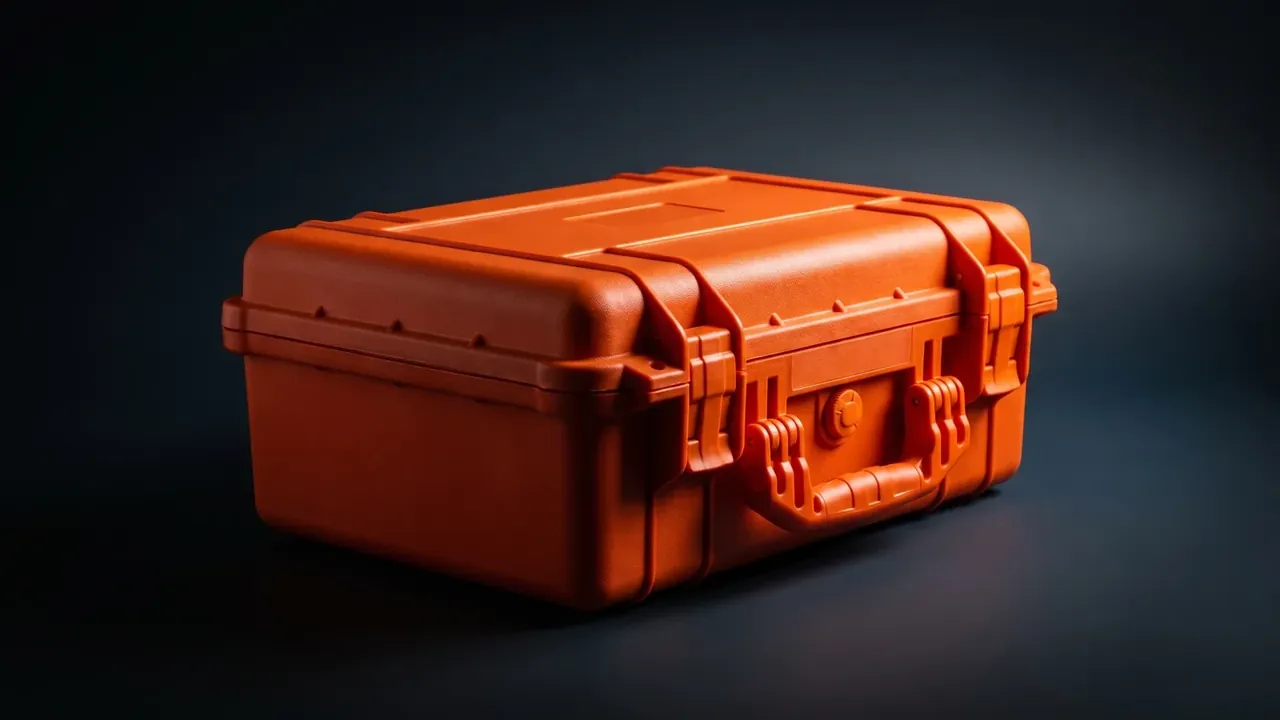
Quick answer: Servicing a weapons consolidated tool kit runs on four beats: handover glance, monthly five-point check, annual strip-down and change on criteria. Three measurable numbers decide the rest: gasket free height down to 5.2 millimetres, latch pull-off below 120 newtons, foam slot sag past 3 millimetres.
Table of contents
- How to Set the Service Cycle for a Weapons Consolidated Tool Kit
- Gasket Ageing: Criteria and Change Point
- Latch and Hinge Wear Limits
- Liners and Markings: Where Servicing Stops
- Making the Check Log Work
- FAQ
1. How to Set the Service Cycle for a Weapons Consolidated Tool Kit
A fixed calendar is the wrong start. The same shell in a controlled store and under a steel roof past 35 degrees ages seals at different rates, and 300 openings a year does not wear hinges like 1200.
Two numbers set the band: openings and store temperature. Under 500 openings and 30 degrees keep the standard cycle; above 800, or months above 35 degrees, strip-down moves to twice a year. EPDM compressed above 35 degrees loses rebound a year early.
| Beat | When | Time per case |
|---|---|---|
| Handover glance | Every handover | 40 seconds |
| Monthly | Once a month | 12 minutes |
| Strip-down | Every 12 months | 90 minutes |
| Change | On criteria | Depends |
2. Gasket Ageing: Criteria and Change Point
The gasket on a weapons consolidated tool kit is the first part to expire. It sits in a U-channel, 8 by 6 millimetres free section, compressed to 4.2 millimetres on closing, and that millimetre of rebound holds the joint.

Measure, do not look. Lift the gasket out, let it recover ten minutes, read free height with a caliper: 6 millimetres new, 5.2 millimetres means a change, a set of 13 percent. Average Shore A at three points: 55 new, above 70 means plasticiser has migrated. Cracking, or a mark wider than 1.5 millimetres, decides it too.
Tightness checks on the bench: charge to 20 kilopascals through the vent valve, wait 60 seconds, accept a 2 kilopascal drop. Clean with neutral soap only; silicone and mineral oils swell the cord.
3. Latch and Hinge Wear Limits
A catch fails by going slack, not by breaking. New, it holds 180 newtons; under 120 a loaded weapons consolidated tool kit pushes it open in a two-person lift while both catches look closed. Pull-gauge each catch and record the peak.
On a hinge the pin shows and the bore wears: 5 millimetres down to 4.6 calls for a pin, and a bore oval by 0.2 millimetres needs the seat too, or the new pin wears oval again. Silicone grease, 0.2 grams a point, yearly.
Replace in sets: catch body and pin together, hinge pin alone. A second failure from one batch inside six months puts the batch under watch.
| Part | New | Change at |
|---|---|---|
| Gasket free height | 6 mm | 5.2 mm |
| Catch pull-off | 180 N | 120 N |
| Hinge pin | 5 mm | 4.6 mm |
4. Liners and Markings: Where Servicing Stops
Liner work splits in two. A shallow dent in closed-cell foam returns with two minutes of 60 degree air; EVA hardened from Shore A 38 to 50 only slips, and that is irreversible. Base sag of 3 millimetres is the line for a weapons consolidated tool kit.
Paper labels lift within six months above 30 degrees, so use polyester rated minus 20 to 80, cleaned with isopropanol and pressed ten seconds. Engraved numbers at 0.3 millimetres stay readable under paint.
At each strip-down, check the back of the liner for condensation: a leaking joint marks it there first, so look at the gasket, not the liner.
5. Making the Check Log Work
A log is not an archive, it is how a trend shows. One page per case: number, date and beat, item checked, measured value, action, batch. The measured column needs a number; two readings near the limit mean an early change on the weapons consolidated tool kit.
A hundred cases at 12 minutes a month is 240 hours a year, 20 hours a month for one person, with strip-downs adding 150.
The log calibrates the cycle too: a fifth of gaskets changed within a year means the beat is loose or the store too warm; three clean years stretch strip-down to 18 months.
Conclusion
Four beats, three change lines and one page per case cover weapons consolidated tool kit servicing. Intervals follow openings and store temperature, change points follow measurable dimensions, and the log is what keeps a weapons consolidated tool kit in service.
This article discusses only the container (case body) side of specifications and design intent, and does not cover any handling, loading or use of the contents.
Related Reading
- What a consolidated tool case is and how it is built
- Routine care and part life for rotomoulded cases
- Servicing items for submachine gun storage boxes
- Preventing damage in case storage
Related Products
- 8 Series — Gun Cases; Military Equipment Cases; Camera Equipment Cases; Drone Cases; Watch Cases; Knife Cases; First Aid Cases; Electronics Equipment Cases
- WL8-2812 PP Gun Case — model WL8-2812
- All protective cases and toolboxes: 7 series, 158 models