

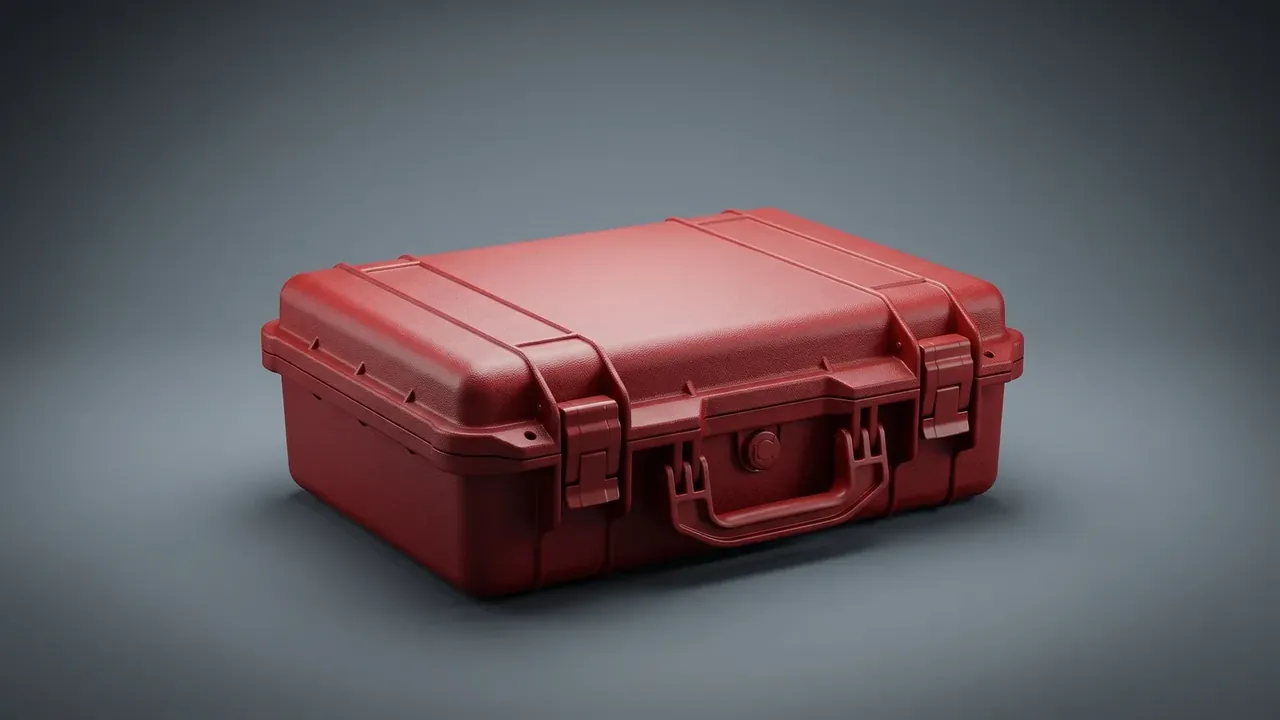
Quick answer: Size a Weapons Consolidated Tool Kit inside out: cavity from the longest item plus clearance, envelope from the cavity plus two wall sections, stack load from gross weight and tier count. Move one figure and the other two are recalculated.
Table of contents
- Where the Weapons Consolidated Tool Kit Dimension Chain Starts
- Splitting Wall Thickness Across Base, Side and Lid
- Back-Calculating Load and Stack Height
- Tolerance Bands and the Gauges That Hold Them
- Writing the Specification as a Working Sheet
- FAQ
1. Where the Weapons Consolidated Tool Kit Dimension Chain Starts
A Weapons Consolidated Tool Kit runs on a four-link chain: cavity, wall section, envelope, stacking footprint. The tool list is the input and the body the variable, so the chain starts at the cavity, where a 560 mm longest item and a 205 mm tallest item, plus clearance, set the floor.
That gives a 592 × 392 × 230 mm cavity; a 4.0 mm side and 5.0 mm base make a 600 × 400 × 240 mm envelope, the 2 × 2 module of a 1200 × 1000 mm pallet, so four cases sit per layer and twelve per three tiers.
Every link keeps its own tolerance band; adding the four together gives a figure no gauge can police.
2. Splitting Wall Thickness Across Base, Side and Lid
Rotomoulding has no moulded-in thickness; powder charge and thermal field decide it. Targets are 5.0 mm base, 4.0 mm side, 4.5 mm lid and 3.6 mm corners, because the base takes abrasion, the lid stack load and the side bulging.
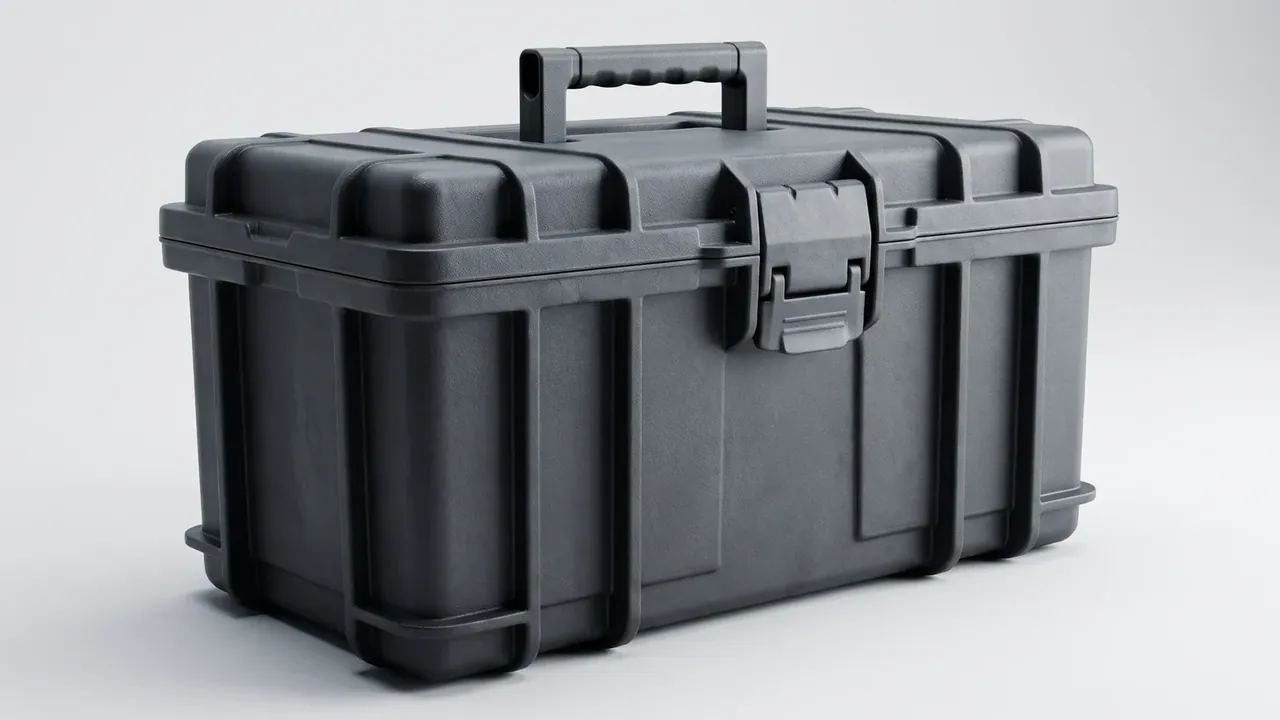
A 600 × 400 × 240 mm case develops 0.96 m²; at 4 mm and 0.94 g/cm³ that is 3.6 kg of powder, charged at 3.8 kg.
Corner thinning runs 15 to 20 percent below the flat wall, so the drawing reads minimum, not nominal. Nine ultrasonic points per case; under 80 percent of the zone target means another powder pass.
3. Back-Calculating Load and Stack Height
Three loads get confused: gross weight, stack load, drop impact. The sum starts with tier count, which clear height and forklift lift decide.
At 28 kg gross and three tiers the bottom case carries 56 kg; a 1.5 factor gives an 84 kg test at 23 °C, lid deflection capped at 3 mm. Four tiers reach 126 kg.
| Tiers | Load on bottom case | Test load | Allowed deflection |
|---|---|---|---|
| 2 | 28 kg | 42 kg | 2 mm |
| 3 | 56 kg | 84 kg | 3 mm |
| 4 | 84 kg | 126 kg | 4 mm |
Ribs 8 mm high at 120 mm pitch spread load into the side walls; sparse ribs let the lid dish and open the gasket.
Each handle is rated 42 kg; a one-sided lift feeds the hinge torque, so the sheet forbids it.
4. Tolerance Bands and the Gauges That Hold Them
Bands are separate: ±1.0 mm on pockets, ±2.0 mm on the envelope, 1.5 mm flatness. Shrinkage of 2.5 percent is compensated into the mould and checked on a template.
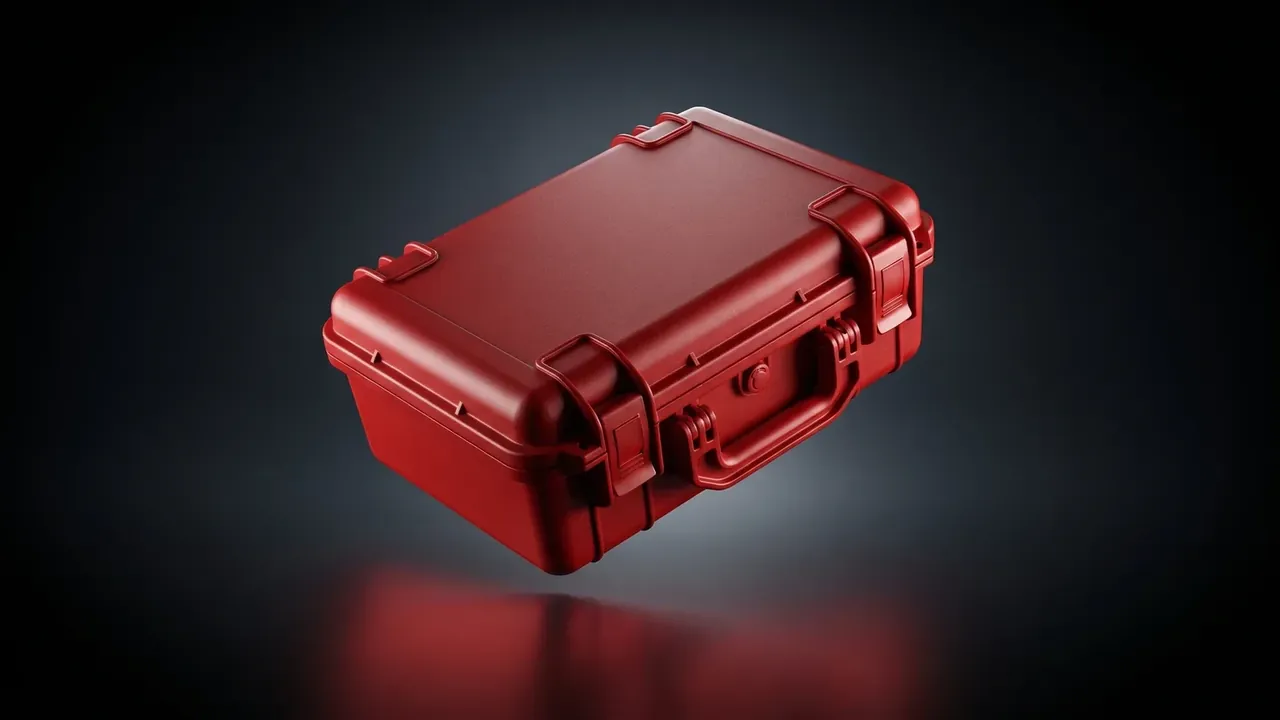
A 3 m tape covers the envelope, a caliper the pockets, an ultrasonic gauge the walls, and a surface plate the lid flatness.
Deep pockets take go/no-go gauges at nominal ±1 mm. Parts condition at 23 ± 2 °C for 24 hours, since a sunlit case reads 1.5 mm large.
5. Writing the Specification as a Working Sheet
A specification for a Weapons Consolidated Tool Kit should be a sheet, not a paragraph: envelope, cavity, wall zones, gross weight, tier count, latch and marking positions.
| Item | Write it as | Common error |
|---|---|---|
| Cavity | 592 × 392 × 230 mm, ±1.0 | envelope only |
| Wall | base 5.0, side 4.0, lid 4.5, minimum | average 4 mm |
| Gross weight | 28 kg with body and liner | net payload only |
| Stacking | three tiers, 56 kg on the bottom | stackable, no figure |
Change control bites harder than design. One extra tool lengthens the cavity 30 mm, the envelope becomes 630 mm, and a pallet layer drops to three.
An 80 × 50 mm label recess of 0.5 mm, clear of ribs and latches, keeps a barcode scannable.
Conclusion
A usable specification is numbers that hold each other: cavity from the tool list, envelope from the cavity, load from the tier count, tolerance from what the gauges can check. Written in that order, a Weapons Consolidated Tool Kit holds size, wall thickness and load without contradiction.
This article discusses only the container (case body) side of specifications and design intent, and does not cover any handling, loading or use of the contents.
Related Reading
- How to choose a Weapons Consolidated Tool Kit
- What a Weapons Consolidated Tool Kit is
- Heavy duty protective case specifications
- How protective case size ranges are divided
Related Products
- 8 Series — Gun Cases; Military Equipment Cases; Camera Equipment Cases; Drone Cases; Watch Cases; Knife Cases; First Aid Cases; Electronics Equipment Cases
- WL8-2812 PP Gun Case — model WL8-2812
- All protective cases and toolboxes: 7 series, 158 models