

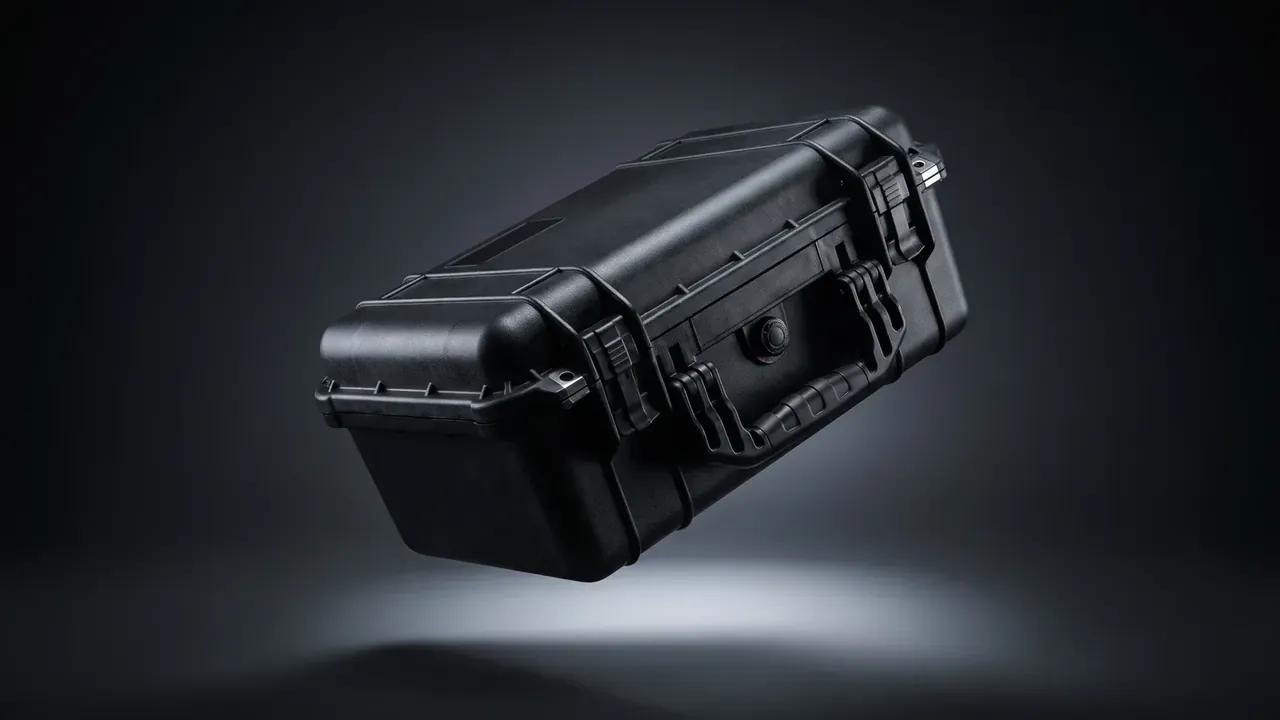
Quick answer: A weather-resistant plastic protective case is set by its compound: 0.6% UV stabiliser, 2.0% masterbatch, ΔE ≤3.0 and chalking grade 1 at 1,000 h.
Table of contents
- Weather Migration Path of a Weather-Resistant Plastic Protective Case
- UV Stabiliser and Colour Masterbatch
- Colour Shift and Chalking After Xenon Exposure
- Impact Retention at Low Temperature
- Field Settings for Outdoor Crews
- FAQ
1. Weather Migration Path of a Weather-Resistant Plastic Protective Case
Two shells from one batch sit in a yard for two years. One only fades, the other cracks under a thumb. Sunlight strips the tertiary hydrogen off the backbone, the radical takes oxygen, and the chain breaks within tens of micrometres of the surface.
The failure of a weather-resistant plastic protective case runs in four stages: initiation, propagation, scission, chalking. The first two are invisible, the third shows as colour shift, and only the fourth is chalking. Judging durability means asking how long the shell holds before stage three.
Additive load in the skin sets the pace. Too little and the ultraviolet is spent in the first year, leaving bare resin; too much and dispersion leaves agglomerates. The tiers below go by compound load, not wall thickness.
| Stabiliser tier | UV stabiliser | Masterbatch | Where it goes |
|---|---|---|---|
| Indoor rotation | 0.2% | 1.2% | Stores and short trips, under a season outdoors |
| General outdoor | 0.6% | 2.0% | Two years in the open, intermittent rain |
| Long-term outdoor | 1.0% | 2.4% | No cover all year, longer inspection gap |
2. UV Stabiliser and Colour Masterbatch
0.6% stabiliser and 2.0% masterbatch are one recipe, aimed at holding tensile retention above 80% at 1,000 h. The hindered amine scavenges scission radicals, the absorber turns energy near 340 nm into heat, and pigment screens the rest; each covers a different band.
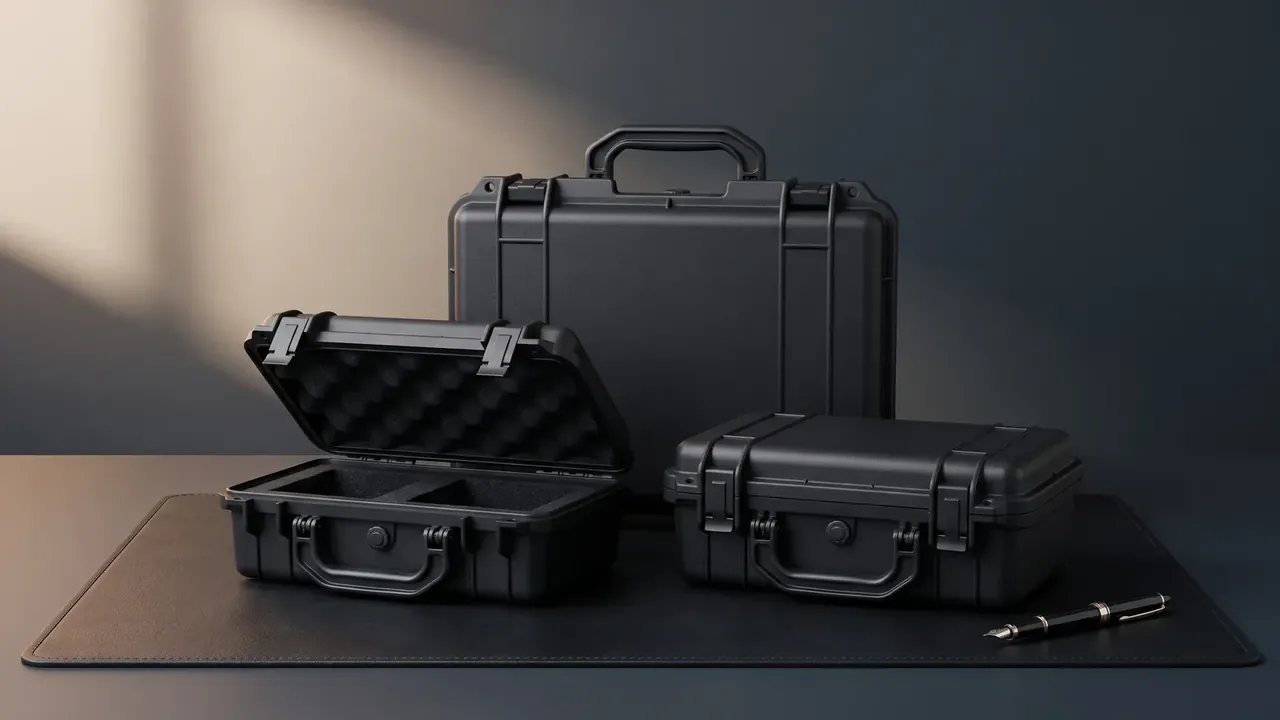
Published comparisons show why the split matters. Under 1,000 h of xenon, 0.5% absorber alone reached ΔE 4.1 and 76% tensile retention; 0.3% absorber with 0.3% hindered amine came to ΔE 1.8 and 90%. Same load, half the shift. The 0.6% in a weather-resistant plastic protective case is split rather than doubled on one side.
Masterbatch moves surface energy too. Untreated polypropylene sits near 30 mN/m, below the wetting threshold of most pressure-sensitive adhesives; with 2.0% masterbatch and a moulded texture the outer face measures 38 mN/m, past the 36 mN/m needed for screen printing, so a decal does not lift.
More is not better. Past 2.4% the pigment raises melt viscosity, corners trap air and show silver streaks, and a streak is a ready-made crack starter.
3. Colour Shift and Chalking After Xenon Exposure
State the conditions in full for a weather-resistant plastic protective case: ISO 4892-2 Method A, daylight filters, 0.51 W/m² at 340 nm, black panel 65 ℃, 102 min dry light plus 18 min light with spray, 50% relative humidity. Drop one and the 1,000 h figure compares with nothing.
| Exposure block | Cumulative irradiance | What changes | Reading |
|---|---|---|---|
| 500 h | about 0.92 MJ/m² | Yellowing starts, gloss drops | ΔE around 1.2, grade 0 |
| 1,000 h | about 1.84 MJ/m² | Colour steadies, skin chalks | ΔE ≤3.0, chalking grade 1 |
| 2,000 h | about 3.67 MJ/m² | Chalking deepens, fine cracks | ΔE around 4.5, grade 2 |
The usual conversion puts 1,000 h at one to two years outdoors and 2,000 h at three to five, depending on site irradiance. It ranks compounds, not warranties; a shell that runs 1,000 h in Hainan has not seen Harbin weather.
Chalking is rated by the tape method of ISO 4628-6: grade 0 for none, grade 1 for slight and visible only under magnification, grade 2 for faint but naked-eye visible. A weather-resistant plastic protective case takes grade 1 as the 1,000 h line, because grade 2 means the skin resin has gone and mechanical loss follows.
One reading misleads: some compounds show a brief gloss recovery early on, as roughening scatters less specular light; it appears between 300 h and 500 h and reverses sharply.
4. Impact Retention at Low Temperature
Low-temperature impact sits closer to the safety margin than colour. Homopolymer polypropylene notched Izod reads about 5.5 kJ/m² at 23 ℃ and only 3.8 kJ/m² at −30 ℃ by the GB/T 1843 method, retention below 70%. Holding 70% needs copolymer or elastomer toughening; a stabiliser alone will not carry it.
The declared −30 ℃ to +70 ℃ window has a failure at each end. A case from a cold store dropped outside puts its corners at the glass transition, where a crack runs through. In summer a car boot reaches 70 ℃, the gasket softens, and compression set accumulates by the hour.
Toughening has a price. Elastomer lowers flexural modulus, so the lid deflects more under a stack; the weather-resistant plastic protective case answers with a 4.1 mm wall and two ribs, at about 0.3 kg a unit.
5. Field Settings for Outdoor Crews
Field readings come from a handheld colorimeter, spot fixed in a 60 mm square at the lid centre, D65 light, three shots averaged. The spread matters more than the number: beyond 0.8, ageing is uneven, usually from orientation, and that unit cannot stand for the batch.
| Colour reading | What it looks like | Action |
|---|---|---|
| ΔE ≤1.5 | Barely visible, instrument only | Keep in service, re-test yearly |
| 1.5 < ΔE ≤ 3.0 | Whitening visible, texture intact | Demote to indoor rotation |
| ΔE > 3.0 | Clear fading, surface gone dry | Withdraw from front line |
Inside a weather-resistant plastic protective case the cavity measures 475 × 335 × 160 mm and the unit weighs 5.4 kg. Stacked 5 high, the bottom lid carries about 21.6 kg, which with aged modulus decides whether the panel dishes; once it does, gasket compression drops below 20% and the IP66 jet test is lost.
The 4,800-cycle figure covers latches and hinges and does not move with the compound, but it adds to ageing. Past cycle 3,000 a chalked shell drags at the catch seat.
Conclusion
The outdoor behaviour of a weather-resistant plastic protective case is set by the 0.6% stabiliser and 2.0% masterbatch recipe, then checked at 1,000 h against ΔE 3.0, chalking grade 1 and 70% impact retention. A 4.1 mm wall and 5.4 kg weight are structural givens; 5-high stacking and 4,800 cycles mark the use side. The compound owns the skin, the structure owns the whole.
Related Reading
- Case Behaviour in Cold Weather
- Weighing Wooden Crates Against Plastic Cases
- How Corner Radii Eat Usable Length
Related Products
- 8 Series — Gun Cases; Military Equipment Cases; Camera Equipment Cases; Drone Cases; Watch Cases; Knife Cases; First Aid Cases; Electronics Equipment Cases
- WL8-2812 PP Gun Case — model WL8-2812
- All protective cases and toolboxes: 7 series, 158 models