

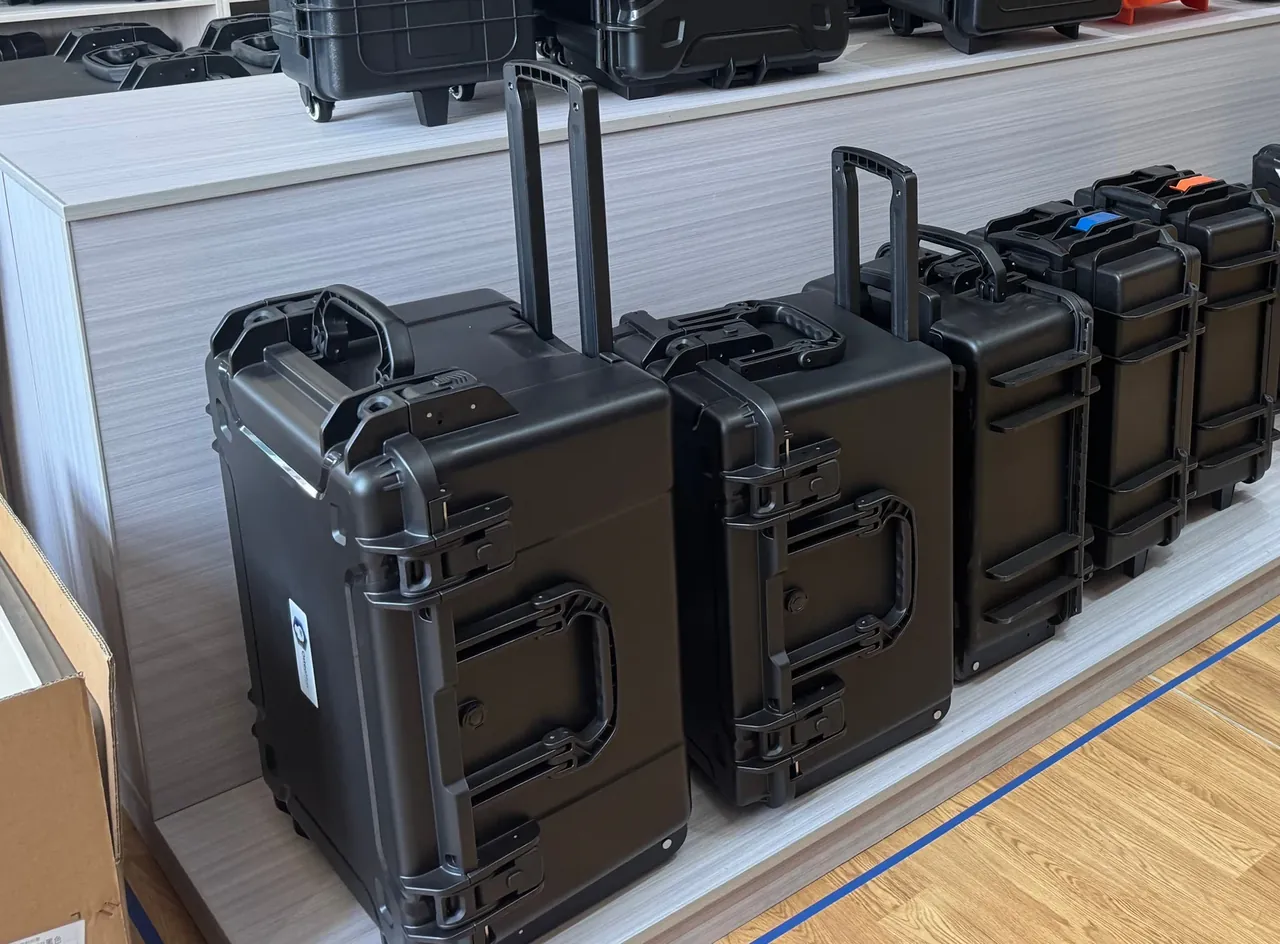
Quick answer: Wheeled Instrument Case with Telescopic Handle is set by caster size and track: 75 mm wheels, a 300 mm track and a 2-stage handle pulled out 300 mm.
Table of contents
- Caster Diameter and Common Surfaces
- Wheel Track and Turning Radius
- Handle Stages and Pull-Out Length
- Handle Load and the Body Joint
- Towing Posture and Centre of Gravity
- FAQ
1. Caster Diameter and Common Surfaces
A case with wheels does not get lighter; the weight moves from the hand to the floor. For Wheeled Instrument Case with Telescopic Handle the first item is not the handle but the caster, and the 50 mm / 75 mm split follows the surface rather than the shell size.
50 mm casters suit indoor floors: tiles, epoxy screed, showroom corridors. The centre of gravity sits low and steering is light, yet a doorstep must be lifted, and that lift costs more than rolling ever does.
75 mm casters suit factory floors: concrete, brick paving, gravel shoulders. The larger rim meets a joint at a shallower angle, so the jolt is softer; the price is a raised boss and a higher centre of gravity, which shows up as lean in a turn.
The body side has to match. Wall thickness around the wheel boss runs 2.0–3.5 mm, with a steel backing plate under the boss tied by ribs to the base; a boss half a hole off centre twists the whole Wheeled Instrument Case with Telescopic Handle body under tow.
| Caster diameter | Common surface | Joint behaviour | Body-side treatment |
|---|---|---|---|
| 50 mm | tiles, epoxy screed, showroom | stops at narrow joints, lifted over thresholds | boss recessed, plate flush with the base |
| 75 mm | concrete, brick paving, gravel | shallow entry angle, softer jolt | boss proud, ribs wrapping the seat |
2. Wheel Track and Turning Radius
Track is the lateral distance between the two casters, and Wheeled Instrument Case with Telescopic Handle sets it at 300 mm. A wide track lets the outer wheel travel a long arc and the body follows a smooth curve; a narrow track drags the outer wheel, swings the tail out and makes the wrist pull it back.
Turning radius is not a body dimension; it falls out of track, handle tilt and whether the casters swivel. With both casters fixed the case must be tipped until one wheel lifts before the radius closes; with swivel casters a 300 mm track turns inside a narrow aisle.
Load belongs here too. One wheel carries 30 kg while the pair share the load unevenly, and under tow the body tilts and that wheel takes more than half, so a Wheeled Instrument Case with Telescopic Handle sizes boss and axle above half the payload.
| Track | Turning behaviour | Lean | Suits |
|---|---|---|---|
| 300 mm and wider | smooth arc, tail stays behind | slight outward lean | tall cases and long-distance models |
| narrower than 300 mm | tail swings out, wrist pulls back | noticeable lean | short wide bodies, short trips |
3. Handle Stages and Pull-Out Length
Two stages with 300 mm of pull-out is the common pairing for Wheeled Instrument Case with Telescopic Handle. A two-stage tube has one locking point, so there is little to rattle, and 300 mm puts the grip just below hip level, where the arm hangs and body weight does the pulling.
A third stage lengthens the travel and deepens the recess in the body. Every extra stage adds a sliding joint and the play accumulates: after 5 km loaded, the grip end of a three-stage handle shows a wider gap than a two-stage one.
Pull-out length also follows stature. Too short and the user stoops, loading the lower back; too long and the arm is held up, loading the shoulder. 300 mm is the compromise, and a taller user adds a soft grip sleeve rather than another stage.
| Stages | Travel | Locking points | Recess depth | Play |
|---|---|---|---|---|
| 2 | 300 mm pull-out | one | shallow | low accumulation |
| 3 | longer travel | two | deep | adds per stage |
4. Handle Load and the Body Joint
Under tow the handle root sees bending, not tension. The body is pulled at an angle, the weight rides on the casters, and the handle only passes the push along; the peak moment lands on the joint between handle seat and body, so the wall there takes the top of the 2.0–3.5 mm range with a steel backing plate spreading the load.
A loose joint on a Wheeled Instrument Case with Telescopic Handle shows itself plainly: the handle rocks in its seat, and once the movement passes 3 mm the towing direction starts to wander. Four screws through a backing plate, spaced evenly across the seat, keep one side from loosening first.
The lid latches are a separate line. Retention of 200–400 N keeps the lid shut over rough ground; torsional load from towing reaches the lid seam, and a slack latch opens that seam to water and dust. The hinge is rated for 20000 cycles, and a worn bushing amplifies the twist once the seam misaligns.
The rejection rule sits here: after 5 km of loaded towing, uneven wear above 1 mm on a single wheel, or handle play above 3 mm, sends the design back for structural change. Uneven wear points at boss alignment, play at the backing plate, and both point at the joint rather than the wheel.
5. Towing Posture and Centre of Gravity
A 30 degree tilt is the usual towing posture for a Wheeled Instrument Case with Telescopic Handle: the user holds the grip, the body leans forward, and the centre of gravity sits just ahead of the line between casters, so the wrist holds an angle instead of lifting weight.
Centre of gravity height comes from the load, not the shell. Heavy items on the floor keep it low and stable at 30 degrees; heavy items on top make the body sway, load one caster and start uneven wear on that side. The interior of a Wheeled Instrument Case with Telescopic Handle puts the heaviest item against the base, with foam and dividers locating rather than ballasting.
Five kilometres is the length of a full acceptance run: wheel wear, handle play, latch retention and lid seam misalignment are read together. The first two over limit mean a structural change, the last two a hardware change.
Wheels save the back, not the weight. The case weighs what it weighed, so caster size, track, handle length and joint strength are settled together; leave one out and the saved effort returns to the wrist.
Related Reading
- Combined handle and telescopic tube design
- Two casters or four
- Caster material and surface wear
- Caster bearing service life
JUNZHIJIA
Related Products
- 8 Series — Gun Cases; Military Equipment Cases; Camera Equipment Cases; Drone Cases; Watch Cases; Knife Cases; First Aid Cases; Electronics Equipment Cases
- WL8-2812 PP Gun Case — model WL8-2812
- All protective cases and toolboxes: 7 series, 158 models