

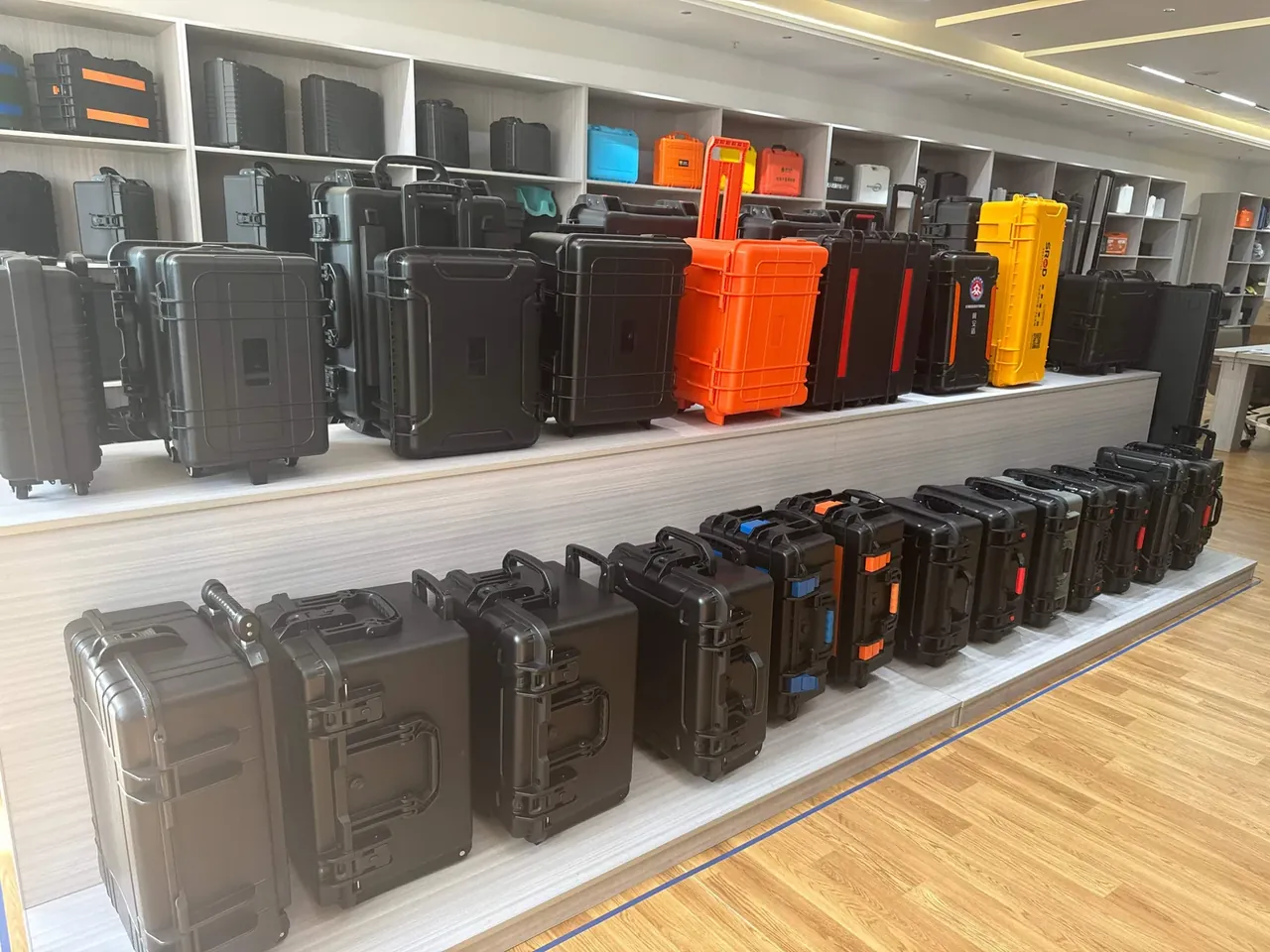
Quick answer: A case wheel set turns on one axle or four: two wheels with a handle need 1.1 m, four casters 0.2 m, and they climb 15 mm versus 8 mm.
Table of contents
- Two routes: which axle turns
- Turning radius: 1.1 m and 0.2 m
- Kerbs: 15 mm and 8 mm
- Per-wheel load: three-point support and 1.9 g
- Brake travel 8 mm and track 320 mm
- FAQ
1. Two routes: which axle turns
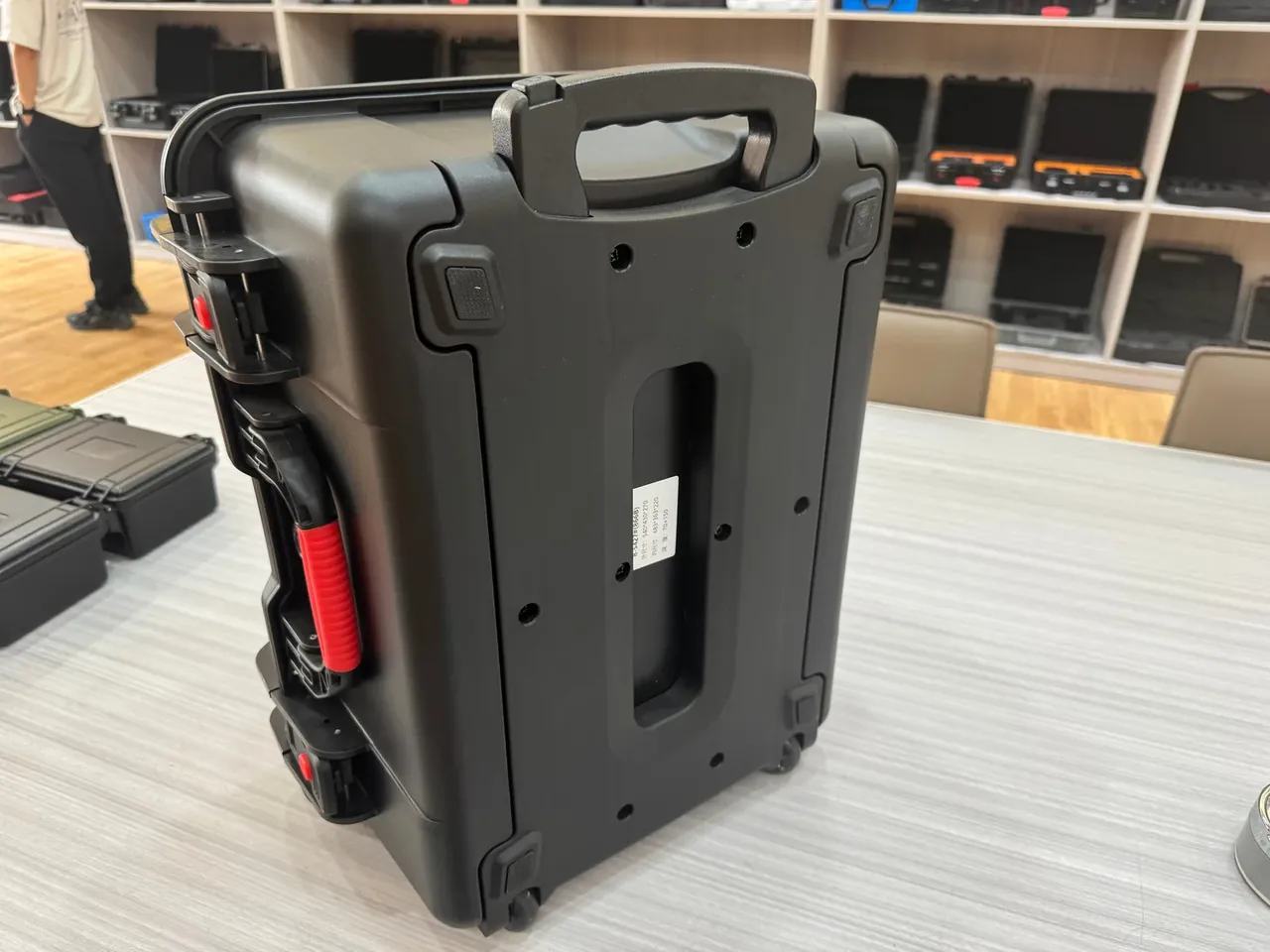
The two wheels of a two-wheel case wheel set sit on one axle and do not steer. Tilting the handle swings the case around that axle midpoint, on an arc wider than the operator walks.
Every wheel in a four-caster set turns 360 degrees on its own vertical pin, so the case can move sideways and spin about its centre. The difference is the number of steering axes, not the number of wheels.
Three casters give a 0.3 m radius; four wheels with two of them fixed push it past 0.6 m. Count steering axes first.
| Layout | Turning radius m | Wheel dia mm | Wheel type | Kerb mm |
|---|---|---|---|---|
| Two wheels + handle | 1.1 | 75 | Two fixed | 15 |
| Four, two fixed | 0.6 | 60 | Two fixed, two swivel | 11 |
| Four swivel | 0.2 | 50 | Four swivel | 8 |
2. Turning radius: 1.1 m and 0.2 m
The 1.1 m figure follows from a handle at 45 degrees with the grip about 1.0 m above the axle. Turning around in a 2.4 m aisle takes three reverses.
Four casters turn inside their own footprint: a 320 mm track gives 0.16 m to the centre plus 40 mm of offset, so the case spins about itself in a 1.0 m aircraft aisle.
A short radius is not automatically better. Small radius means four wheels correcting each other and a case that wanders on the straight; large radius means easy pushing but a wide floor. A 1.6 m warehouse aisle suits the 0.6 m layout, while two wheels will not enter and four swivels will not track.
| Turning radius m | Aisle width m | Turns to reverse | Typical floor |
|---|---|---|---|
| 0.2 | 1.0 | One, in place | Cabin, plant room, racking aisle |
| 0.6 | 1.6 | Two | Warehouse main aisle |
| 1.1 | 2.4 | Three | Loading dock, outdoors |
3. Kerbs: 15 mm and 8 mm
A wheel climbs a kerb by wedging its rim against the edge, and the contact angle decides the push. A 75 mm wheel on a 15 mm kerb meets it at 53 degrees; a 50 mm wheel on an 8 mm kerb meets it at 47 degrees.
Angle sets force. At 53 degrees the push needed is about 1.3 times the case weight, at 47 degrees about 1.1 times. Both exceed the weight, so shoving does not work: the case has to be tipped forward 10 to 15 degrees first.
In proportions the four-caster layout is barely behind: 16 percent of wheel diameter against 20 percent. What stops it is wheel size and short travel, because a chipped kerb jams a 50 mm wheel outright.
The working line: a kerb up to 20 percent of wheel diameter can be dragged, above 25 percent it has to be lifted.
| Wheel dia mm | Kerb mm | Kerb as % of dia | Contact angle deg | Rating per wheel kg |
|---|---|---|---|---|
| 50 | 8 | 16 | 47 | 12 |
| 60 | 11 | 18 | 48 | 18 |
| 75 | 15 | 20 | 53 | 25 |
4. Per-wheel load: three-point support and 1.9 g
A 28 kg case spreads 7 kg onto each of four wheels. They never all touch at once: a 3 mm floor dip or a lifted handle side puts the weight on three wheels at 9.3 kg each.
Dropping off a kerb multiplies that. A 15 mm drop decelerates the case within 0.08 s, a dynamic factor of about 1.9, so the check value is 18 kg. A wheel rated 12 kg cannot carry this case: 12 divided by 1.9 gives 6.3 kg, and three wheels support only 19 kg.
Two wheels work differently. The case sits on two of them, 14 kg each at 28 kg and 26 kg at the kerb, which crosses the 25 kg rating. A two-wheel case wheel set tops out near 26 kg.
Three-point support times 1.9 is the whole of the four-wheel check. That is why the same 28 kg case takes 25 kg wheels on two and 20 kg wheels on four: sharing is thinner, but the check basis is 50 percent higher.
5. Brake travel 8 mm and track 320 mm
Four-caster cases usually carry a brake with 8 mm of pedal travel, locking the two front wheels. Below 6 mm the operator cannot tell a full press from a half press; above 12 mm the sole cannot push sideways and people use a toe.
The 320 mm track sets the rollover angle. With the centre of gravity about 500 mm up and half the track at 160 mm, the critical angle is 18 degrees. Dragging sideways at 0.3 g puts the tilt at 17 degrees, one degree short, so a case on a slope is pulled with the handle low.
Narrowing the track to 280 mm drops the angle to 15 degrees and rules out sideways moves on a slope; widening to 360 mm lifts it to 20 degrees for 0.03 m more turning radius.
Conclusion
Pick the case wheel set by steering axes first and wheel count second. Two wheels on one axle give a 1.1 m radius and a 15 mm kerb, which suits docks and yards; four swivel casters give 0.2 m and 8 mm, which suits cabins and racking aisles. Check per-wheel load at three-point support times 1.9, so a 28 kg case needs 18 kg wheels on four and a 26 kg ceiling on two.
Related Reading
- Choosing wheel material by floor type
- Bearing service after water ingress
- Matching handle and caster load ratings
- Writing a spec for a custom wheeled case
Related Products
- 8 Series — Gun Cases; Military Equipment Cases; Camera Equipment Cases; Drone Cases; Watch Cases; Knife Cases; First Aid Cases; Electronics Equipment Cases
- WL8-2812 PP Gun Case — model WL8-2812
- All protective cases and toolboxes: 7 series, 158 models