

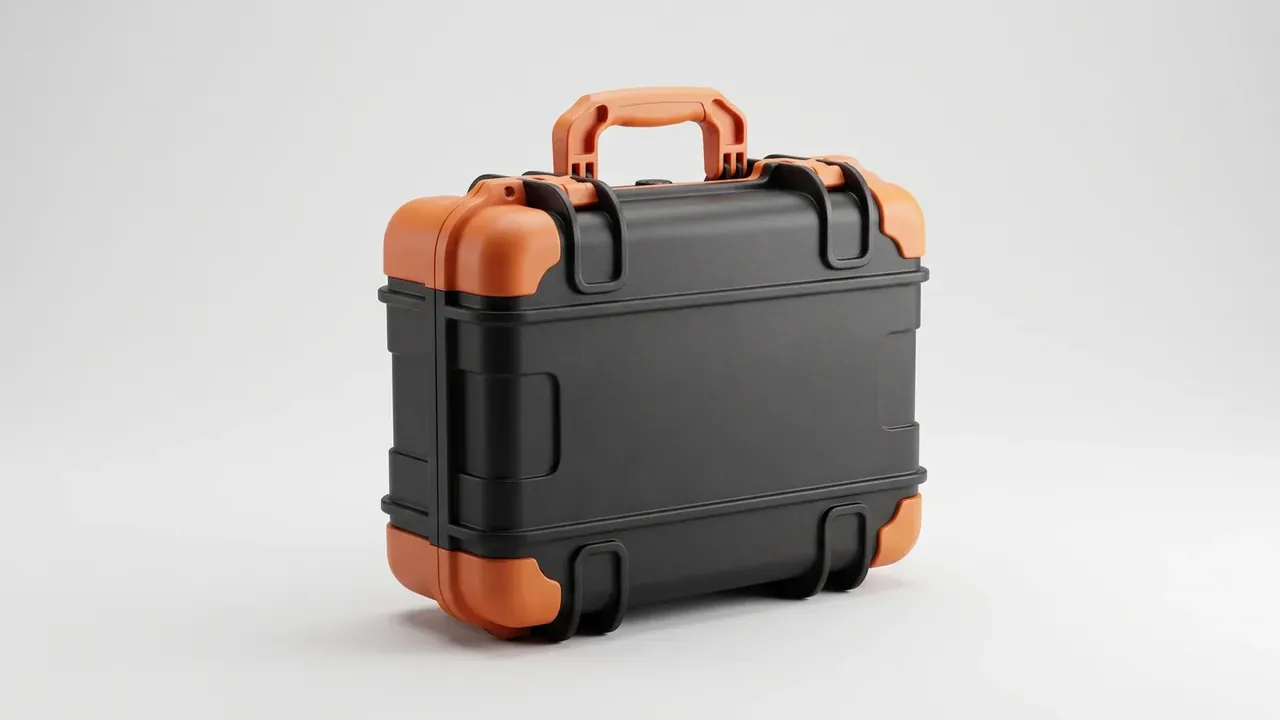
Quick answer: A Custom wheeled protective case is pinned down by three numbers: cavity size, outside envelope including wheels and handle, and the wall thickness that matches rated load. Allow 10 to 15 mm per side inside, 38 mm per side outside, then take 3.0 mm at 40 kg, 3.5 mm at 60 kg and 4.0 mm at 90 kg.
Table of contents
- Three Dimensions That Set the Case
- Wall Thickness and Rib Grades
- Wheels, Handle and Load Math
- Tolerances on the Drawing
- Sampling, Validation and a Frozen Spec
- FAQ
1. Three Dimensions That Set the Case
Page one of a Custom wheeled protective case spec sheet carries dimensions, not colour. Cavity size starts from the largest item: 10 to 15 mm per side, plus a 20 mm liner if used. Too tight and it will not drop in; too loose and it rattles.
The envelope adds 38 mm per side for wall, corner bumper, wheel shroud, draft and clearance. Height carries wheel lift, 82 mm at 75 mm and 108 mm at 100 mm; a stowed handle sits 26 mm off the back.
| Cavity (mm) | Outside (mm) | Wheel (mm) | Rated load (kg) |
|---|---|---|---|
| 420×320×180 | 496×396×272 | 75 | 40 |
| 620×420×230 | 696×496×322 | 100 | 60 |
| 800×560×340 | 876×636×432 | 100 | 90 |
2. Wall Thickness and Rib Grades
Wall grades follow load: 3.0 mm under 40 kg, 3.5 mm at 60 kg, 4.0 mm at 90 kg. Press tonnage climbs from 1300 t to 1500 t and 1650 t over an 800×560 mm projected area. Force a thick wall on a small press and short shots and weld lines appear where a Custom wheeled protective case splits.
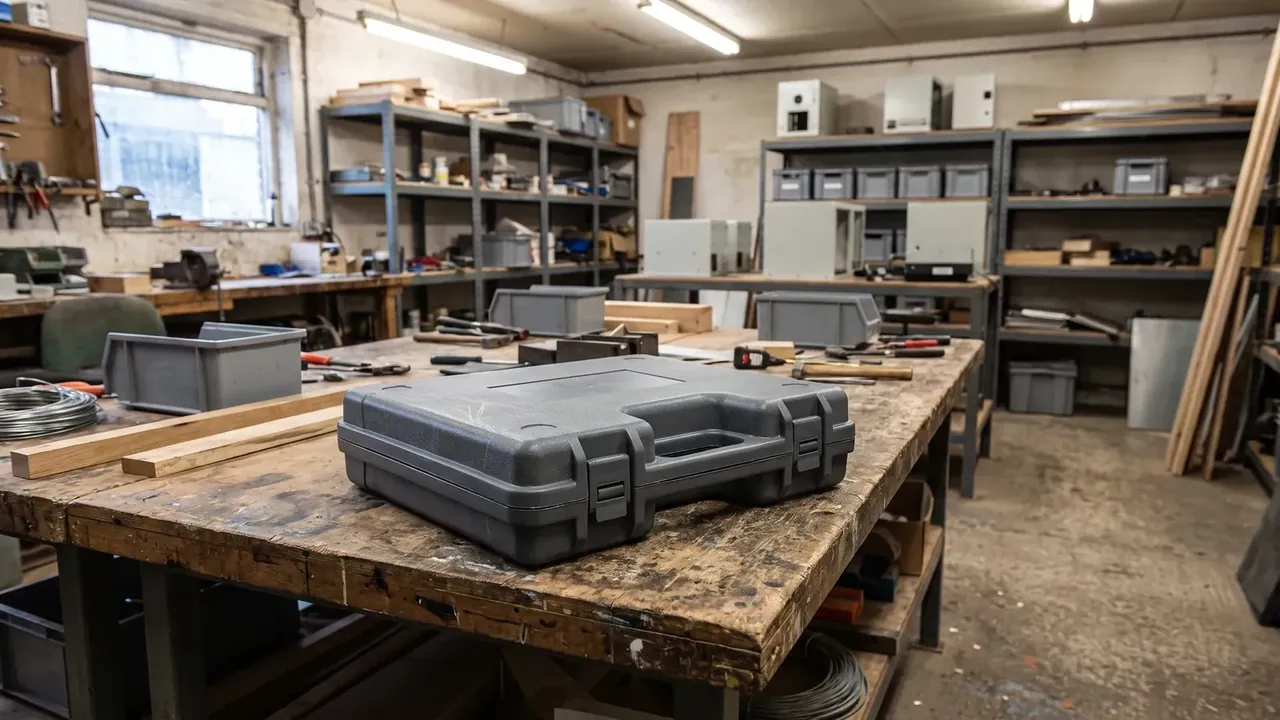
Ribs support the wall rather than replace it: 90 mm pitch, 0.6 of wall thickness, R1.5 root, 1.2 degrees of draft. The base takes a 120 mm grid; each wheel boss gets four radial ribs and a 5.0 mm local wall.
3. Wheels, Handle and Load Math
Rated load is what the wheels carry. A four-wheel set is checked on three-point contact, so each wheel takes 55 percent of total load, leaving margin for uneven floors. A 75 mm wheel clears a 15 mm step, a 100 mm one 25 mm, with fixed wheels at the rear and swivel at the front.
The handle runs three aluminium sections with a 1.2 mm wall, extends to 1050 mm and takes 400 N. Its housing uses four M6 screws at 2.5 N·m, then a 500 N hold test with under 1 mm of shift.
| Rated load | Static per wheel | Handle pull | Factory walk |
|---|---|---|---|
| 40 kg | 25 kg | 250 N | 3 km |
| 60 kg | 35 kg | 400 N | 5 km |
| 90 kg | 50 kg | 500 N | 8 km |
4. Tolerances on the Drawing
On a Custom wheeled protective case drawing, tolerances belong on mating surfaces. Cavity length, width and height run at ±1.5 mm, diagonal difference under 1.2 mm, the lid gap 0.8 to 1.2 mm and lid flatness 0.6 mm. A 6.5 mm by 5.0 mm gasket groove with an R0.5 floor puts a 6 mm cord at 25 to 35 percent compression.
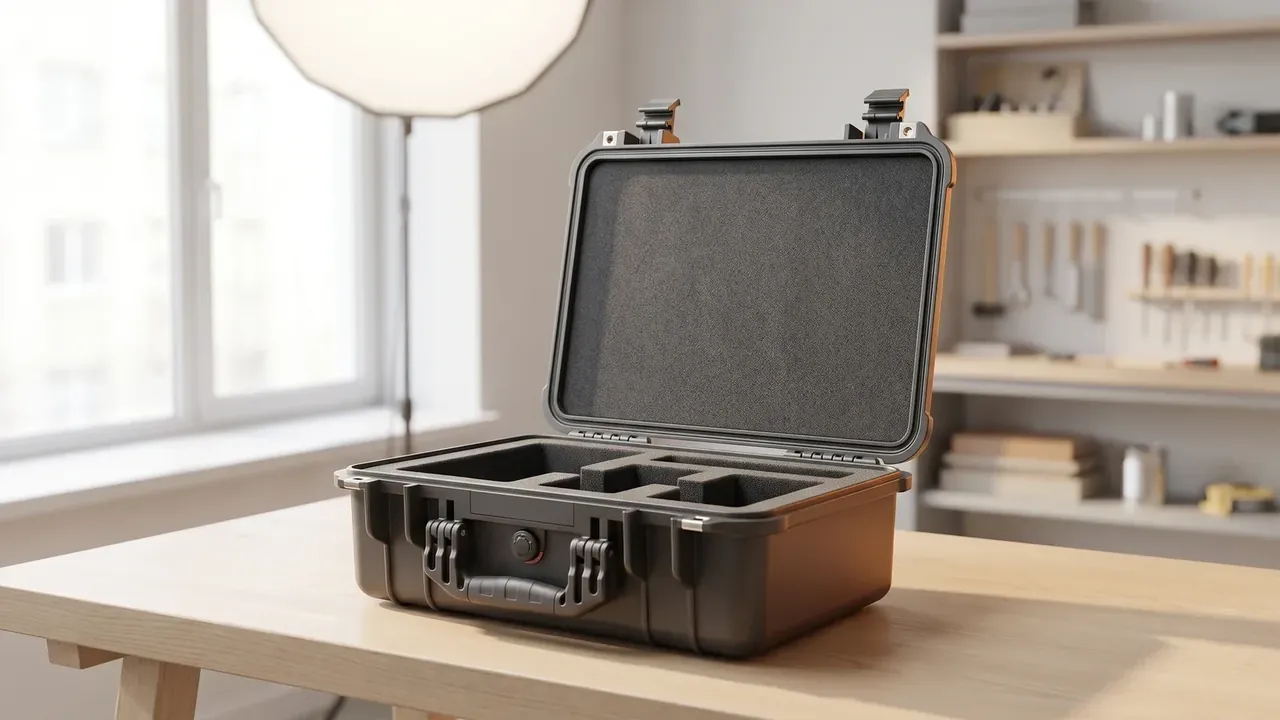
Name the datums: A base plane, B long side centre, C wheel boss face, holes at ±0.3 mm. The mating land between lid and base is often missing; under 8 mm the closed case rocks.
5. Sampling, Validation and a Frozen Spec
T1 pulls three cases for dimensions and appearance, T2 five for a first-article check, inside 15 days with one tool correction. Validation follows: a drop on each of six faces from 1.1 m, a corner drop after four hours at minus 25 °C, and a 5 km walk over 20 mm steps. The spec freezes at V1.0, rising 0.1 per change.
| Check | Condition | Verdict |
|---|---|---|
| First article | 5 cases, full dimensions | cavity within ±1.5 mm |
| Drop | 1.1 m, six faces | no crack, latches shut |
| Cold drop | 4 h at −25 °C | no chipped bumper |
| Walk | 5 km, 200 steps of 20 mm | tread wear under 1.5 mm |
Conclusion
A Custom wheeled protective case is specified by three linked numbers: cavity sets the envelope, the envelope sets wall and press, and the wall sets wheels and handle. Put them on the drawing, hang tolerances off datums, then clear drop, cold and walk tests. Without that chain, every Custom wheeled protective case after the first is watched by hand.
This article discusses only the container (case body) side of specifications and design intent, and does not cover any handling, loading or use of the contents.
Related Reading
- Choosing a wheeled protective case
- Keeping a wheeled case in service
- Where heavy duty case specs stop
- Picking a case size band
Related Products
- 8 Series — Gun Cases; Military Equipment Cases; Camera Equipment Cases; Drone Cases; Watch Cases; Knife Cases; First Aid Cases; Electronics Equipment Cases
- WL8-2812 PP Gun Case — model WL8-2812
- All protective cases and toolboxes: 7 series, 158 models