

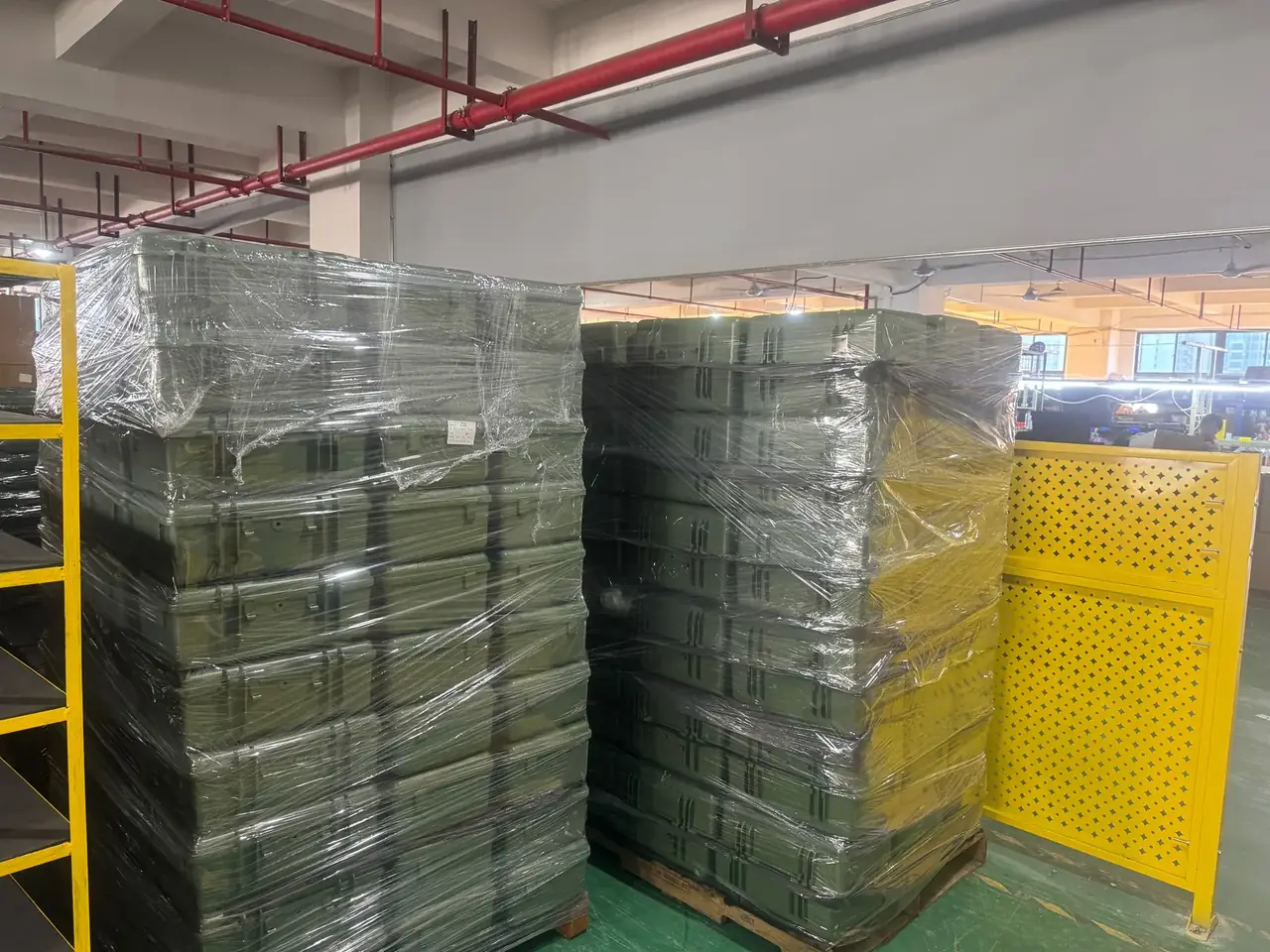
Quick answer: Wholesale Military Transport Cases hinge on a 0.8 mm spigot clearance and 75 mm rivet pitch holding six-layer offset under 1.6 mm after 24 h.
Table of contents
- Stacking-spigot fit clearance in Wholesale Military Transport Cases
- Corner rivet pitch across the shell
- Interlayer offset after six-tier stacking
- Spigot wear measured after destacking
- Clearance setting for wholesale batches
- FAQ
1. Stacking-spigot fit clearance in Wholesale Military Transport Cases
Stacking to the sixth tier, interlayer offset is not one shell deforming but the clearance adding up each tier's small deviation. The case considered here measures 720×500×310 mm outside and 645×430×235 mm inside, with a 5.3 mm wall. A downward spigot runs around the base rim while the lid of the tier below carries a matching recess; only when these two faces seat together is the horizontal play of the upper shell held in check. The 0.8 mm fit clearance is the first value locked on the drawing, read with a feeler gauge around the face.
Three trial settings of 0.6 mm, 0.8 mm and 1.0 mm show the reading is not linear. Too tight and the lid seats stiffly; too loose and every tier keeps free play that multiplies into top-tier drift. For Wholesale Military Transport Cases the clearance tier is first measured on a single shell, then re-checked under the full stack, and any mismatch between the two sends the mould parting line back for inspection.
| Clearance tier | Single-shell reading | Six-tier drift |
|---|---|---|
| 0.6 mm tier | 0.58 mm | 1.1 mm |
| 0.8 mm tier | 0.79 mm | 1.4 mm |
| 1.0 mm tier | 1.02 mm | 2.3 mm |
2. Corner rivet pitch across the shell
The corners carry the stack load downward, where four groups of rivets tie the shell, the reinforcing frame and the spigot seat into one piece. Rivet pitch is set at 75 mm, spaced evenly along each corner edge.
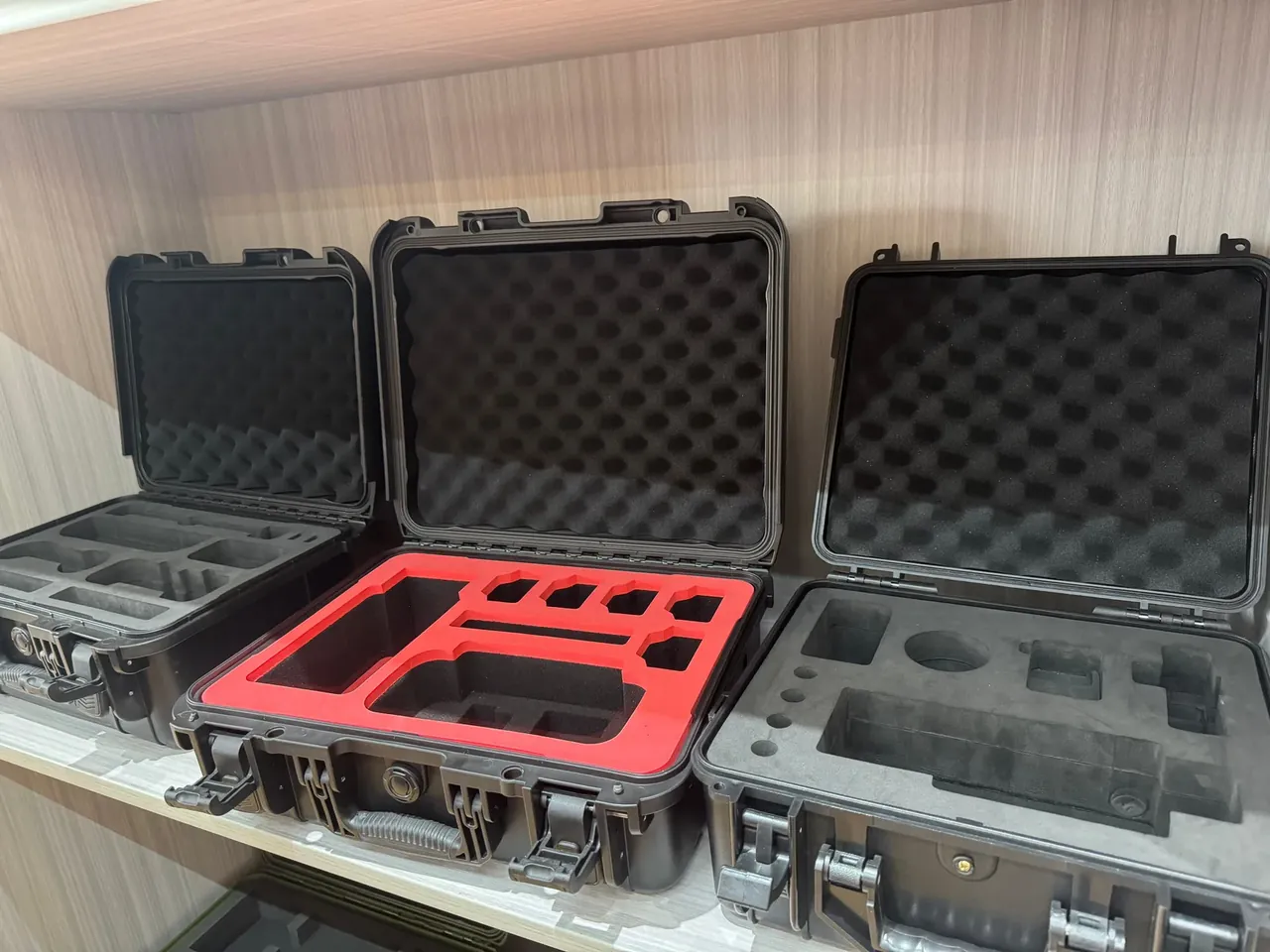
After riveting, hole-edge indentation is measured; beyond one tenth of the wall the shell returns for mould correction. The four latches, each pulling 470 N, are also re-checked here, because corner stiffness and lid clamping sit at opposite ends of the same load path and a slack reading at either end lifts the stack measurement. Corner inspection for Wholesale Military Transport Cases normally records rivet pitch, hole-edge indentation and latch recovery on a single card.
3. Interlayer offset after six-tier stacking
The stack condition is 6 tiers held for 24 h, ballasted to a 24 kg load against a 9.6 kg empty shell, at ordinary workshop temperature on a level pallet. A baseline along each front lid edge gives the shift, with the largest of six taken. Holding interlayer offset to 1.6 mm is the boundary that decides whether this batch enters multi-tier circulation.
| Stack tier | Single re-check offset | Cumulative maximum |
|---|---|---|
| Tier 2 | 0.3 mm | 0.3 mm |
| Tier 4 | 0.5 mm | 1.0 mm |
| Tier 6 | 0.6 mm | 1.6 mm |
Offset accumulates without being proportional: the step from tier four to tier six grows the most, which says the spigot play is amplified tier by tier rather than spent in one go. After 3500 open-close cycles, any slack in the lid hinge lifts the offset further, so the re-check is scheduled after that cycling, with the hinge allowed to settle before the baseline is drawn. The stacking log for Wholesale Military Transport Cases notes the measurement moment of each tier, so a reading taken after settling creep is never mixed with one taken just after stacking.
4. Spigot wear measured after destacking
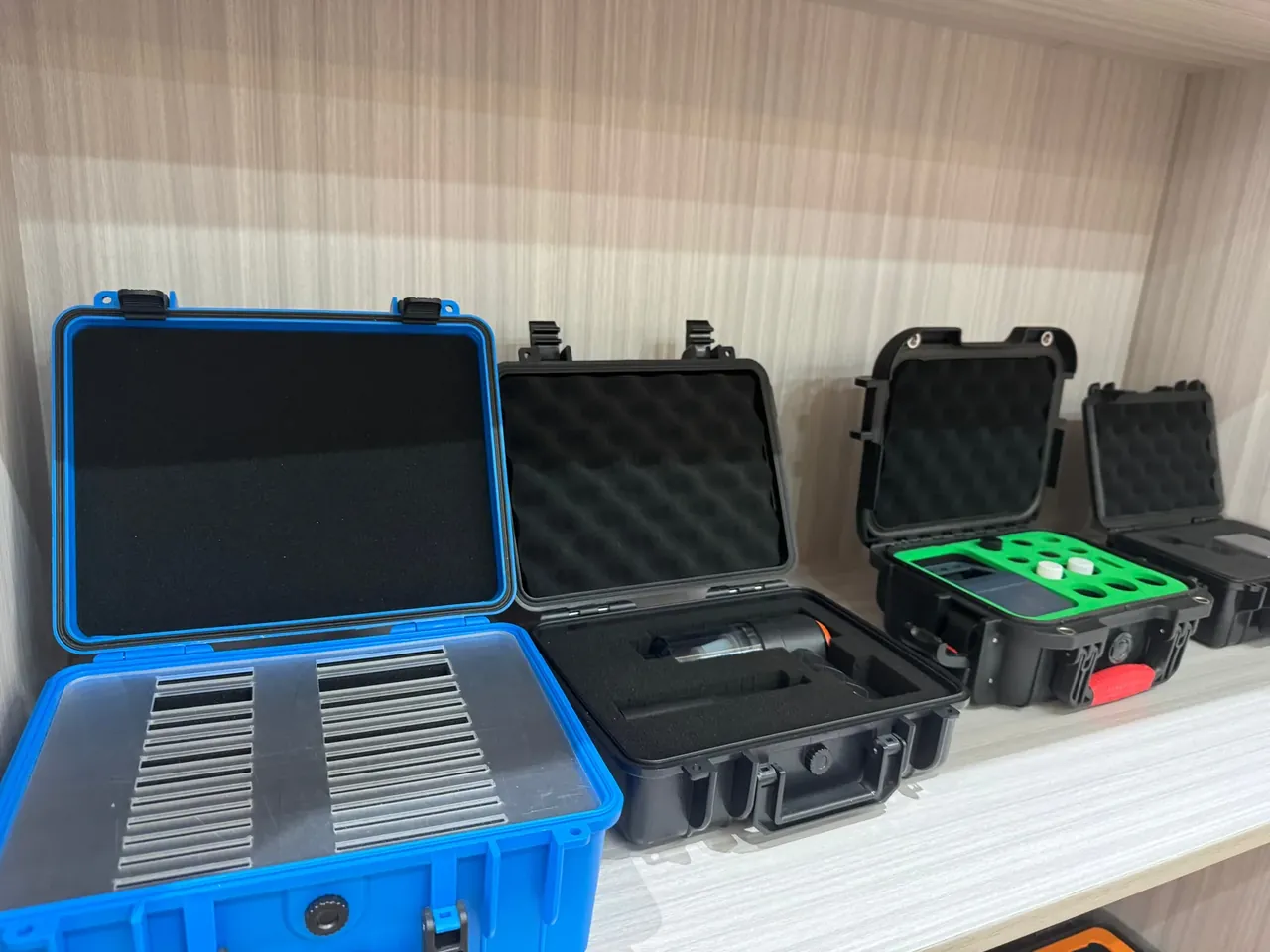
With the top five tiers removed, the bottom shell is turned over and the seating face of its spigot is examined for wear. Spigot wear is capped at 0.2 mm, and what is measured is material lost along the height of the seating face, not surface scratching. Wholesale Military Transport Cases place this re-check after stacking because once the wear runs high, the next round of stacking already starts from a biased position.
| Offset reading | Matching wear | Action for the tier |
|---|---|---|
| Within 1.2 mm | 0.12 mm | Release directly |
| Around 1.4 mm | 0.17 mm | Run one more check |
| Near 1.6 mm | 0.20 mm | Hold a sample |
Two seal rings at 23 % compression, benchmarked against the IP67 lid requirement, are re-checked in the same pass: once the lid face is pushed off by a worn spigot, compression stops being even around the perimeter and a single hand press cannot reveal the real difference. The wear reading counts only once the lid is pressed back onto one plane.
5. Clearance setting for wholesale batches
The clearance setting is fixed at the tightest tier whose sixth-layer offset still holds 1.6 mm, and any looser spigot combination is diverted to single-tier circulation. The setting is not a mean of the three tiers but the tightest acceptable one, since a real stack rarely stops at four levels and a little margin costs less than sorting shells afterwards. Once fixed, the drawing carries fit clearance, 75 mm rivet pitch and base flatness in one tolerance band; every mould regrind is trial-assembled against that band, and a deviation beyond 0.05 mm reopens the tiers. A reference stack sits on the inspection rig, and each shift begins by measuring its interlayer offset to confirm the rig itself has not settled before the day's batch is read. Batch records for Wholesale Military Transport Cases therefore split into two columns, one for single-shell seating readings and one for six-tier offsets, and release is signed only when both pass. Each of the three readings takes its own column, so a drift shows on its row.
Conclusion
For Wholesale Military Transport Cases the box side comes down to three readings, 0.8 mm fit clearance, 75 mm rivet pitch and 1.6 mm six-tier offset, confirming one another. Destack wear of 0.2 mm and the recovery after 3500 cycles decide whether the batch stacks back the same way next time. Aligning the tiers in one record is more dependable than judging a single shell alone.
Related Reading
- Military rotomolded case procurement
- Military supply transport case procurement
- Military air transport case procurement
- IP67 dustproof waterproof military transit case
Related Products
- 8 Series — Gun Cases; Military Equipment Cases; Camera Equipment Cases; Drone Cases; Watch Cases; Knife Cases; First Aid Cases; Electronics Equipment Cases
- WL8-2812 PP Gun Case — model WL8-2812
- All protective cases and toolboxes: 7 series, 158 models