

Quick answer: A wind turbine maintenance tool case solves tethering first: six 8 mm holes, 8 kg on one point for 30 min and twelve pockets set the handover.
Table of contents
- Carrying a Wind Turbine Maintenance Tool Case Up the Tower
- Tether Holes and Lanyard Routing
- Latch Force at Low Temperature
- Shadow Board Pockets and Missing-Tool Detection
- Handover on the Tower and Checks on Landing
- FAQ
1. Carrying a Wind Turbine Maintenance Tool Case Up the Tower
There is no bench inside a tower, and once the lid opens every tool needs somewhere to be tied.
The climb runs 90 m from ground to hub across three platforms. At the ISO 2533 lapse rate of -0.65 °C per 100 m, the hub sits about 0.6 K below ground, so the local winter minimum, not the height, sets the temperature inside the case.
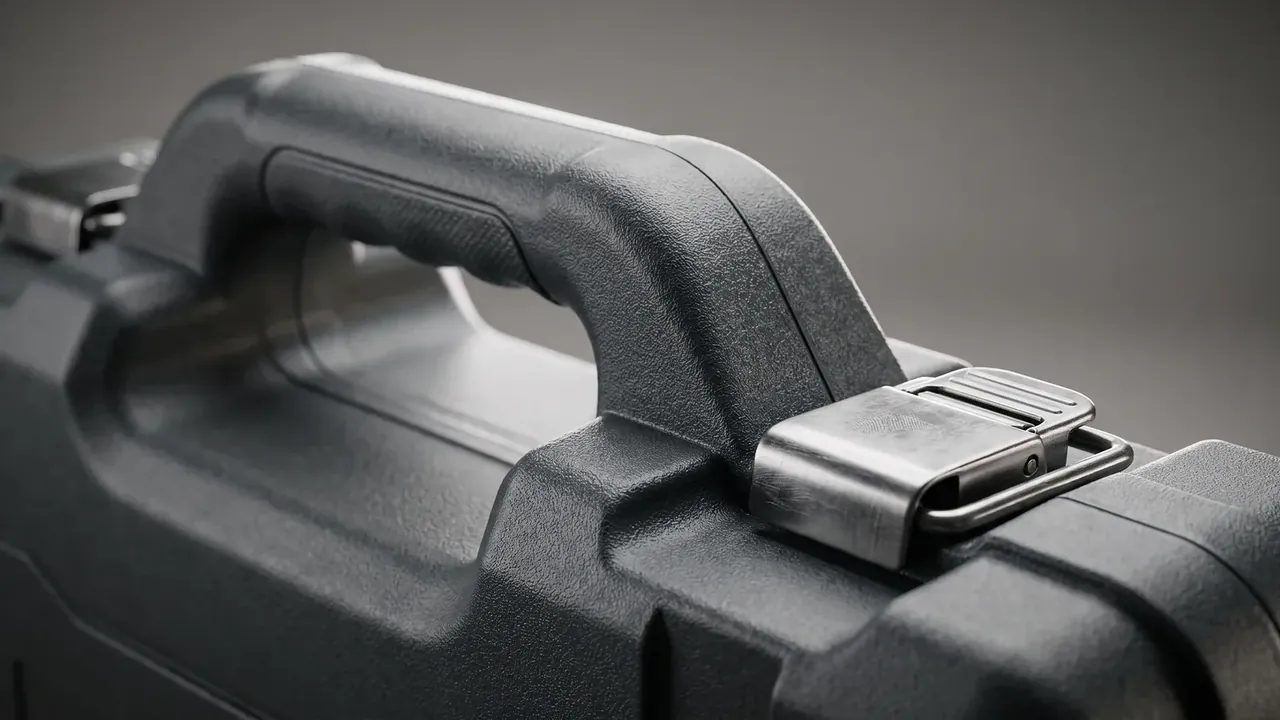
Carrying a wind turbine maintenance tool case decides more than outline. At 5.2 kg with the handle fitted, one hand stays free for the ladder, and the 500×380×240 mm body has to pass the hoop opening without catching a rail. The handle opening must swallow a gloved hand, and it sits opposite the latch.
| Tether grade | Hole layout | Static hang, one point | Tools it suits |
|---|---|---|---|
| Three point | Three corners plus one long-edge centre | 8 kg for 30 min | Socket and spanner sets |
| Six point | Four corners plus both short-edge centres | 8 kg for 30 min | Torque wrench, hydraulic head |
| Twelve point | One every 90 mm along the rim | 6 kg for 30 min | Small parts, gauges |
Three points are enough, six are comfortable, twelve earn their place only for fine-grained kits. Every extra hole interrupts a rim rib, and at 4.8 mm the wall is a floor rather than a margin.
2. Tether Holes and Lanyard Routing
Six 8 mm holes are the only interface the wind turbine maintenance tool case offers to a lanyard. They sit at the corners and short-edge midpoints, clear of hinge seats and latch travel, with 3 mm of material around each bore and a chamfer at the mouth.
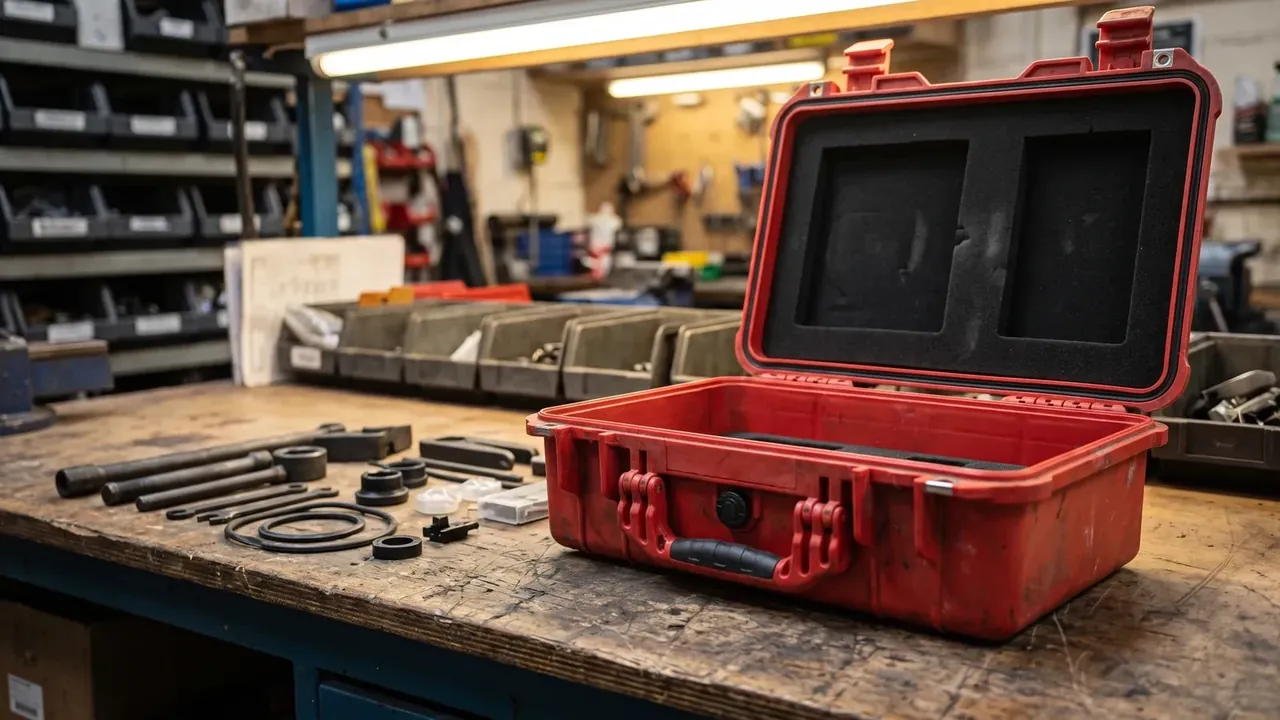
The lanyard is 4 mm rope, 600 mm long, threaded through a hole and clipped to a tool tail. The length follows the fully open lid: shorter and the tool cannot leave its pocket, longer and the tail hangs below the platform as a fresh dropped object. Ratings follow the 2:1 safety factor of ANSI/ISEA 121, so a tool runs at half the lanyard capacity or less.
Route the rope along the wall, past the latch, into the pocket; any span crossing the parting line gets pinched when the lid closes. A double sheet bend survives soaking where an overhand knot slips.
3. Latch Force at Low Temperature
Minus 30 °C is the test point for this class. PP loses 40% to 60% of its impact strength in the cold: homopolymer embrittles between -5 and -15 °C, impact copolymer holds to -45 °C. Pick the wrong grade and the latch fails first, then the lid.
A wind turbine maintenance tool case sets latch force at 45 N, the ceiling for a gloved hand. Below that the tongue pops open under ladder vibration; above it the latch needs two hands while one holds the rail.
| Cold grade | Material and embrittlement | Latch force | Behaviour in cold |
|---|---|---|---|
| Ambient | Homopolymer PP, -5 to -15 °C | 30 N | Tongue turns brittle below 0 °C |
| Low temperature | Impact copolymer PP, -25 to -45 °C | 45 N | One hand still works at -30 °C |
| Extreme | Toughened copolymer plus insert, -40 °C | 55 N | Needs a two-stage tongue |
A steel spring stiffens at -30 °C and the operating force can climb rather than fall, so 45 N means nothing without a test temperature beside it.
4. Shadow Board Pockets and Missing-Tool Detection
The wind turbine maintenance tool case carries a 12-pocket EVA sheet, one per tool, numbered on the pocket floor rather than on the tool. Detection takes 3 s: lift the lid, scan once, and an empty pocket is a missing tool.
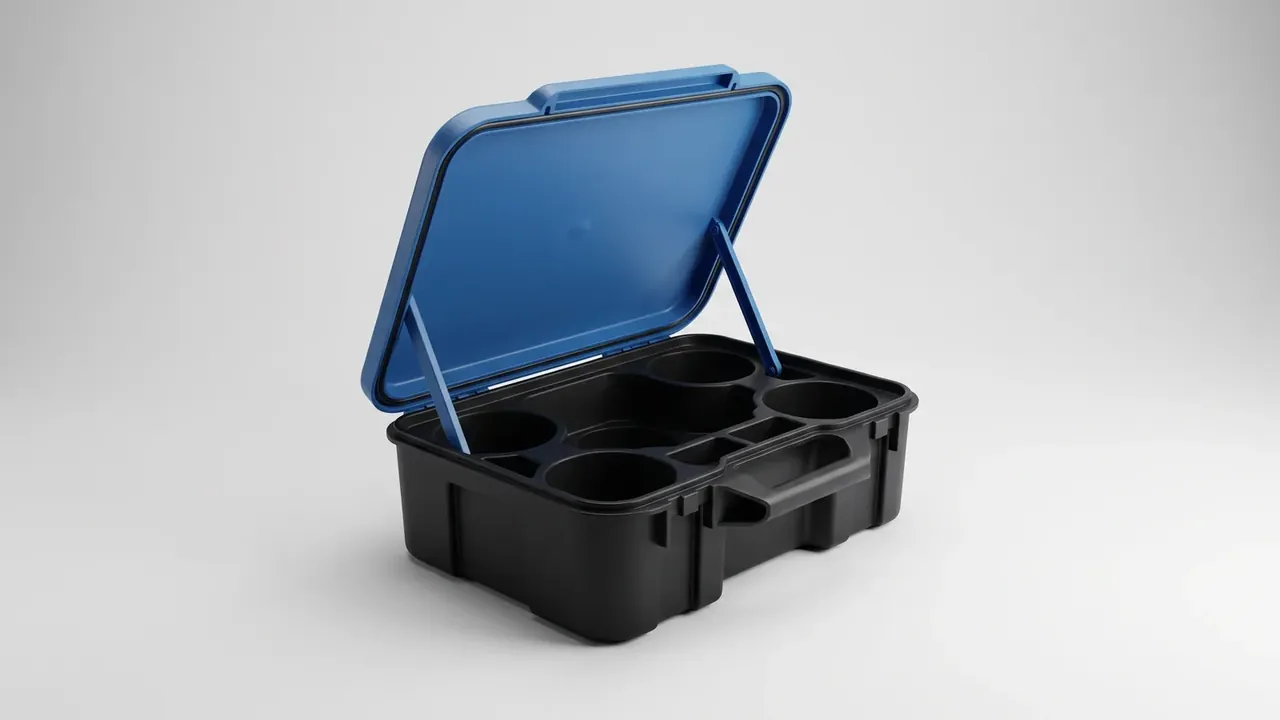
Order pockets by reach. Sockets sit outside, the torque wrench takes the long centre bay, and O-rings go nearest the hinge. Leave 5 mm between pocket walls so a tool lifts out without scraping and still cannot rattle.
| Check method | What it relies on | How a gap shows |
|---|---|---|
| Count by hand | The issue list | Relies on memory, slow but needs no board |
| Single-colour board | Pocket outline | Shadow can hide an empty pocket |
| Two-tone board | Colour under the skin | Red floor shows at once |
Two-tone foam beats one colour: black over red exposes a lifted tool instantly. Clip the board rather than bonding it, since at 20 mm it clears the lid and a worn board swaps on its own.
5. Handover on the Tower and Checks on Landing
The wind turbine maintenance tool case changes hands three times: at the store, on the platform, after landing. All three use the same board with the same numbering, or a missing item cannot be traced. On the platform the lid opens only to 90°, so wind cannot lift a tool free.
The opening baseline is 6000 cycles. At two openings a day over 250 working days that is roughly twelve years, with hinge and latch wear front-loaded into the first 2000 cycles.
IP66 and a 1.5 m drop are the two floors: rain and washdown above, a fall through the grating below. On landing, check that the latch still closes with one hand, then look for a lifted lid edge.
Tether grade means the version whose holes show no plastic deformation after 8 kg hung on one point for 30 min; finer lanyards belong on hand tools only.
Conclusion
A wind turbine maintenance tool case answers three questions: whether a tool can be tied, counted and carried back down. Tether holes decide if anything falls, latch force at -30 °C decides whether a glove can open the lid, and the shadow board decides whether a missing item is worth a return climb.
Related Reading
Related Products
- 8 Series — Gun Cases; Military Equipment Cases; Camera Equipment Cases; Drone Cases; Watch Cases; Knife Cases; First Aid Cases; Electronics Equipment Cases
- WL8-2812 PP Gun Case — model WL8-2812
- All protective cases and toolboxes: 7 series, 158 models