

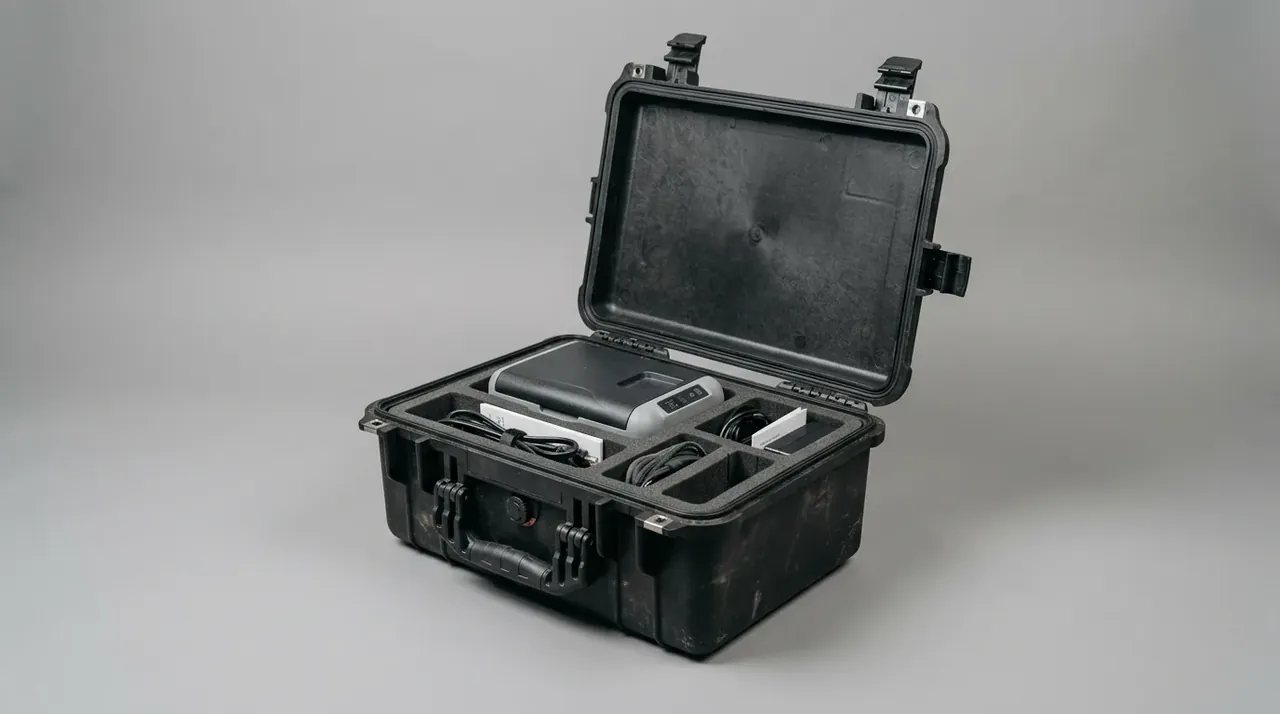
Quick answer: A blade inspection case splits 560 × 400 × 250 mm into five bays, so a 4.5 kg host, six probes and a 1 L couplant bottle travel at 11.8 kg.
Table of contents
- Why the bays come before the foam
- Host bay and probe slots
- Coiling: 3 m of hose on a 400 mm drum
- Couplant: a one litre bottle in its own bay
- Cold starts, one-hand carry and ladder work
- FAQ
1. Why the bays come before the foam
A 4.5 kg flaw detector, three metres of 6 mm probe hose and a litre of couplant share nothing but the trip. The host fails at a corner drop from 1 m. The hose fails where it kinks, leaving a white crease in the jacket. The couplant fails by leaking, and one leak ruins a foam block.
The lazy layout is one open cavity with the coil beside the host, all inside 560 × 400 × 250 mm. Retrieval breaks it: the hose sits underneath, so every job starts with 40 s of dragging it free.
Five bays give the host a floor of its own, six vertical probe slots, a drum bay, a bottle bay and one for adapters. The path becomes open the lid.
| Box layout | Bays | Hose kinks per trip | Moves to reach the host | Loaded weight |
|---|---|---|---|---|
| Single cavity | 1 | 2 | 4 | 10.6 kg |
| Host plus hose | 2 | 1 | 3 | 11.2 kg |
| Five bays | 5 | 0 | 1 | 11.8 kg |
| Six bays with bottle bay | 6 | 0 | 1 | 12.1 kg |
2. Host bay and probe slots
The host bay is 260 × 200 × 120 mm with 10 mm of EPE, screen up, connector to the opening. Another 3 mm clears the screen so lid foam touches only the bezel: the display is 2.5 mm of tempered glass on a 0.3 mm adhesive layer.
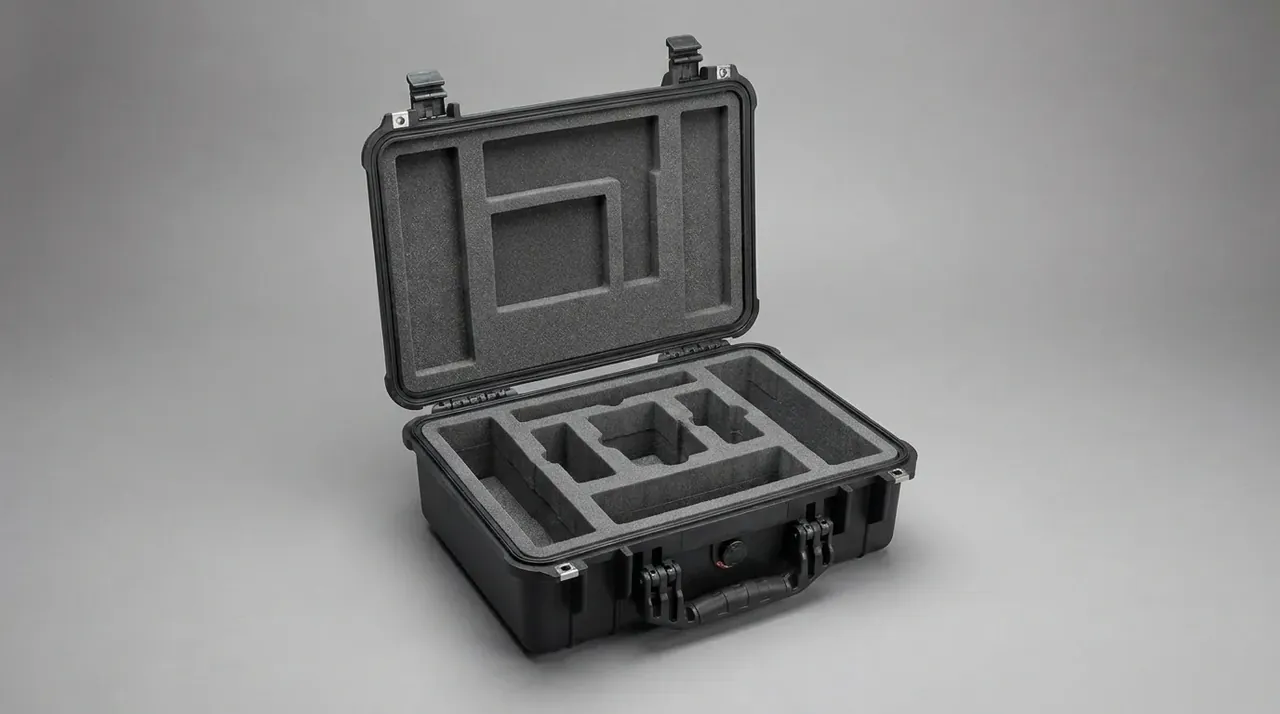
Six slots of φ30 × 80 mm take the 6 mm probes, sunk 80 mm. Standing protects the root: the probe-to-hose transition is 25 mm long, and flat storage bends it through 90°, while eight swaps a day shows wrinkling within a month.
Walls run 12 mm with a 2 mm chamfer, so a gloved finger can pinch the tail without picking at it.
3. Coiling: 3 m of hose on a 400 mm drum
A 6 mm hose takes a 60 mm bend radius at ten times its diameter, so a 130 mm drum would do, yet this one is 400 mm. Retrieval sets it: 3.8 turns on a 250 mm drum means rotating the wrist through nearly four turns while pulling, impossible in cut-resistant gloves, while 2.4 turns slide off in one pull.
The arithmetic checks: 1.26 m per turn at 400 mm times 2.4 gives 3.02 m for a three metre hose. The wall is 2.5 mm and the face 40 mm with 8 mm flanges; 2.4 turns use only 15 mm of it.
The exit keeps a 40 mm free length under a 3 mm clamp; eight flexes a day, spread over an 8 mm radius, push jacket fatigue past 10,000 cycles.
| Drum diameter | Turns for 3 m | One-hand pull | Face width used | Shell width |
|---|---|---|---|---|
| 250 mm | 3.8 turns | 12 s | 24 mm | 460 mm |
| 320 mm | 3.0 turns | 9 s | 20 mm | 490 mm |
| 400 mm | 2.4 turns | 6 s | 15 mm | 560 mm |
| 500 mm | 1.9 turns | 6 s | 12 mm | 640 mm |
4. Couplant: a one litre bottle in its own bay
The bottle is φ90 × 180 mm at 1 L and sits cap-up in a 2 L bay on a 20 mm pad of 40 g felt, 12 mm clear of each wall.
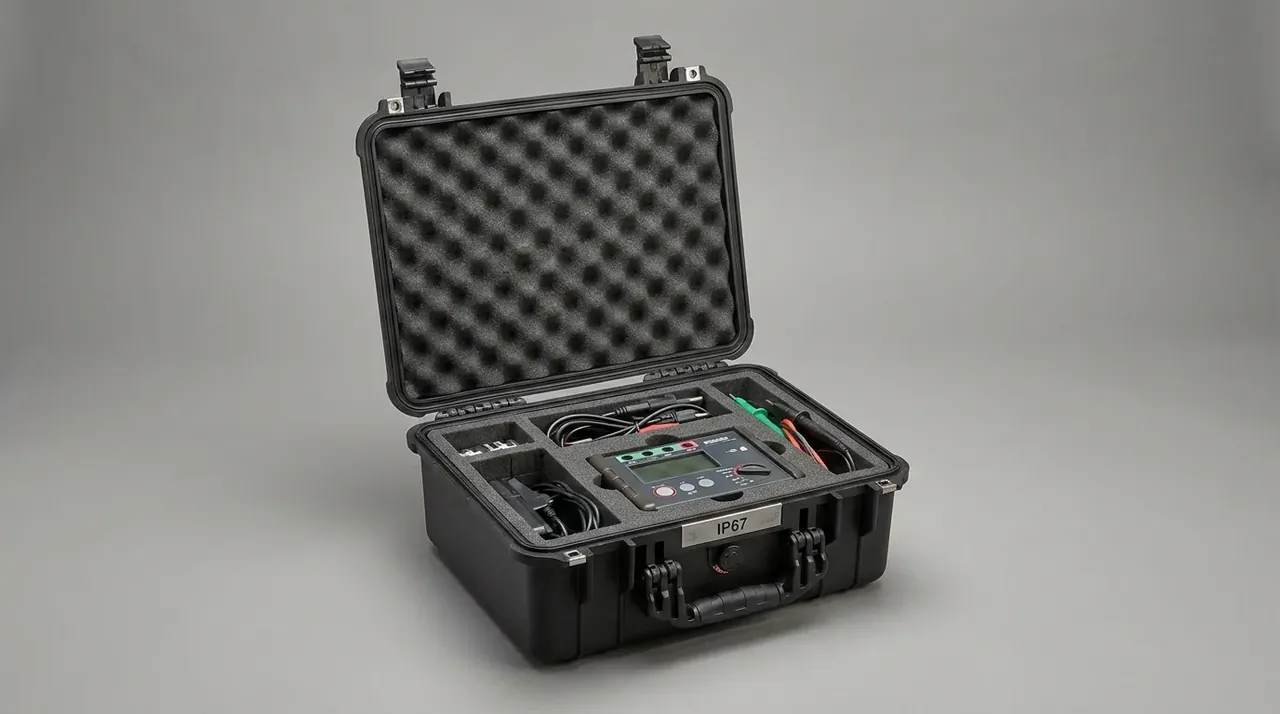
Leak-free at 30° rests on a 3 mm cap gasket, the 12 mm walls and the pad. Fill to 1 L, tilt 30° for 2 hours, invert for 2 more, then weigh the pad: under 2 g passes.
The pad holds 60 mL, one cap working loose. Couplant is water-based, and once it soaks into open-cell EPE the foam moulds from inside, so the pad is a removable sheet.
| Bottle format | Result at 30° | Bay volume | Bay construction | Cleaning |
|---|---|---|---|---|
| 1 L rigid bottle | No seepage | 2 L | 12 mm walls plus felt | Swap the pad |
| 500 mL pouch | Seeps under load | 1.2 L | Needs a rigid sleeve | Wipe the walls |
| 2 L jerrycan | No seepage | 3.5 L | Needs a sunken well | Swap the pad |
| 4 × 200 mL bottles | No seepage | 1 L | Six round pockets | Wipe each one |
5. Cold starts, one-hand carry and ladder work
EPE stiffens about 30 percent at -20 °C and its compression set climbs from 3 to 8 percent, costing 1.5 mm of travel, so northern builds thicken the host bay from 10 mm to 15 mm and add 8 mm of height. A -30 °C gasket seats at 25 percent compression and holds opening force under 60 N.
Loaded weight is 11.8 kg against a 12 kg one-hand ceiling. The handle is rated 25 kg with a 28 mm grip; ladder carry uses two 50 mm straps and a 15 mm panel spreading the load over 0.06 m² of back.
Lid open to host in hand takes 90 s: 8 s for two latches, 3 s to raise, 12 s to lift the host, 20 s for a probe, 25 s to couple.
| Carry mode | Weight ceiling | Main load path | Limiting condition |
|---|---|---|---|
| One hand | 12 kg | Two ribs at the handle root | Wrist must stay neutral |
| Both shoulders | 18 kg | Back panel and straps | Rear face must be flat |
| Ladder carry | 15 kg | Panel lower edge and waist belt | Both hands stay free |
| Two people | 30 kg | Side handles | Passage wider than 700 mm |
Conclusion
Three decisions carry a blade inspection case: five bays keeping a 4.5 kg host, six 6 mm probes and a 1 L bottle apart, a 400 mm drum coiling 3 m in 2.4 turns and releasing in 6 s, and a bottle bay holding 30° without seepage behind a 40 g pad. Get those right and 11.8 kg still moves through a tower at -20 °C on one hand.
Related Reading
- Field protection for wind turbine blade components
- Bay layout and stacking for nacelle parts
- Hoisting and fall arrest for tower instrument cases
- Case configurations for field inspection kits
Related Products
- 8 Series — Gun Cases; Military Equipment Cases; Camera Equipment Cases; Drone Cases; Watch Cases; Knife Cases; First Aid Cases; Electronics Equipment Cases
- WL8-2812 PP Gun Case — model WL8-2812
- All protective cases and toolboxes: 7 series, 158 models