

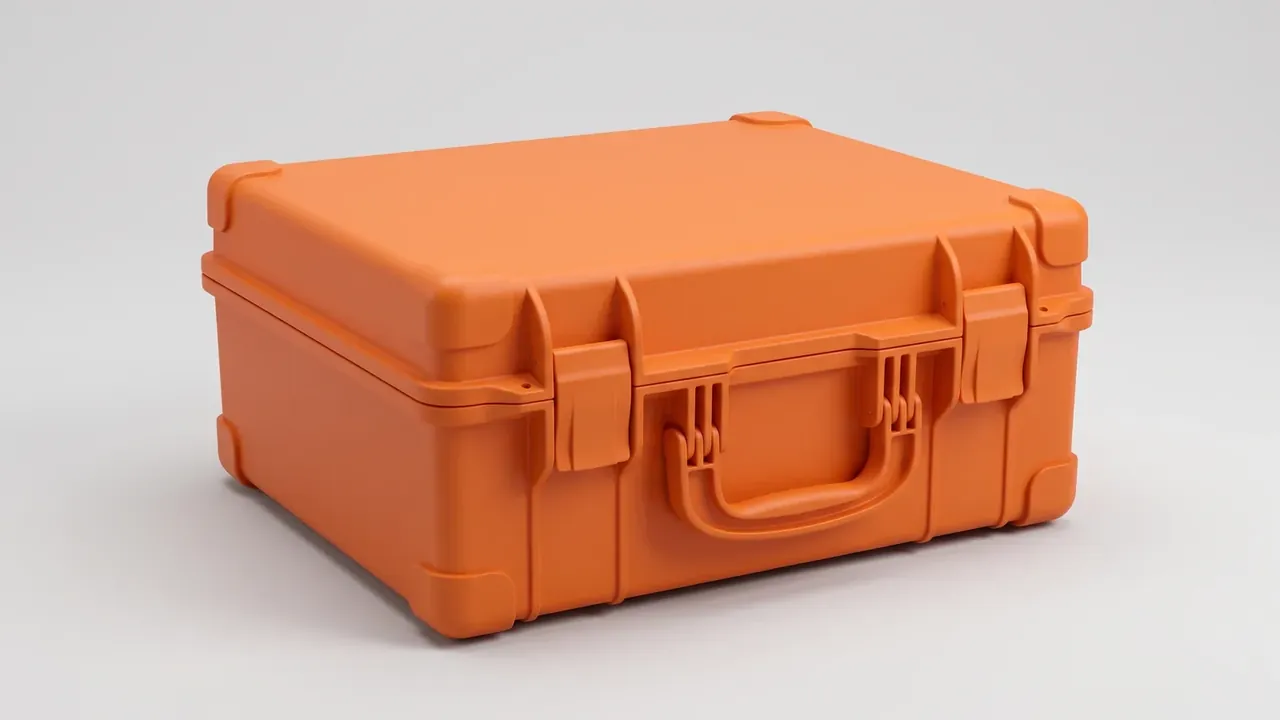
Quick answer: Tethering cases climb a tower on four M8 inserts, not the handle: 1.5 kN each at a factor of 4, with 100 m of 6 mm rope and two tag lines.
Table of contents
- Why Tethering Cases Ride the Hoist
- Door and Hatch Set the Envelope
- Four M8 Inserts and Their Ratings
- Rope Length and Tag Lines
- Fall Arrest: Tether, Anchor, Drop
- FAQ
1. Why Tethering Cases Ride the Hoist
A 90 m tower has 30 ladder sections with a rest platform every 3 m, and an empty climb takes 11 minutes. Tethering cases loaded to 24 kg take 25 minutes on the same route. Site rules cap a one-person carry at 15 kg, so past that line the hoist is the only compliant route.
Two technicians leapfrogging 24 kg stop four times and lose 40 minutes; a base winch rigs in 6 minutes, lifts in 225 seconds and is received in 4, under 12 minutes, and the 28 minutes saved pay for a gearbox oil check.
| Method | People | One-way time | Effort | Main risk |
|---|---|---|---|---|
| Carried on the back | 2 | 40 min | Four stops | Misstep, back strain |
| Straight winch lift | 2 | 12 min | Rigging | Case striking the wall |
| Winch with tag lines | 3 | 14 min | Holding the lines | Rope snagging |
Rungs sit 280 mm apart, so a case on the back pushes the centre of gravity 180 mm outward and later steps need the handrail.
2. Door and Hatch Set the Envelope
The tower door is usually quoted at 600 × 900 mm, with a 150 mm sill and a 120 mm cable tray just inside. Stack the three and the envelope that still passes is 540 × 360 × 230 mm, the ceiling for tethering cases. Measure clear width, sill to head, and the first obstruction 500 mm behind the door.
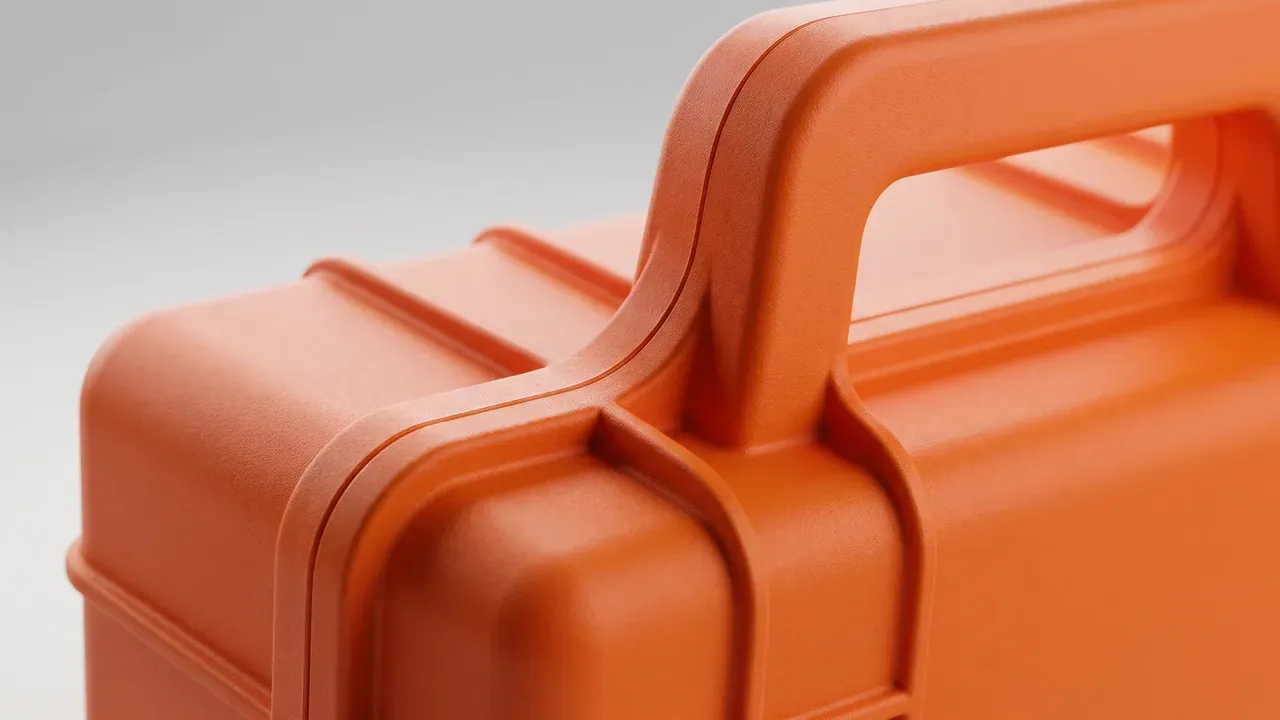
Four platform hatches follow. The 500 mm round opening is tightest: a 230 mm case passes upright, while the 360 mm width needs a 20 degree tilt, which turns the dividers from vertical to diagonal load and loosens the foam slots by 2 mm. Corners therefore carry a 30 mm radius.
Once the envelope is fixed, ribs can be laid out: three transverse ribs at 160 mm spacing stiffen the 540 mm face, and trimming 40 mm of width lets wall thickness fall from 3 mm to 2.6 mm.
3. Four M8 Inserts and Their Ratings
A handle lifts; it does not hoist. The moulded handle is proven at twice the working load, so 24 kg hanging at 48 kg is fine, but a winch start adds 0.5 m/s², the load reaches 60 kg, and the stress line at the handle root turns white. Tethering cases get separate hoist ears: one M8 stainless insert per corner, 12 mm deep, 6.2 kN pull-out, rated 1.5 kN.
| Part | Specification | Rated load | Safety factor | Inspection |
|---|---|---|---|---|
| Hoist ear | M8 stainless insert, 12 mm deep | 1.5 kN | 4 | Quarterly |
| Sling | 25 mm polyester webbing | 1.6 kN | 7 | Annually |
| Tether ring | One each side | 2.5 kN | 5 | Quarterly |
Rate at a quarter of pull-out because of snagging: a sling caught on a hatch rim meets a winch that does not stop, and a 0.5 t unit pulls 24 kg to 1.2 kN. The ear holds, the 1.6 kN sling parts first.
4. Rope Length and Tag Lines
A 90 m tower takes 100 m of 6 mm wire rope: 8 m absorbs the shift after the nacelle yaws, 2 m stays as tail. At 0.13 kg/m the rope is 13 kg, so with a 24 kg case the winch is sized on 37 kg.
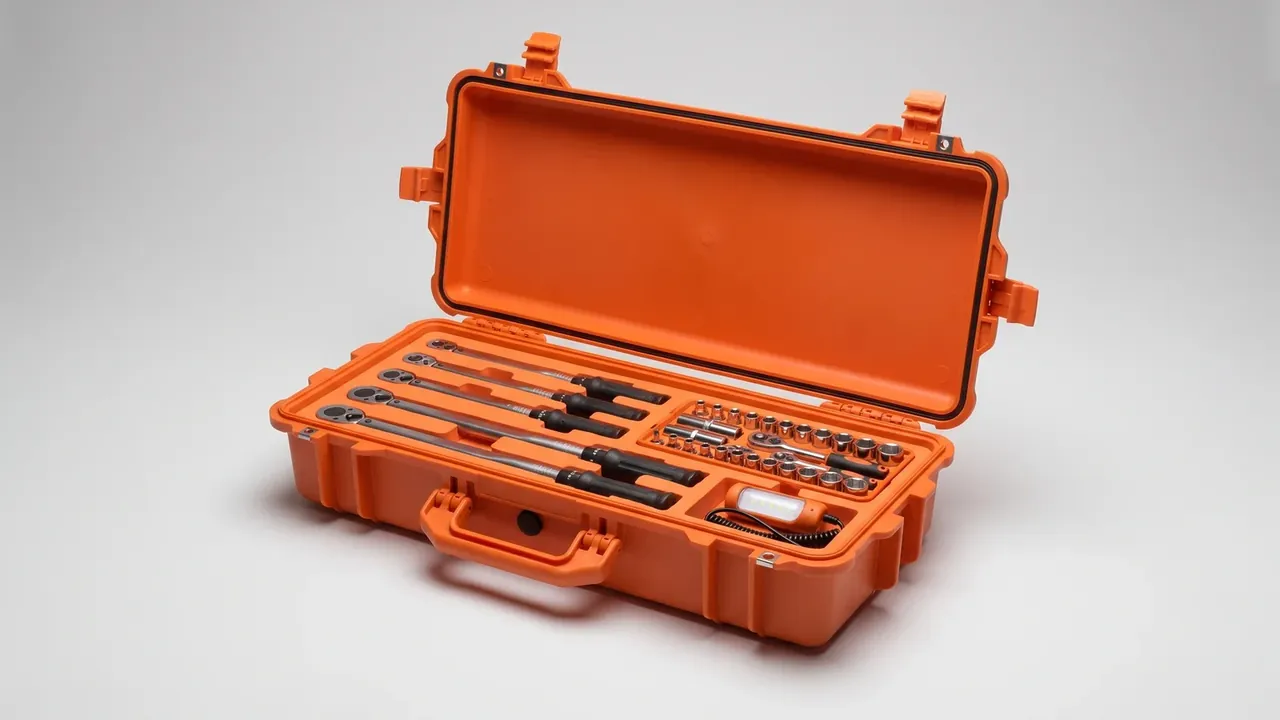
Swing needs its own sum. At 0.4 m/s of lift, crosswind funnelled through the door reaches 6 m/s at 40 m, and without tag lines the case swings ±350 mm, half of a 500 mm hatch. Two lines dropped from the 30 m and 60 m platforms cut that to ±60 mm, leaving 190 mm at the rim.
Rope ends take three clips at 36 mm spacing, saddle on the load side, re-checked every ten lifts; a nylon sling folded at one spot loses 15% of its strength.
5. Fall Arrest: Tether, Anchor, Drop
The tether is a second line of defence, not the main sling. Tethering cases carry one ring per side rated 2.5 kN; the tether is 1.2 m with double hooks, one end on the case, the other on a platform post anchored at 12 kN, so the weak link stays on the case.
Drop distance sets the shock: 1.2 m of tether with a 0.15 m pack lands a 24 kg case at about 2.1 kN, inside the rating with 20% in hand, while 1.5 m with a 0.1 m pack climbs to 3.2 kN.
| Level | Part | Rating | Trigger | Action |
|---|---|---|---|---|
| One | 25 mm main sling | 1.6 kN | Snag overload | Replace |
| Two | 20 mm back-up sling | 1.8 kN | Main sling parts | Replace, check ears |
| Three | 1.2 m tether | 2.5 kN | Unhook, fall | Inspect, reset |
The step most crews skip sits between levels two and three: put the back-up sling on a different hoist ear. Hang both on one ear and a single pull-out defeats two levels at once.
Conclusion
Whether tethering cases reach the nacelle comes down to four numbers: a 540 × 360 × 230 mm envelope that clears a 600 × 900 mm door, four M8 ears at 1.5 kN that absorb a snag, 100 m of rope with two tag lines holding swing to ±60 mm, and a 1.2 m tether on a 2.5 kN ring. Lose one and the lift falls back to carrying, which the 15 kg limit rules out at 24 kg.
This article covers case-side specifications and design implications only, and does not address any handling, loading or use of the contents.
Related Reading
- Case protection for blade inspection gear
- Dividers and stacking for nacelle components
- Salt-spray cases for offshore turbine parts
- Cases and instrument bays for grid patrol crews
Related Products
- 8 Series — Gun Cases; Military Equipment Cases; Camera Equipment Cases; Drone Cases; Watch Cases; Knife Cases; First Aid Cases; Electronics Equipment Cases
- WL8-2812 PP Gun Case — model WL8-2812
- All protective cases and toolboxes: 7 series, 158 models