

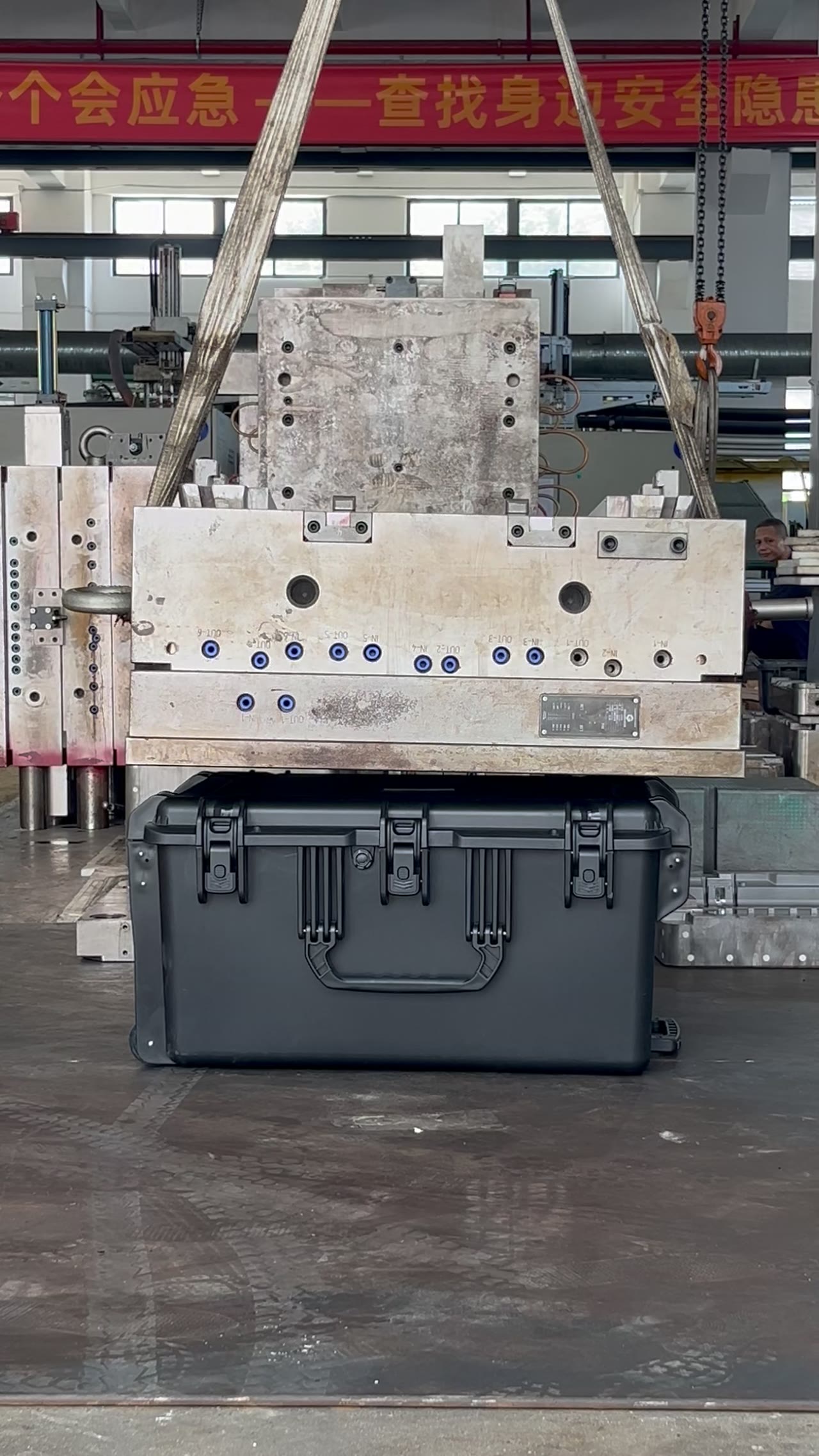


Case Drop Test: Edges, Corners and Faces
Three postures, one case, one drop height: corner first, then edge, then flat. The final cut makes the run look like a single continuous fall, but the numbers behind it do not sit in the same league, and the reason is how much material actually meets the floor at the instant of contact. A corner arrives on 3–8 mm. An edge spreads across an 8–20 mm band. A face lands on 45–95 mm, two orders of magnitude wider. What follows is where each posture sends the energy, why the concentration factor moves through 2.5–6, and why the sequence has to stop between impacts.
01Corner First: 3–8 mm of Contact Takes the Whole Impact
A corner is where three edges meet, and at the instant of landing only a narrow strip of it touches. Measured contact length runs 3–8 mm. The same case landing flat presents 45–95 mm, so the contact area differs by two orders of magnitude while the energy stays identical. Squeeze one number into the smaller patch and local stress climbs: the concentration factor sits between 2.5 and 6, and corners always take the top of that band.
Rotomoulded corners are also the least predictable place for wall thickness, since material piles up where the mould lets it and thins where it does not. The question after a corner drop is therefore not whether the case broke but whether the tip has gone pale or the edge line has furred. Across 0.8–1.8 m, one height may leave a white mark and another may split the corner open; nothing gradual happens in between.
02Edge Landing: An 8–20 mm Band Bends Instead of Crushing
Turn the case so one edge leads and contact changes from a point to a line, 8–20 mm wide in measurement. The load path changes with it: a corner crushes locally, an edge bends a whole panel and hands the energy to a longer stretch of wall. Inside the same 2.5–6 band of concentration, edges usually land in the lower half, which is why a single edge drop rarely splits anything.
What actually goes wrong on an edge is straightness, not strength. Bending flattens the line slightly, and a flattened line no longer meets the floor along its full length next time, so the load moves to whichever end still touches. Lay a straightedge against the edge after every drop: light through the middle means that section has already yielded and the next reading is no longer a first reading.
03Face Landing: 45–95 mm Looks Clean and Misleads
Set the case down flat and contact length reaches 45–95 mm, so energy per unit area is at its lowest and the case answers with one dull thud. That posture is the easiest to trust and the easiest to misread, because nothing visible happens. What does happen is the whole lid bending down and springing back, leaving no mark outside while the foam inside has been compressed once more.
Face drops still belong in the run, not to find damage but to calibrate. If a case survives flat at the low end of the height range and dents near the top, the margin sits between those two figures. Use the flat drop as the baseline and let corner and edge drops hunt for the boundary; run it the other way round and you learn that a corner broke, not where the line is.
04The Pause of 20–60 Seconds Is About State, Not Camera
The cuts make it look continuous. In the bay, every posture is separated by 20–60 seconds, and the pause is not for the camera. It lets the shell spring back, lets compressed foam recover, and gives the inspector time to write down what the last impact did. Skip it and the next drop starts from an already deformed state, which makes a deeper mark impossible to attribute.
Three to six drops per posture follows the same logic. The first is a baseline; the second and third test repeatability. If the mark after the second corner drop is clearly deeper than after the first, that corner is accumulating rather than surviving. Past 3–6 drops the data stops describing the case and starts describing fatigue in the batch.
05Five Checks After Every Drop, and Where the Line Sits
Each impact is followed by the same 5 checks: a pale or furred corner tip, an edge line still straight, a lid face still flat, latches that close by hand, foam inside free of hard creases. The first two show up after corner drops, the last three only after face drops. Keeping the order fixed is what makes records from different batches comparable at all.
The judging rule is narrow. The clip documents a process; pass or fail comes from the formal record of drop height, count and checklist, and the footage itself makes no load or protection claim. One practical close-out: put height, posture and all 5 results on a single sheet per case. The cell where the first pale mark appears is the boundary for that shell.
| Corner contact length | 3–8 mm |
|---|---|
| Edge contact width | 8–20 mm |
| Face contact length | 45–95 mm |
| Stress concentration factor | 2.5–6 × |
| Drop height | 0.8–1.8 m |
| Drops per posture | 3–6 |
| Checks per drop | 5 |
| Interval between drops | 20–60 s |
FAQ
Why do corner and face drops read so differently?
Contact area. A corner meets the floor over 3–8 mm, a face over 45–95 mm, so identical energy over a smaller patch raises local stress, which is what a concentration factor of 2.5–6 describes. Corner drops find cracks, face drops show overall stiffness, and neither replaces the other.
Why stop and inspect after every single drop?
So the state can be attributed. During 20–60 seconds the shell springs back and the foam recovers, and the next drop starts from the same point. Skip the pause and a deeper mark could be accumulation or chance, and the record loses its meaning.
How many drops per posture are enough?
3–6. The first is a baseline, the next two test repeatability. Three corner drops with a clearly deepening mark mean that spot is accumulating. Add more and you are measuring fatigue in the material rather than the case under this kind of impact.
Nothing cracked on camera, so does it pass?
No. Surviving one drop says only that this height and this landing point survived, and it does not extrapolate to a harder drop or to cold. Pass or fail comes from the formal record of height, count and the 5 checks; the footage alone will always flatter the margin.