

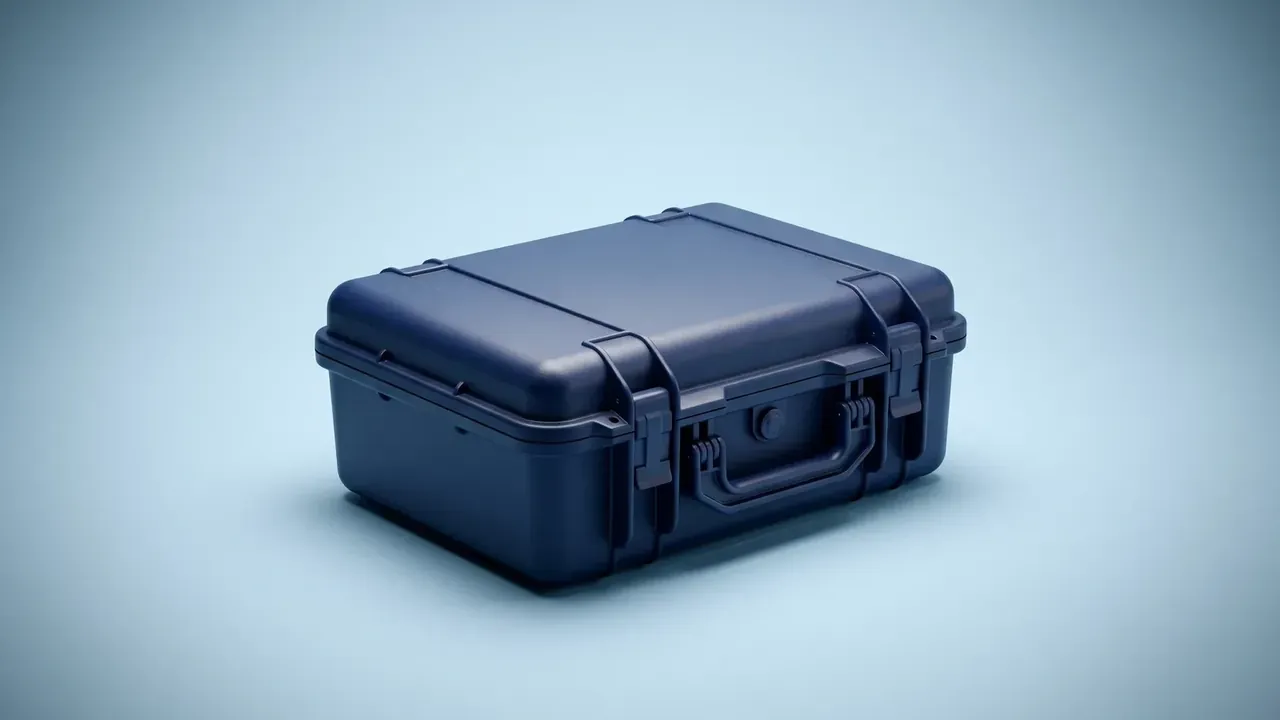
Quick answer: The pitch is 25 mm, plates 8–12 mm, bay width a multiple of the pitch; an Adjustable Divider Instrument Case switches three models in 3 min.
Table of contents
- Slot Pitch and Whole-Number Bays
- Divider Thickness and Lateral Stiffness
- Changeover Time Across Three Models
- Where Dividers and Foam Meet
- Fixing Empty Bays Against Shifting
- FAQ
1. Slot Pitch and Whole-Number Bays
One case holds three instrument models, so the trick is a pitch that divides cleanly. An Adjustable Divider Instrument Case moulds its slots in one shot, so a bay measures 25 mm times the span count minus one plate.
Bay width equals 25 mm times spans, minus plate thickness: five spans leave 117 mm behind an 8 mm plate and 113 mm behind 12 mm.
| Slot spans | Bay with 8 mm plate | Bay with 12 mm plate | Instrument width band |
|---|---|---|---|
| 3 | 67 mm | 63 mm | 52–58 mm |
| 4 | 92 mm | 88 mm | 74–84 mm |
| 5 | 117 mm | 113 mm | 96–108 mm |
| 6 | 142 mm | 138 mm | 118–132 mm |
| 8 | 192 mm | 188 mm | 160–180 mm |
Units 84 mm, 108 mm and 176 mm wide land on four, five and eight spans, leaving 8 mm, 9 mm and 16 mm of clearance.
That 16 mm does not need a new body. Move the band to a 12 mm plate and the bay drops to 188 mm, or merge bays and cap both ends. A width between two lines drifts loose, where 2 mm becomes a lid that will not close. An Adjustable Divider Instrument Case settles that arithmetic before the tool is ordered.
2. Divider Thickness and Lateral Stiffness
The 8 mm and 12 mm plates split by bay height, not by weight. In a 60 mm bay an 8 mm plate barely moves when pushed; in a 120 mm bay a finger press shows the middle bowing, because deflection climbs with the cube of height and doubling 60 mm to 120 mm multiplies it by eight.
When stiffness runs short the instrument fails before the plate does: a plate bowing 2 mm leans the unit, the connector presses on the neighbouring shell, and the body knocks at closing.
| Plate | Bay height | Load per bay | Lift feel |
|---|---|---|---|
| 8 mm | 60–80 mm | 1–2 kg | Edge pinched |
| 10 mm | 80–100 mm | 2–3 kg | Two fingers |
| 12 mm | 100–120 mm | 3 kg | Whole hand |
Ten millimetres covers the 80–100 mm band. A 3 kg unit is the ceiling per bay; past it the lower edge whitens, then the slot lip splits. An Adjustable Divider Instrument Case is specified height, then load, then clearance.
3. Changeover Time Across Three Models
Three minutes per change breaks into 20 s to open the lid, 40 s for four to six plates, 60 s to re-lay them and 60 s to seat and test-fit. Two changes a day is over 700 movements a year.
The costly part is finding the right plate, not turning it. Plates feel identical at 8 mm and 12 mm, one wrong plate shifts a whole row by 4 mm, and body width cannot be corrected later. Colour-code the thicknesses or bundle plates per model, and the job on an Adjustable Divider Instrument Case collapses into fetch, align, press.
What an Adjustable Divider Instrument Case saves sits in change frequency, not change speed. At one change a week, 3 min or 30 min hardly matters; at three a day, trimming 3 min to 2 min returns two working days a year.
4. Where Dividers and Foam Meet
Regular shapes go to plates, odd shapes to foam, and three questions draw the border: does the outline sit on a whole-number line, is one unit over 3 kg, and how often is it lifted out.
| Load | Plates | Foam | Reason |
|---|---|---|---|
| On the number line, daily use | Fit | Not needed | Under 8 mm gap |
| Odd outline, weekly use | Plus a shim | Better fit | Rarely lifted |
| 3 kg with sharp corners | Fit | Needs a rim | Edges cut |
| Same model, no change | Merge bays | Fit | No changeover |
Mixing does not mean stuffing both materials into one bay. Plates set position, foam sets attitude: plates separate units on the number line, foam supports the slope and the boss. Lay foam first and let the plate trap its edge, or it rides up whenever the body of an Adjustable Divider Instrument Case is opened.
A mixed bay also changes removal order: lift one side so the foam recovers, then slide the unit out along the plate. Reverse it and the foam drags from its pocket, costing a minute of realignment that an Adjustable Divider Instrument Case repeats every shift.
5. Fixing Empty Bays Against Shifting
An empty bay is the most exposed space: with the load gone, the plate next door has no support on one side and tips into the gap in transit.
Treat it by filling or shrinking: a block as wide as the bay pushes the plate back, while shrinking moves both plates so the gap joins the edge and can be capped. Fillers must be hookable.
On an Adjustable Divider Instrument Case the side play of a plate in its slot is held to 1 mm. It comes from slot-to-plate clearance and diagonal misalignment over the plate height. Taking 0.5 mm out of the slot width removes half; a locating boss at the plate base handles the rest.
Rejection call: if a plate moves more than 1 mm side to side in its slot, or the slot cracks after 500 changes, the divider structure has failed.
A failed call does not scrap the body, since plates are separate parts and a fresh set restores the fit. Where a batch carries many empty bays, gather them at one edge, cap that edge with a short plate and run the opposite side on the number line. Protective cases built to order follow the same rule: fill the gap or shrink it.
Related Reading
JUNZHIJIA
Related Products
- 8 Series — Gun Cases; Military Equipment Cases; Camera Equipment Cases; Drone Cases; Watch Cases; Knife Cases; First Aid Cases; Electronics Equipment Cases
- WL8-2812 PP Gun Case — model WL8-2812
- All protective cases and toolboxes: 7 series, 158 models