

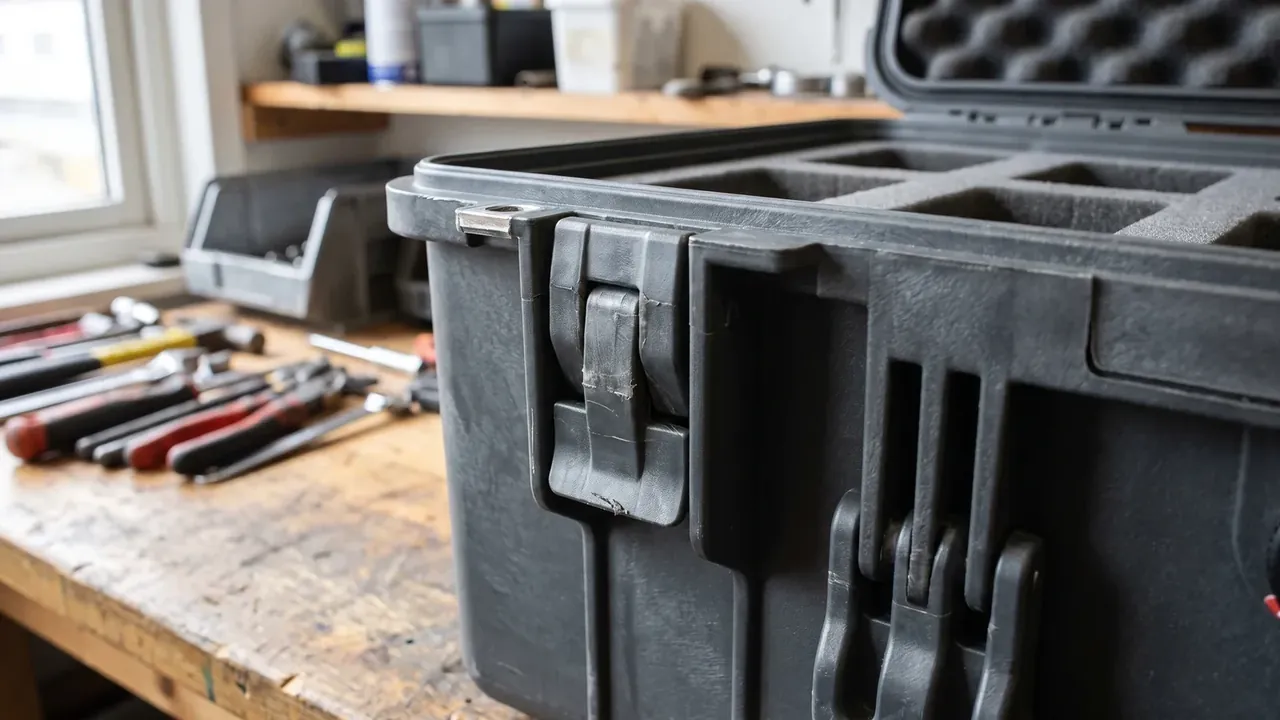
Quick answer: Choose bonded foam when three heavy instruments have to stay put, and dividers when thirty identical parts have to come out fast. Bonded foam presses each item into 38 kg/m³ polyethylene, dividers separate items with 5 mm interlocking sheet, and the two trade drop acceleration against handling time.
Table of contents
- Start With How the Load Sits
- Bonded Foam: Cut Tolerance and Preload
- Dividers: Sheet Thickness and Cell Size
- Drop and Vibration: Where They Differ
- Three Numbers on the Quotation
- FAQ
1. Start With How the Load Sits
A 445 × 345 × 205 mm cavity loses 20 mm to egg-crate foam in the lid and 10 mm to a base pad, leaving 175 mm of usable depth. The liner has to keep items off each other, off the walls, and within reach of one hand.
Count the items first. Three or fewer with irregular outlines, such as a 7.8 kg portable gas chromatograph and two probes, point straight to bonded foam, because the pocket is cut to the item and the item has only one place to sit. More than thirty identical parts, such as 24 sample needles, belong in dividers, where any cell can be pulled without reading a number.
Then ask how often the load changes. A cut pocket is fixed once the tool has run, so a new instrument means a new support layer and three days of sampling; pull one 5 mm sheet from a divider frame and two cells become one in ten minutes. Handling time finishes the argument, because a bonded liner looks tidy on a bench while a shift still has to line every item up with its pocket.
2. Bonded Foam: Cut Tolerance and Preload
A bonded liner is a sandwich: 20 mm egg-crate in the lid, a 30 mm die-cut support layer, a 10 mm base sheet. The egg-crate holds the top face, the support layer the outline, and the base spreads load into the floor.
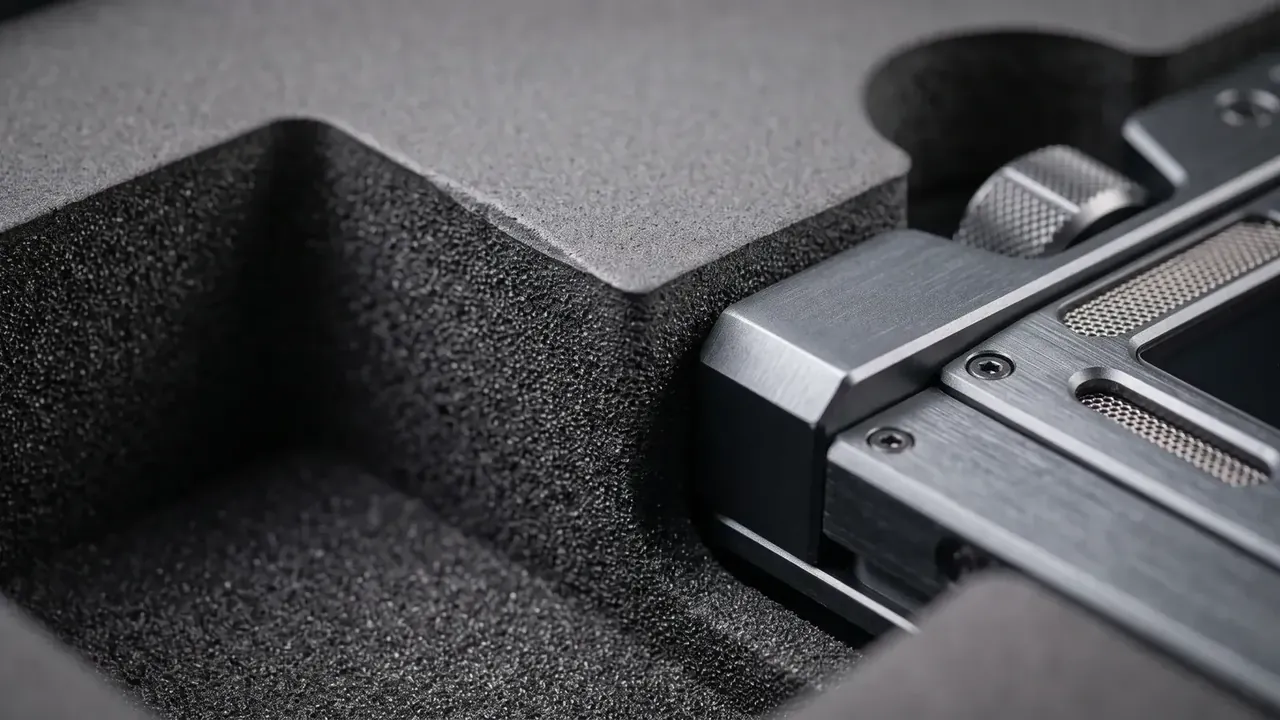
Cut tolerance runs at ±0.5 mm and the pocket is 2 mm larger than the item, 1 mm a side. Too tight and the item will not seat; too loose and it rattles, grinding dust out of the pocket wall in a 1.2 m drop. Preload is 3 mm, so the item carries about 12 N before the case moves.
Density decides how much of that matters. Polyethylene at 38 kg/m³ gives 3.8 kPa at 25% compression; at 25 kg/m³ the same deflection gives 2.1 kPa, which a 30 kg instrument will bottom out. EVA at 45 kg/m³ reaches 6.4 kPa, at the cost of hardness that marks thin walls.
CNC cutting a 30 mm support layer takes six minutes and turns a revised drawing into a sample the same day; a steel die costs 380 and only pays back past 200 sets. The trade-off is set out in foam cutting process and tolerance: CNC under 50, a die past 200.
3. Dividers: Sheet Thickness and Cell Size
The frame is interlocking PE foam sheet, usually 5 mm. Thinner sheet bows once 24 cells are loaded; 8 mm holds shape but costs two cells.
Cell size is the largest outline plus 4 mm. A 60 × 60 × 80 mm cell takes a 52 mm sample bottle four at a time at 1.2 kg, and 24 cells come to 28.8 kg. Past 20 kg the count drops to 16, or the floor bows in carriage.
| Divider layout | Cell size | Load per cell | Suits |
|---|---|---|---|
| 3 × 4 = 12 cells | 95 × 75 × 80 mm | 2.4 kg | Handheld meters, radios |
| 4 × 6 = 24 cells | 60 × 60 × 80 mm | 1.2 kg | Bottles, fittings, standard parts |
| 5 × 8 = 40 cells | 45 × 40 × 60 mm | 0.5 kg | Screws, probes, O-rings |
| Sliding tray, 6 cells | 130 × 95 × 100 mm | 4.0 kg | Power modules, cable reels |
Cell mouths are radiused at 3 mm, each floor keeps a 2 mm drain slit, and a washed liner dries in 30 minutes. Anything not square is the weak point: a 90° elbow jams against the sheet, the cell becomes an L, and the custom slot lifts the set from 42 to 70.
4. Drop and Vibration: Where They Differ
In a 1.2 m six-face drop with a 7.8 kg instrument, a bonded case peaks at 42 g inside the cavity; the same load in dividers over a 3 mm pad peaks at 78 g. Bonded foam wraps the item, dividers only fence it, and 4 mm of travel remains on impact.
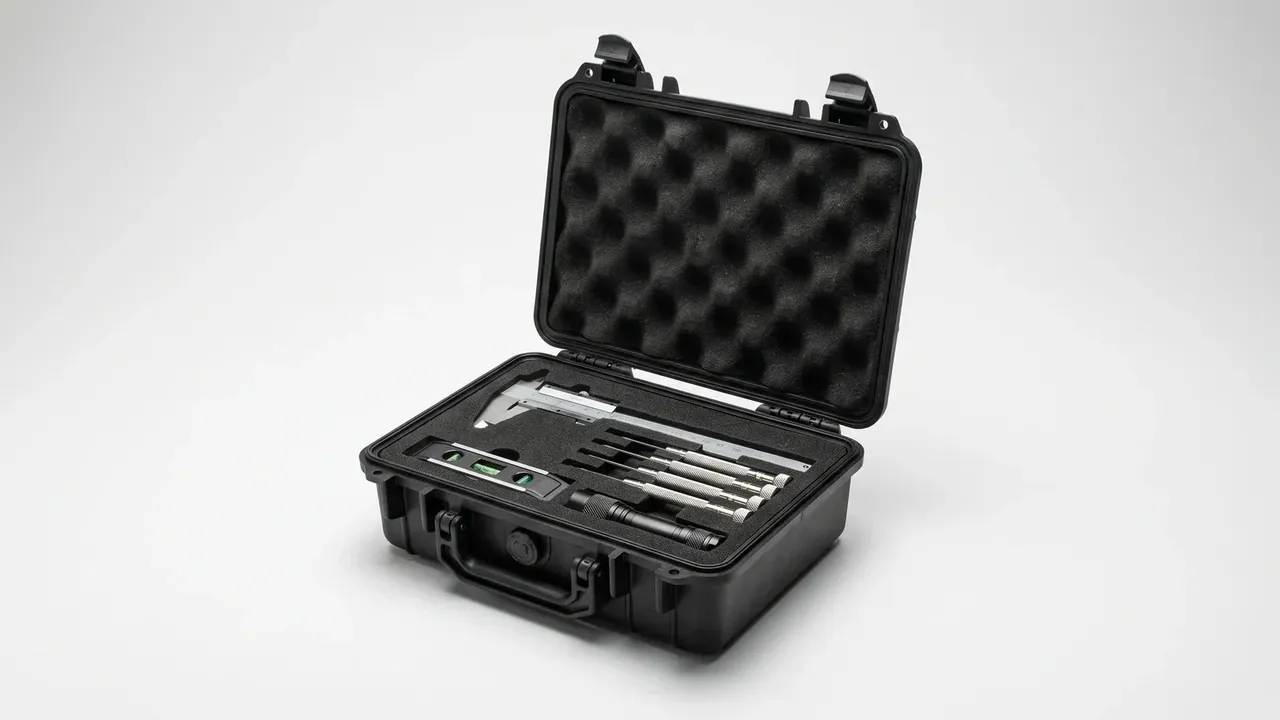
Vibration separates them further: three hours of sweep from 10 to 500 Hz at 1.5 g rubs metal against sheet until 0.02 mm of anodising is gone, while a bonded part does not shift at all.
Temperature pushes both curves. Twenty-four hours at 70 °C leaves 8% compression set, so foam returns to 92% of its thickness and preload falls from 12 N to 9 N on the second trip. At -20 °C travel shortens 30% and the same drop lifts the peak from 42 g to 61 g. Dividers ignore temperature until the sheet goes brittle and a tab snaps.
5. Three Numbers on the Quotation
Liner price comes from three numbers: layers set foam volume, cells set sheet length, tolerance decides CNC against a die.
- Bonded: 20 mm egg-crate plus 30 mm support, CNC, 86 per set, three days to sample
- Dividers: 5 mm sheet, 24 cells, die cut, 42 per set, five days to sample
- Hybrid: 20 mm bonded base with 12 cells above, 128 per set, six days
- Tooling: divider die 380, programming 240, minimum 50 sets
- Lead time: 12 days bonded, 7 days dividers, 15 days hybrid
- Acceptance: gap to the item ≤2 mm, three sets trial fitted, no crack after a 1.2 m drop
| Option | Cost per set | Weight per set | Picking 24 parts | Peak in a 1.2 m drop |
|---|---|---|---|---|
| All bonded | 86 | 1.9 kg | Eight pockets, about 32 s | 42 g |
| All dividers | 42 | 1.1 kg | Cell by cell, about 42 s | 78 g |
| Hybrid | 128 | 2.3 kg | 12 bonded, 12 divided, 22 s | 48 g |
What separates the options is not the unit price but how often the wrong part is pulled. A hybrid keeps high-frequency parts in cells and low-frequency parts in pockets, and the search time saved in a shift clears the 42 gap in two months.
Conclusion
Few items with a fixed shape get foam cut to their outline, many identical items get sheet dividers. Bonding costs three days of changeover, dividers cost a custom slot for anything odd. What decides it is not the material but three numbers in the drawing: ±0.5 mm tolerance, 3 mm preload, 5 mm sheet.
This article discusses only the specification and design intent on the container (case) side, and does not cover any handling, loading or use of the contents.
Related Reading
- Specifying custom foam inserts
- Choosing internal dividers
- Foam cutting process and tolerance
- Quality checks on a case assembly line
Related Products
- 8 Series — Gun Cases; Military Equipment Cases; Camera Equipment Cases; Drone Cases; Watch Cases; Knife Cases; First Aid Cases; Electronics Equipment Cases
- WL8-2812 PP Gun Case — model WL8-2812
- All protective cases and toolboxes: 7 series, 158 models